
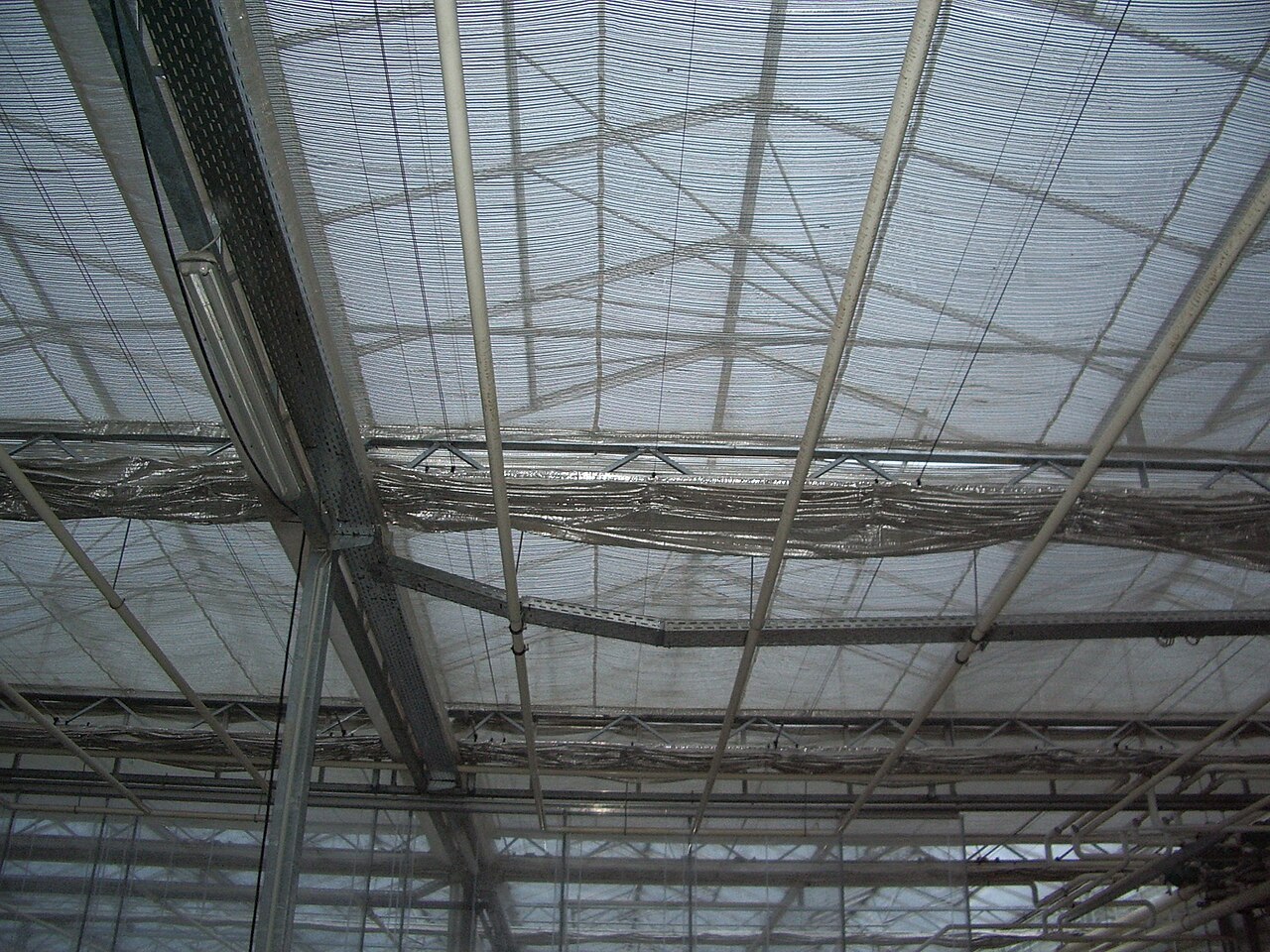
Arrigoni, an Italian maker of agricultural netting and greenhouse covers, has published field trial results showing that two of its thermo-reflective shading screens can cut irrigation water lost to evaporation by as much as half compared with uncovered crops. The company presented the data at the EIMA International farm machinery show in Bologna this November.
Its research team tested 25 fabrics in summer, with maximum temperatures above 31 degrees Celsius, against an uncovered control. Water loss was measured as reference evapotranspiration, the FAO standard method calculated with the Penman-Monteith formula, so that screens could be compared on equal terms. The company said a 2023 trial by the French technical institute ACSE gave supporting results, but it did not publish that study's details.
The two products, Prisma and Robuxta, reflect part of the incoming sunlight rather than simply blocking it, keeping the covered space cooler without cutting off all light. A lighter grade blocking about 30 percent of light cut evaporative loss by 40 percent; a denser one blocking 49 percent cut it by 46 percent. A full cover blocking essentially all light cut loss by 75 percent, but the company notes that is impractical because the crop needs light. Robuxta has a reinforced monofilament structure for strength in windy places.
Patrizia Giuliani, Arrigoni's sales director, said the data would go into the company's updated catalogue of nets and films. The company cites FAO estimates that agriculture takes about 70 percent of the freshwater withdrawn worldwide and that irrigated production must grow by more than 50 percent by 2050, while water supplies are projected to rise by no more than 10 percent.
Shading screens work alongside fogging, pad-and-fan cooling and ventilation, but once installed they need no energy. By lowering the temperature under cover and slowing evaporation from soil and leaves, they can reduce how often and how much growers of berries, vegetables and other high-value crops irrigate in the hottest weeks.
The summer 2026 figures have not been verified by an independent third party beyond the company's own reporting and the earlier French study, and growers would want data for their own crop, climate and structure before switching.
Photo: Blumenfischer / Wikimedia Commons (CC BY-SA 3.0)
Source: Global Agriculture

Comments
(0)