
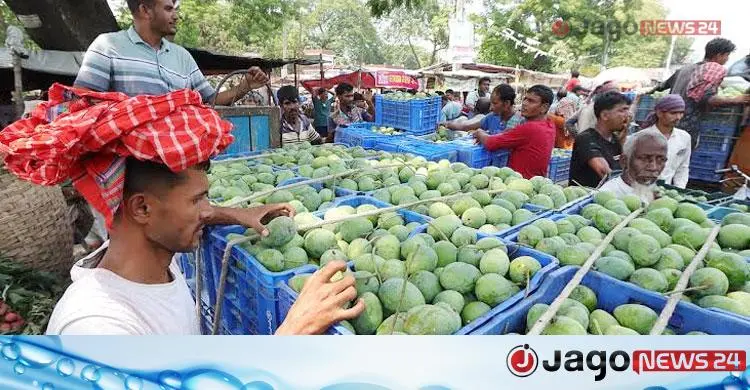
The economy built around mangoes in the Rajshahi region grows every year. Mangoes from Rajshahi and Chapainawabganj meet domestic demand and are increasingly valued abroad. Behind that success, however, a long-standing practice known as 'dholon' is taking away a large share of mango farmers' profits.
Although the administration decided that mangoes should be bought and sold by the kilogram, in many markets and wholesale hubs of Rajshahi division farmers still have to hand over 52 to 54 kg of mangoes instead of 40 kg (one maund), while being paid only for 40 kg. As a result, mangoes worth hundreds of crores of taka go free of charge to traders and commission agents (aratdars) every season.
A bumper crop, but not for farmers
According to the Department of Agricultural Extension (DAE), the target for this season is about 12 lakh 55 thousand tonnes of mangoes in the four districts of Rajshahi, Chapainawabganj, Naogaon and Natore. A large share of the country's mango output comes from this region.
Those involved say favourable weather has brought a good yield this year. But despite rising output, farmers are not getting the benefit because of flaws in the market system; instead, they are denied a fair price when they sell.
Abdul Kader, a mango grower in Puthia upazila of Rajshahi, said: "The cost of orchard care, labour, fertiliser and pesticide goes up every year. But if at the time of sale I have to give 54 kg of mangoes for the price of 40 kg, where is the chance of making a profit?"
Alam Sarkar, a mango farmer in Shibganj upazila of Chapainawabganj, made the same complaint. "Many traders do not want to buy mangoes at all without the extra weight. We are forced to sell at a loss," he said.
What 'dholon' means
Locally, 'dholon' means giving more mangoes than the agreed weight. Once it was customary to add one or two kg per maund to cover losses from transport, fruit dropping or rotting. Over time the practice grew out of all proportion. Today many markets take 52 to 54 kg of mangoes for the price of 40 kg, and in some places traders demand another two to three kg on the pretext of quality, size or transport damage. Farmers are forced to sell anyway.
Farmers say the practice continues in markets from Baneshwar, Charghat and Bagha in Rajshahi to Kansat, Shibganj and Bholahat in Chapainawabganj and Sapahar and Porsha in Naogaon.
The economic picture makes the loss clearer. If a maund of mangoes sells for Tk 2,000, the price on paper is Tk 50 a kg. But if a farmer gives 54 kg for the same Tk 2,000, the real price falls to about Tk 37 a kg, meaning he loses the value of about 26 per cent of his produce.
Leaders of mango growers' cooperatives claim that, calculated on total output in the four main mango districts, the value of the mangoes taken as extra weight alone could exceed Tk 500 crore a season.
Ismail Khan Shamim, secretary of the Shibganj Mango Growers' Cooperative Society, said farmers invest heavily in their orchards from the start of the year to the end, but at market a large part of their produce goes for free. This is not only a personal loss but a concern for the farm economy of the whole region, he said.
Traders' view
Traders see it differently. A trader at Rajshahi's traditional Baneshwar mango market, speaking on condition of anonymity, said: "After harvest there are losses, and the weight falls, during transport, sorting, storage and marketing. The practice of taking extra weight grew up over a long time to make up for that loss."
Farmers ask why producers alone should bear the whole cost of these losses in the market system.
To settle the dispute, a meeting was held on 11 June last year at the initiative of the Rajshahi divisional administration, attended by mango farmers, traders, aratdars, market leaseholders and administration representatives. It unanimously decided to abolish dholon and trade mangoes by the kilogram, and capped the aratdars' commission at Tk 1.50 per kg.
Farmers complain, however, that the decision remains on paper only, and most markets still trade mangoes the old way.
Economist Md Abdul Wadud said traders are buying mangoes cheaply on the one hand and taking extra weight on the other, so farmers are denied the real value of what they grow. This is not only a problem of the mango market but a reflection of a major weakness in the country's farm-produce marketing system, he said, adding that if farmers do not get fair prices, sustainable development of agriculture will suffer.
Ahmed Shafi Uddin, president of the Rajshahi district unit of Shushashoner Jonno Nagorik (SUJAN), said the size of Bangladesh's mango-based economy grows every year and Rajshahi mangoes are exported abroad as well as meeting demand at home. "Yet if the farmers at the heart of production are denied a fair price, that success is called into question," he said.
He said such irregularities could be greatly reduced by making electronic scales mandatory in every market, introducing digital receipts, monitoring markets regularly and strengthening farmers' organisations.
Rajshahi Divisional Commissioner A N M Bazlur Rashid said there is no scope to buy mangoes by extra weight. The deputy commissioners of the districts concerned will be instructed to take the necessary steps and run mobile courts to ensure mangoes are sold by the kilogram, he said.
Source: Jagonews24. First published in Bengali on The Agro News.
Comments
(0)