

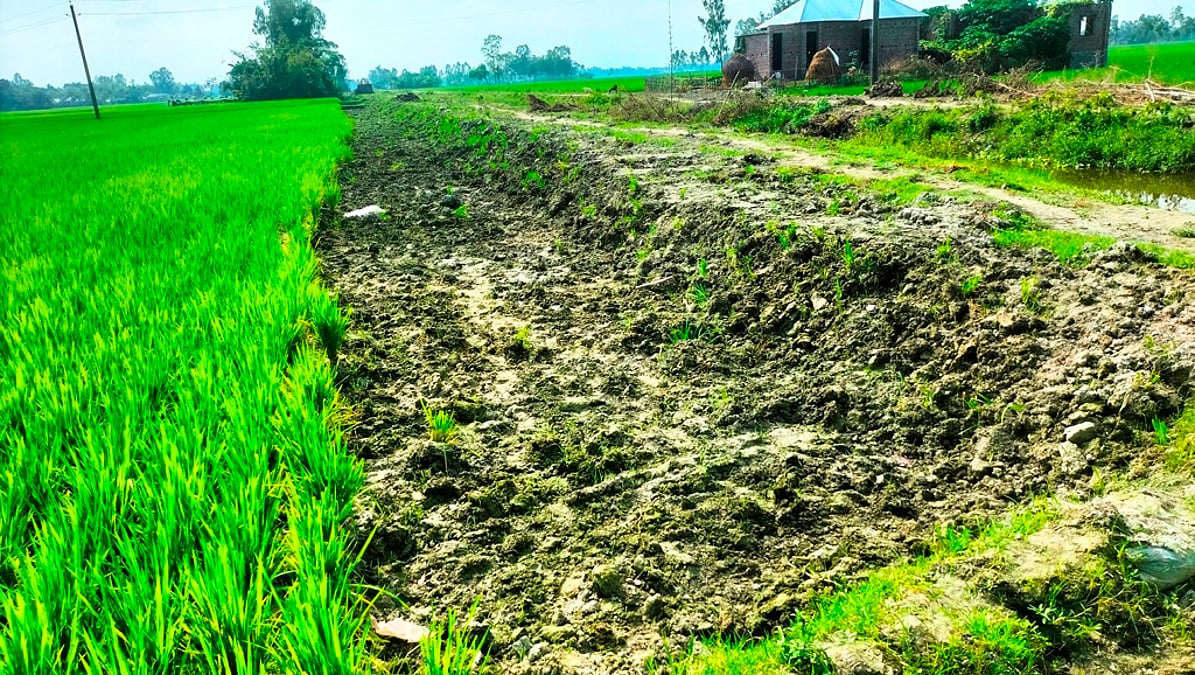
Fertile farmland in Rajshahi is shrinking fast because of the uncontrolled spread of commercial fish ponds and concrete structures. This has raised deep concern about food security, soil fertility and sustainable land management. Those involved say weak monitoring and lack of law enforcement are the main causes.
According to the Bangladesh Bureau of Statistics (BBS), total cropland in Rajshahi district fell by 16,159 hectares between 2015 and 2023. Over the same period, inland water bodies and built-up areas grew significantly, meaning farmland is being lost permanently.
According to the survey, inland water bodies in Rajshahi covered 15,044 hectares in 2015, rising to 24,498 hectares in 2023. Built-up areas, including homes, roads and commercial structures, grew from 54,233 hectares in 2015 to 62,727 hectares.
Fish pays more, so farmers give up rice
Government officials and farmers say much high-yielding farmland in Rajshahi is being converted into commercial fish ponds, in many cases in violation of soil conservation policy and the Agricultural Land Protection and Use Act, 2018.
According to the district fisheries office, the number of ponds in Rajshahi rose from 40,788 in 2015 to 51,275 in 2025, an increase of about 25 percent. But farmers and NGO officials say the real number is much higher because of unregistered and illegal ponds.
Last fiscal year Rajshahi produced 84,803 tonnes of fish, against local demand of just 52,063 tonnes. According to Department of Agricultural Extension (DAE) officials and farmers, economic pressure is pushing many landowners from farming to fish, which is far more profitable than boro rice and other traditional crops.
A farmer in Godagari upazila, speaking on condition of anonymity, said: "Growing rice earns at most Tk 40,000 a year. But leasing the same land for a pond brings Tk 80,000 to Tk 1.2 lakh a year."
An owner who recently dug ponds on 40 bighas in the same upazila said fish farming is several times more profitable than growing crops.
Digging at night, under a syndicate's protection
Under current rules, before a pond is dug on farmland, the upazila agriculture officer and the Soil Resource Development Institute must verify it and the deputy commissioner must give approval. But the investigation found this process is often bypassed. In many cases ponds are dug at night to avoid the administration's notice.
Farmers allege that powerful syndicates have grown up under the protection of politically influential circles and are digging ponds illegally.
A DAE official, speaking on condition of anonymity, said: "Before 5 August 2024, these syndicates were controlled by Awami League and Jubo League leaders. Now people linked to the BNP and its youth and student organisations are involved."
Meanwhile, Rajshahi's fish traders are turning to neighbouring districts where land can be leased more cheaply. In Chapainawabganj a pond can be dug on farmland for a lease of about Tk 30,000 a year, while in Rajshahi the lease is about Tk 60,000.
Farmer killed while protesting
Resistance to illegal pond digging has also turned violent. On 17 December, a farmer named Ahmed Jubayer (22) was crushed to death under an excavator while protesting illegal pond digging late at night in Boro Palsha village of Mohanpur upazila.
Joynal Abedin, a farmer from the same village, said: "When a pond is dug in the middle of a beel, water logs on the surrounding land and it can no longer be cultivated."
Agricultural experts warn that pond digging removes the fertile topsoil and spreads infertile subsoil around, so the land will not be as productive even if it returns to farming. Unplanned digging also disrupts natural drainage, alters the local microclimate and increases crop diseases.
Rajshahi University professor Mohammad Al Baki Barkatullah said: "Although profitable for some people in the short term, converting farmland into ponds is a serious long-term threat to food production, farmers' livelihoods and national food security."
What the administration says
Deputy commissioner and district magistrate Afia Akhter said: "Pond digging is approved subject to the report of a committee of upazila-level agriculture and fisheries officials. These rules are not followed in illegal cases."
She said regular mobile courts and night-time drives are being carried out against illegal pond digging.
Source: Jagonews24. First published in Bengali on The Agro News.

Comments
(0)