
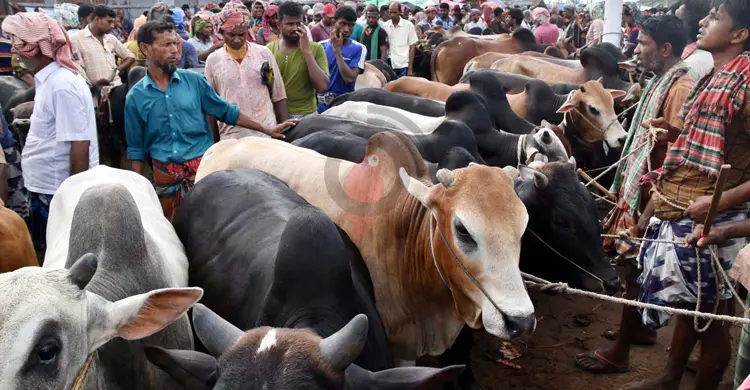
Cattle markets in Rajshahi have come alive ahead of the coming Qurbani Eid. Cattle have begun arriving from different parts of the country at the City Haat, the largest in north Bengal, and at other markets in Rajshahi.
Wednesday (6 July) was the weekly market day, and the City Haat was packed with sacrificial animals before midday. With Eid near, the supply of cattle and goats at Rajshahi's other markets has also risen.
Police and market authorities have made extensive preparations around Rajshahi's cattle markets, including security, smooth movement of traffic and machines to detect counterfeit notes.
Local buyers, medium cattle
A visit to the Rajshahi City Haat found the grounds loud with haggling, with large numbers of cattle and goats arriving from the morning.
Buyers and sellers said that at first most buyers came, bargained and left without buying. But with Eid close and this the last weekly market before Eid, sales rose today. With big outside traders not coming, local people are doing most of the buying, and buyers complain that prices are high. Sellers said that although cattle of all sizes were on offer, medium-sized cattle were in greatest demand.
Mozaffar Ali brought four cattle to the City Haat from Naogaon. He said all three medium-sized ones had sold at a good price, but the big one had not sold yet because the offers were comparatively low.
Another seller, Shamsher Ali, brought two cattle from Paba in Rajshahi. "As soon as I got to the market I sold the medium-sized one at the price I expected. But I haven't been able to sell the big one yet. Only a handful of buyers are buying big cattle. People come and bargain, but they take medium cattle," he said.
Buyers complain of high prices
Buyers complain that prices are much higher this time. Bipul Hossain, who lives in the Uposhohor New Market area of Rajshahi, said he had gone from market to market for several days hoping prices would fall, without buying. "But prices are rising further, so I bought a small cow within my means," he said. Not only Bipul but most buyers made the same complaint.
Admitting the complaint had some truth, a cattle farmer named Ujjal said that because the prices of all daily necessities and production costs had risen, cattle were a little dearer than last time, "but not by that much".
Atiqur Rahman Kalu, lessee of the Rajshahi City Haat, said that with today the last weekly market before Eid, the supply of animals was very large. But because of various crises, including floods, big traders had not come, so only local buyers were buying. "Sales are low as a result, but prices are excessively high," he said. He added that animals would be sold at the market until the day before Eid.
Checks on sick and fattened cattle
The authorities are also working to stop the sale of sick cattle and cattle fattened by unhealthy methods. Rajshahi district livestock officer Dr Julfikar Md Akhtar Hossain said that in the past unscrupulous farmers fattened cattle by feeding them drugs or giving injections, but that practice is no longer used, and they have also turned away from applying hormones. Farmers now get proper guidance and fatten cattle naturally, earning more profit at lower cost, he said.
Even so, he said, the livestock department has formed medical teams and is taking other steps so that no one can sell sick or harmful cattle.
The eight districts of Rajshahi division have 2,728,460 animals ready for sacrifice this year. Of these, 392,852 are in Rajshahi district, where 16,079 farmers have 121,372 cattle, 233,235 goats, 38,245 sheep and 3,211 buffalo. The district's likely demand for sacrificial animals this year is 382,118, leaving about 10,000 more animals than needed.
Source: Jagonews24. First published in Bengali on The Agro News.
Comments
(0)