
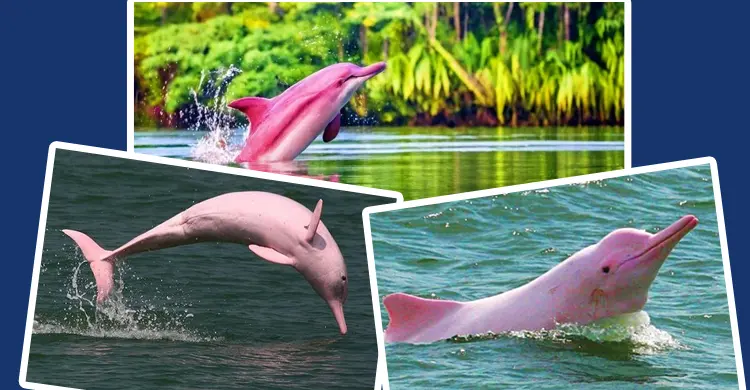
Life in the sea is always colourful, and its creatures are a treasury of beauty that multiplies the beauty of nature. The sea is home to countless lovely animals and plants whose names we do not know, and even familiar animals sometimes appear in a different form. Among the friendliest and most striking of them is the dolphin.
Forty species of dolphin have been found around the world, though some sources put the number higher. Eight species are very well known: the Irrawaddy dolphin, the finless porpoise, the Ganges river dolphin, the humpback dolphin, the spotted dolphin, the spinner dolphin, the bottlenose dolphin and the pink dolphin.
Of these, the rare pink dolphin is found in the Amazon region of South America, where it is called the "Amazon river dolphin". Of the four species of river-dwelling dolphin, it is the largest.
Born grey, turning pink
Its scientific name is Inia geoffrensis, and it is also known as boto or bufeo. Its most striking feature is its colour: in adulthood its body turns completely pink. But this dolphin, famous for being pink, is not pink at first. At birth it is grey, and its colour changes to pink as it grows older. When excited, its body turns bright pink.
Besides its colour, the dolphin is notable for its weight and size, outdoing many other aquatic animals. At birth it weighs about 1 kg on average and is 30 inches long, but adults weigh more than 450 pounds on average and grow 8-10 feet long. It can turn its neck through 180 degrees and bend its body like a bow.
Its main food is fish, which it catches easily with its long beak and the 28 pairs of large teeth in its jaws. The pink dolphin's brain capacity is also high: about 40 per cent greater than a human's, according to the article.
The pink river dolphin lives about 30 years on average, though there are cases of it living to 40. People are the only threat to these Amazon dolphins. Many hunters kill them to use as catfish bait, and sadly many use current nets to catch them.
Although dolphins are famous for living in groups, the pink dolphin prefers to be alone and is used to small groups of two to four. Larger groups are seen in food-rich areas. Being curious, the pink dolphin mixes easily with people and with other species.
Sightings in Bangladesh
The presence of pink dolphins in Bangladesh first became known in 2002 through a survey by the Wildlife Conservation Society. They stay away from places with river and environmental pollution and heavy human traffic, which is why they are occasionally seen in secluded parts of the Bay of Bengal.
The mammal was first seen in the Bay of Bengal in 2011. The most recent sighting in Bangladesh was in March 2018, when local people saw pink dolphins with two groups of dolphins at the Kolatoli and Sugandha points of Cox's Bazar beach.
Many myths surround the pink dolphin. One says it charms handsome men at night. Another says that if you swim alone in the water, it takes you to a magical city at the bottom of the sea. Many Amazonians firmly believe the pink dolphin is a magical fish that can take human form and come ashore.
Information sources cited in the original: National Geographic and Wikipedia.
Source: Jagonews24. First published in Bengali on The Agro News.

Comments
(0)