
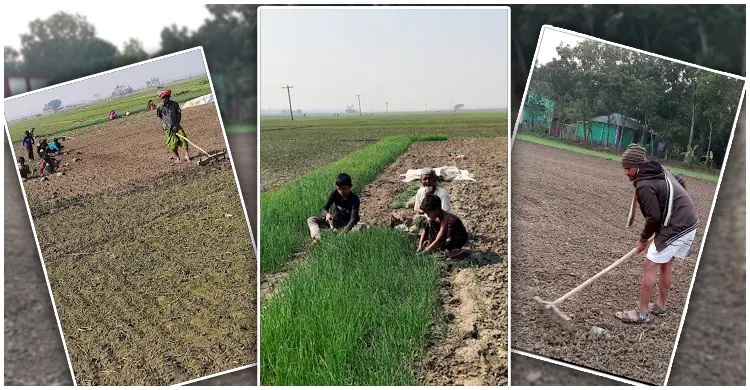
Farmers in Pabna are busy planting onions. Having made little profit from bulb (mulkata) onions, they are now undecided about hali, or seedling, onions. Production costs have risen this year with higher fuel and fertiliser prices, yet planting goes on in a festive atmosphere. Farm workers arrive in the fields before sunrise, and village roads and field paths are busy with them from early morning.
After a full day's work, farmers return home before dusk. Farm workers are also getting good wages. Farmers say they will make a profit if onions are not imported; otherwise they fear losses.
Pabna's share of the crop
Agriculture officials said annual onion production in the country is about 25-26 lakh tonnes. Pabna district alone produces about six and a half lakh tonnes, a quarter of the total. Santhia and Sujanagar upazilas of Pabna produce about four and three-quarter lakh tonnes, so these two upazilas grow a fifth of all the onions produced in the country.
Farmers in the district grow onions in two ways, officials said: from bulbs (mulkata or muri) and from seedlings (hali). Bulb onions are planted in October-November and hali onions in December-January. New bulb onions start reaching the markets in December, and hali onions from mid-March to April.
Mizanur Rahman, deputy director of the DAE in Pabna, said the target for hali (seedling) onions in the district this year is 53,305 hectares, and he expects it to be exceeded. Barring natural disasters, Pabna will produce at least 7 lakh 49 thousand 34 tonnes of onions this time, he said.
He said last year's target (bulb and seedling onions combined) was 52,640 hectares, with a production target of 6 lakh 37 thousand 997 tonnes. Of this, the target was 17,150 hectares in Santhia upazila and 20,641 hectares in Sujanagar, the two upazilas that produce the most onions in the district.
In 2020, the target in Pabna was 45,000 hectares, but onions were grown on about 52,000 hectares, some 7,000 hectares more. Farmers got good prices for onions over the previous two years, and this year they got good prices for hali onions late in the season. That is why they have turned even more to onions this time, and agriculture experts expect the target to be exceeded again this year.
Busy fields, higher wages
On Sunday, January 9, the fields of Beel Gyarkapar, Beel Gajnapar, Kumirgari, Bamondanga, Bamondi and Islampur in Santhia and Sujanagar upazilas were busy with onion planting. People of all ages, from children to the elderly, were in the fields, and women were helping the men. Onion farmers said the cost of farm labour had gone up.
Workers who arrived before sunrise said they are paid Tk 700 a day for planting onions. Some come from the next village, others from distant villages. While the workers are getting good wages, farmers are worried about their rising costs.
At Bonogram haat in Santhia, one of the country's largest onion markets, bulb onions were selling at Tk 850 to Tk 1,100 a maund on Saturday, January 8, with some very good-quality onions fetching Tk 1,200 a maund. Farmers said bulb onions sold at Tk 900 to 1,100 a maund at this time last year.
Ibrahim Hossain, an onion commission agent at the market, said that about four months ago a maund of seed onions cost Tk 3,000 to 3,500. Farmers bought them at high prices to grow bulb onions, but prices did not rise accordingly, so their profits were small. The onion market is now in something of a slump.
He said new hali onions will start reaching the market within three months, and prices may fall further then. If prices fall like this, farmers will lose and middlemen will profit.
What it costs to grow
Farmers Aftab Uddin of Bamondanga village in Santhia, and Arshed Khan and Kanu Khan of Kumirgari village, said growing onions first means buying seed and renting a seedbed to raise seedlings. With ploughing, irrigation, fertiliser, cow dung, weeding, labour and harvesting, it costs about Tk 30,000 a bigha.
Those who lease other people's land must also pay the owner Tk 10,000 a bigha a year in lease money, so their costs are higher. Many small and large farmers also grow onions with loans taken from moneylenders at high interest.
Iyaj Uddin Khan, a farmer on the edge of Beel Gyarka in Santhia, the main onion-growing area, said the annual lease rises when onion prices rise. Because onion prices went up, the lease on land beside Gyarka beel is about Tk 15,000 a year this year, on top of production costs of Tk 30,000 a bigha.
They said the average yield is 40-50 maunds a bigha, so selling at Tk 600 or 700 a maund does not cover costs. Angrily, they said nobody calculates the cost of producing onions; people only count how many taka a kilo onions sell for.
They said the idea that onion prices should stay low year after year has become harmful to farmers. Prices of everything are rising and people's incomes are rising, so farmers can profit only if the price of onions, a spice crop, also rises every year.
Ratan Ali, a farmer in Padmabila village in Santhia, said they lease other people's land by the year to grow onions. Some years they make a profit and some years a loss, and when they lose, they try to make it up by growing two other crops that year.
Calls for better varieties and credit
Alhaj Shahjahan Ali Badsha, central president of the Bangladesh Farmers Association (BFA) and a prominent Pabna farmer, said the population and demand for onions have grown, so there is no alternative to raising yields per bigha. High-yielding varieties of onion need to be spread, as with other crops, he said.
Pabna agriculturist Jafar Sadek, inventor of two-storey farming, said onion prices often rise towards the end of the year, but ordinary farmers do not get that price because debts from growing costs force them to sell most of their onions at the start of the season. Those who store onions can capture the higher prices. Although the government has announced low-interest loans for onion farming, ordinary farmers are not getting the benefit, he said, and many are suffering after taking high-interest loans from moneylenders.
DAE deputy director Mizanur Rahman said onion production is rising along with demand, and improved varieties have been developed. These need long-term testing and observation, so they naturally take time to reach farmers, but several high-yielding varieties have already reached them. He said they are hopeful farmers will get fair prices.
Source: Jagonews24. First published in Bengali on The Agro News.
Comments
(0)