
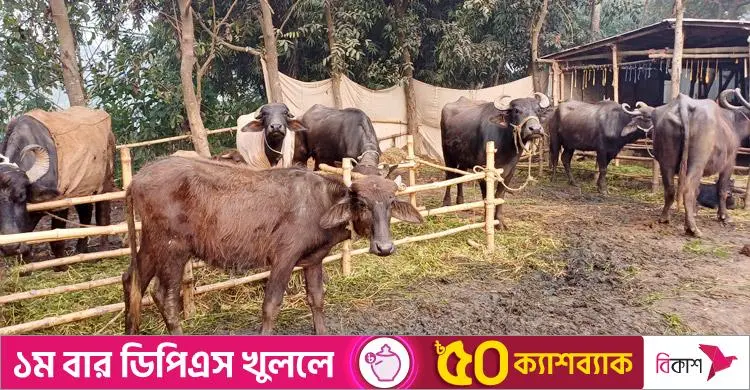
A commercial buffalo farm begun with three cows and three calves has changed the fortunes of Rasel Bepari of Bhagirathpur in Hemayetpur union, Pabna. With double profits, in three years his farm now has 15 cows and 10 calves, and in the meantime he has sold seven buffalo calves for close to a lakh taka each.
Rasel, whose family could not make ends meet driving a buffalo cart and farming, is now prosperous. Seeing him, many others are turning to commercial buffalo farming.
From buffalo cart to farm
Rasel Bepari said he and his father grew vegetables and drove buffalo carts, but even with back-breaking work day and night they struggled to support the family. Inspired by buffalo farms in Lalpur in neighbouring Natore district, in 2019 he started a farm with six buffaloes, including calves, for Tk 7 lakh. Expanding it has changed their fortunes. At least five to seven buffaloes give 3 to 4 kg of milk each throughout the year, which covers the feed and other costs of the farm. Because buffaloes have fewer diseases and cost less to raise than cattle and other livestock, Rasel's farm makes big profits without much investment.
Rasel said: "I now have 25 buffaloes, large and small. Six are giving milk, and I get 15 to 18 kg of milk a day, which sells at Tk 70 to 80 a kg. A buffalo gives milk for six to seven months on average. Including feed, a buffalo costs less than Tk 100 a day on average, but ours costs much less because we feed grass from various fields and grass planted on our land. Then every year each buffalo gives us a calf as profit. The calves sell for Tk 80 thousand to a lakh."
He said: "I couldn't support the family with vegetables and other crops. Driving a buffalo cart didn't get me anywhere either. If the house was damaged, I had to think hard even to buy one sheet of tin. Now this farm has ended our hardship. I've bought land and repaired the house."
Farms doubling in size
Over the past decade, growing demand for meat and milk has raised the market value of buffaloes several times over. With commercial success, many small entrepreneurs have become full-time farmers. Besides Rasel Bepari, the fortunes of at least 30 to 40 people in several upazilas, including Joynal Pramanik, Farid and Moni Bepari of Pabna, have changed through such farms, which have doubled in size within two to three years.
Farmer Joynal Pramanik said he started his farm by buying 22 buffaloes for Tk 26 to 28 lakh. One died while being raised and he has sold three so far. Three years on, he has 45 buffaloes, looked after for now by three herders, a number he will have to increase. The Padma chars nearby meet much of the need for grass; the rest comes from planted grass and a little oil cake and bran. Altogether, he said, raising buffaloes costs much less than cattle or other livestock.
He said a buffalo gives one calf a year and milk for six to eight months. This meets the family's own milk needs, and selling the rest covers the cost of rearing. If the farm produces 20 calves a year, that brings a profit of about Tk 20 lakh.
On disease, he said buffaloes have few illnesses, but not none. If a buffalo dies, about Tk 1.5 to 2 lakh is gone, so farmers must be careful. It would help if government vets gave a little more support, but they do not get much of it, and most of the time they call private vets for health checks.
Jobs for herders
Commercial buffalo rearing has not only changed farmers' fortunes but also created jobs. Most large farms employ two to five people.
Herder Sagar, who looks after buffaloes, said that after milking in the morning he takes them to the field and grazes them all day. They have to be taken to the river four to five times a day to be submerged (bathed). In hot weather, they need to graze for half the day and stay in water for the other half.
He said there is almost no cost in rearing buffaloes now. But in the rainy season, when the fields are under water, grass runs short. Then grass has to be grown on high ground, and more oil cake and bran is needed.
Another herder, Khairul, said he used to work at a brick kiln. "I had to toil like a donkey and it left nothing of my body. Now with these farms we have work. There's less labour in this job. I get a salary of Tk 15,000 and that supports my family."
Official figures
District livestock department data show that five years ago the district had only 7,000 buffaloes, and commercial farms were rarely seen. With grazing land, water and fodder available on the chars in the dry season, farmers are becoming interested in commercial buffalo rearing. At present about 22,000 buffaloes are reared on 66 farms in the district, and 605 buffaloes have been bred this year.
District livestock officer AKSM Musharraf Hossain said commercial buffalo rearing is growing most in Sadar, Ishwardi, Sujanagar, Santhia, Bera and Chatmohar. "We provide the necessary advice and support, including vaccination against golafula (haemorrhagic septicaemia) and deworming. A skilled technician has been posted in each upazila for buffalo breeding. We are also giving the support needed to expand these farms through field workers. Because the region has plenty of grazing land, commercial buffalo rearing will soon bring great success," he said.
Source: Jagonews24. First published in Bengali on The Agro News.
Comments
(0)