
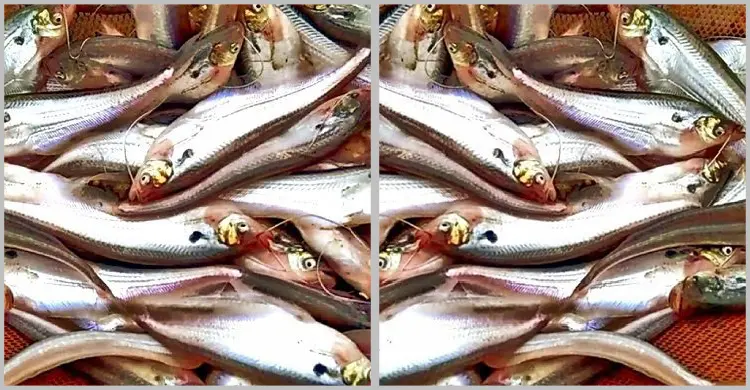
Pabda is among the tastiest fish in the country and is hugely popular for its flavour. It is now almost extinct in natural water bodies, but it is being farmed using modern methods, and farming it this way can be quite profitable.
Choosing and preparing the pond
Choose a pond or water body of 15 to 20 decimals that holds water for seven to eight months. It must be free from flooding and get enough light and air.
Repair the pond banks. First the pond should be drained dry by pumping. If that is not possible, remove all fish by applying 18 to 25 g of rotenone powder per decimal per foot of depth.
If the pond bottom is likely to become muddy, a little sand can be scattered. This prevents gas forming at the bottom and keeps the water clean and the environment good.
Two to three days after applying rotenone, apply stone lime at 1 kg per decimal. Besides lime, applying zeolite (1 kg per decimal) during pond preparation gives good results.
Fertiliser is applied to boost productivity, that is, the growth of natural food, as the last step of pond preparation. Four to five days after liming, apply 80 g of urea and 40 g of TSP per decimal. No organic fertiliser of any kind should be put in the pond.
Stocking the fry
Before releasing fry, acclimatise the transported fry to the temperature of the pond water. Make a solution of 10 litres of water with 1 spoon of potassium permanganate or 100 g of salt, and bathe the fry in it for one to two minutes to disinfect them.
Stock the pond four days after applying fertiliser, once the water turns green or brown. If possible, keep a gentle flow of water in the pond for five to six hours from the time the fry are released. For single-species culture, 200 to 250 healthy fry of 3 to 4 g each can be stocked per decimal.
For mixed culture, stock per decimal 50 pabda and 100 shing of 2 to 3 inches, and healthy fry of 4 to 5 inches: 5 catla, 10 rui, 10 mrigel, 2 silver carp and 2 grass carp. Pabda do well with tilapia, because pabda eat the unwanted tilapia young and grow quickly.
Feeding and harvest
A supplementary feed can be made from 30 per cent fish meal, 30 per cent mustard oil cake, 30 per cent auto rice bran and 10 per cent wheat bran with vitamin premix, or commercial koi fish feed can be used. Pabda generally prefer to feed at night, so this feed can be given twice at night. In mixed culture, feed the other fish in the usual way. From the day after stocking, feed daily starting at 12 per cent of body weight, cutting the rate by 1 per cent every 15 days. Once pabda weigh more than 30 g, the feed rate should be 5 per cent of body weight.
The fish can be harvested at 30 to 35 g within seven to eight months. Under a semi-intensive system, single-species culture can produce 14 to 15 kg of fish per decimal.
Source: Jagonews24. First published in Bengali on The Agro News.

Comments
(0)