
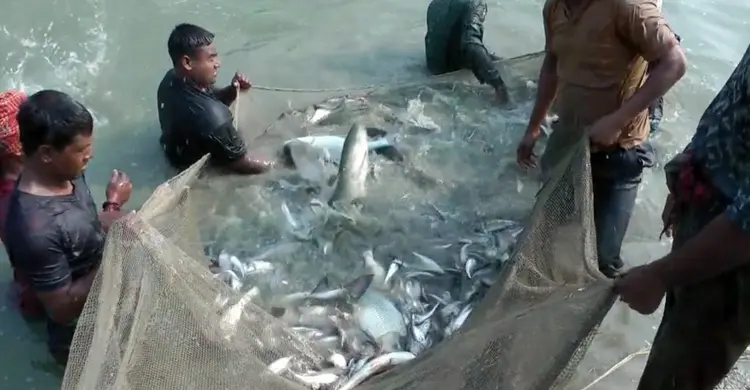
With good profit relative to cost, pabda fish farming has become popular in Maheshpur upazila of Jhenaidah. It began with two farmers in 2016 and the number of pabda farmers now stands at 30. More than 150 tonnes of pabda were produced last season, and the fisheries department expects output to rise further next season.
Farmers bring fry from various private hatcheries in Mymensingh, then raise them in ponds on mixed and pelleted feed. Usually, spending Tk 1.5 lakh on a one-bigha pond yields fish worth about Tk 3 lakh. Pabda sells from the pond side at an average of Tk 330 a kg. Other species are kept in the pond as well to keep the water in good condition.
Buyers come to the pond
Pabda farmer Abbas said pelleted feed is used in most cases to keep the fish in good shape. Selling is easy too: whether 150 or 200 maunds are harvested, large wholesalers from Dhaka, Chattogram and elsewhere buy it straight from the pond side. Profit and easy sales are making pabda farming popular.
Raju said he has been farming pabda with his father since finishing his studies, and hopes to sell pabda worth about Tk 2.5 lakh this year. Other fish must be farmed alongside pabda to keep the water right, which is called mixed farming.
Another farmer said interest in pabda farming has grown. There is little problem selling it, and 150 or 200 maunds are bought straight from the pond side, so many farmers are now turning to it. He added that the fisheries department is training them in various ways, and when problems arise officials come to test the pond water and take other necessary steps.
Exported to India
Maheshpur upazila fisheries officer Alamgir Hossain said pabda farming is more profitable than any other sector of agriculture. Besides regularly encouraging farmers to take it up, the fisheries department is helping with sales. He said pabda produced in Maheshpur is sent to India through LCs, and with high demand in domestic markets such as Dhaka, Chattogram and Cumilla, farmers are doing well. Pabda fry are usually released into ponds at the start of March and are ready for harvest from six months later.
Source: Jagonews24. First published in Bengali on The Agro News.

Comments
(0)