
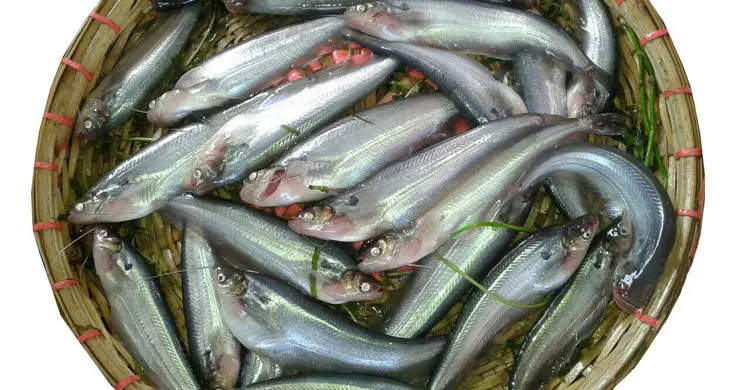
Bengalis are known as people of fish and rice, and pabda is a very popular and tasty fish. But it is now almost extinct. Various methods can be used to help it breed, and artificial breeding is one way to save it. Here are some techniques worth knowing.
Choosing brood fish
When selecting brood fish, the male is comparatively smaller than the female. In the breeding season the male's belly is flat and its pectoral fins are serrated. The female is comparatively larger than the male; in the breeding season her belly is swollen and soft, and her pectoral fins are not very serrated.
Before and after spawning
Eight to 10 hours before the injection is given, the fish are caught and moved to glass-nylon hapas set up in the pond. Until then, a continuous shower of water must be sprayed on the fish from above through a perforated PVC pipe to supply oxygen.
After spawning, the fish should be removed carefully from the hapa as quickly as possible and the eggs moved to trays. Care is needed to keep the water temperature in the tray and the pond roughly the same; at first, pond water can be filtered and put in the trays. As soon as the eggs are moved, water must be supplied continuously from above through a perforated PVC pipe so the eggs get enough oxygen. The eggs hatch within 16 to 20 hours.
Feeding and rearing fry
The hatchlings in the trays must be given their first feed within 21 to 36 hours of hatching. Tubificid worms are the best first feed; they are put in a small bowl and chopped finely. If tubificid worms are not available, zooplankton should be caught from a pond, strained through a fine sieve and put in the trays.
Feed should be given two to three times a day according to the fry's needs. After six to eight days of rearing in trays, the fry should be moved to cisterns. Cisterns of 2.4, 1.3 and 0.5 cubic metres can hold 300 to 500 fry, with a water depth of 30 to 40 centimetres. After 10 to 15 days in the cisterns, once the fry reach 2 to 3 centimetres, they can be stocked in nursery ponds.
Nursery pond
The pond should be 3 to 6 decimals in area. After the pond is prepared, 300 to 400 fry can be released per decimal. Before stocking, a fine-meshed net should be dragged through the pond to remove insects, snakes, frogs and so on. Fry should be released in the morning or before evening. After stocking, supplementary feed equal to 10 to 20 per cent of the fry's body weight should be given daily. The fish's health should be checked by netting every 15 days.
Source: Jagonews24. First published in Bengali on The Agro News.

Comments
(0)