
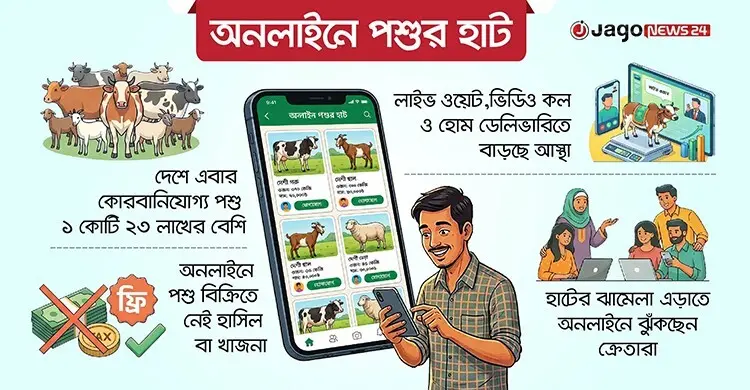
Digital cattle markets are dominating the sacrificial animal trade this year. From small farmers to corporate companies, almost everyone is now selling animals online, and most companies have already sold their sacrificial animals. Those who buy from a company once tend to buy from the same one in later years. Digital markets are most popular among the upper middle class and expatriates, and online sales of sacrificial animals are becoming more popular and more trusted by the day.
Selling sacrificial animals online became popular during the coronavirus pandemic, and digital markets run by various companies have been busy again this year. Bengal Meat, Othoba.com, Bikroy.com and several other companies and entrepreneurs are selling sacrificial animals online, and posts about animals for sale fill Facebook pages, groups and social media.
Countless companies and entrepreneurs are now in the business. Most are again selling by 'live weight', which ensures transparency. Each platform attaches live video of the animal, its weight on a digital scale, its age (by number of teeth), breed and a health certificate from a registered veterinarian. For online payment, escrow services and mobile banking protect buyers financially.
Sold out early
Sheikh Imran Aziz, head of business at Bengal Meat, told Jagonews24, "We are getting a good response to online sales of sacrificial animals this year. Because our capacity is limited, we target about 500 animals every year, and we are working to the same target this year. Almost all our cattle have already been sold; only 15 to 20 are left. The goats sold out completely earlier. Buyers' trust in online sacrifice has grown a lot, which is why we get a good response every year."
Othoba.com, the e-commerce arm of PRAN-RFL Group, is selling sacrificial cattle online and has again had a strong response, with all its animals already sold. On 21 May it posted on its Facebook page: "The Haat To Home campaign is now SOLD OUT! With your amazing love and support, all the cows went quickly! Best Rate and free delivery brought a great response! Heartfelt thanks to everyone who ordered. And for those who missed out, don't worry: more attractive offers are coming! Stay with Othoba."
Khandaker Tasfin Alam, executive director of PRAN-RFL Group's digital transformation department, told Jagonews24, "One hundred percent of the cattle we had have been sold. We put up roughly 70 to 80 cattle, mostly from our own farm and some from vendors. We got a very good response. People's interest in buying cattle online is growing, and we hope it will grow further."
Bikroy.com has long been trading animals online, and buyers can shop for various sacrificial animals on its website.
The e-commerce site Sorobor is offering an online sacrificial animal market. Its head of operation, Md Golam Sarwar, told Jagonews24, "Our company is 12 years old. From the start we have sold cattle both online and offline. So far this year we have sold about 100 cattle online and offline combined."
He said, "The trend of buying sacrificial animals online is growing slowly. Corporate employees, doctors and busy professionals in particular, who have little time to go to the market or little knowledge of buying cattle, are more comfortable online. But buyers can also come to our farm to see the cattle if they wish."
Buyers want to know how cattle were raised
Tasdikh Habib, co-founder of Shukher Khamar, which sells cattle online, told Jagonews24 that buyers were turning to online farms not only to avoid the hassle of the market but also to make sure they get safe, naturally raised animals.
"The upper middle class and those above are buying cattle online most. They want to avoid the trouble of going to the market. Expatriates are another big group of buyers," he said.
"Buyers first look at the cattle online, then watch them on live calls and show them to family members. We measured live weight on video and sent photos and videos from 360-degree angles. Those who bought from us did not buy on impulse. Many had followed our online activity for a long time and been in touch. Some came to the farm six months ago to book a cow."
"This market is growing fast. I think online sales of sacrificial animals will grow further," he said.
Awareness about cattle feed and rearing has also become a big factor, he said. "We don't feed our cattle any steroids or broiler feed. We raise them on natural feed. People are becoming aware: with a cow bought at the market, they don't know how it was raised or what it was fed. That is why interest in online farms is growing."
The Bogura-based Shukher Khamar had 96 cattle for sacrifice this year, and all were sold about a week before Eid. About 60 percent of total sales were entirely online, with many buyers purchasing without visiting the farm.
"Not only people from Bogura, but buyers from Dhaka, Narayanganj, Narsingdi, Shariatpur, Khulna, Sirajganj and even Chattogram bought cattle. Many expatriate Bangladeshis also ordered cattle from us for their families," Tasdikh Habib said.
Many farmers are also attracting buyers by posting photos and videos of cattle on social media and online platforms, and say the response is good. Farmer Md Farooq sells cattle through an online page called 'Firoza Agro Farm'. He said the cattle's weight is stated alongside the photos and videos, and they are selling at Tk 550 or Tk 500 a kg. Many book in advance, and others come to the farm to see and take them. People from various districts get in touch, so some cattle are sold even before they are taken to market.
Why Daraz pulled out
Daraz Bangladesh, a leading e-commerce platform, once sold sacrificial animals online but has since withdrawn because of various obstacles.
A H M Hasinul Quddus Rusho, Daraz Bangladesh's chief corporate affairs officer, told Jagonews24, "We no longer sell sacrificial animals online, though we did run this around 2021-22. At that time we not only sold cattle and goats but also arranged slaughter and delivery of the meat after the whole sacrifice process. But we later found it difficult to deliver quality meat properly without freezer vans, and we had to refund many customers. Also, no government-designated space was allocated to e-commerce companies for selling animals through digital channels. Altogether it became quite challenging for us, so we withdrew."
Mohammad Shahab Uddin, former senior vice-president of e-CAB, the e-commerce traders' association, believes farmers get good prices selling online. He told Jagonews24, "Farmers and sellers across the country now contact buyers directly by sending photos, weights and other details of cattle via social media. Even people living abroad can see animals online, bargain and buy a sacrificial animal for their home area. This means even marginal farmers are getting good prices."
He said online sacrificial animal markets became widely popular from the coronavirus period, when people cut down on physical presence and buying and selling through digital channels increased. It has since spread further, and animals are now sold not only on e-commerce platforms but also on Facebook, WhatsApp and other social media. "Online animal sales will expand further in future," he said.
No market fee online
Buyers pay a market fee when they buy at a cattle market, but there is none online. Fisheries and Livestock Minister Mohammad Amin Ur Rashid said that, as in the past few years, animals would be sold online at the time of sacrifice this year, and no toll or market fee would be charged.
Online sales of sacrificial animals became popular on a large scale during the coronavirus pandemic in 2020, when people began buying cattle on Facebook, websites and digital platforms instead of going to markets to avoid infection. The market has gradually expanded since then.
There are 1,23,33,840 animals fit for sacrifice in the country this year, more than 22 lakh above expected demand, which is 1,01,06,334 animals. According to the livestock ministry, with supply exceeding demand, no shortage is expected in the market.
Source: Jagonews24. First published in Bengali on The Agro News.
Comments
(0)