
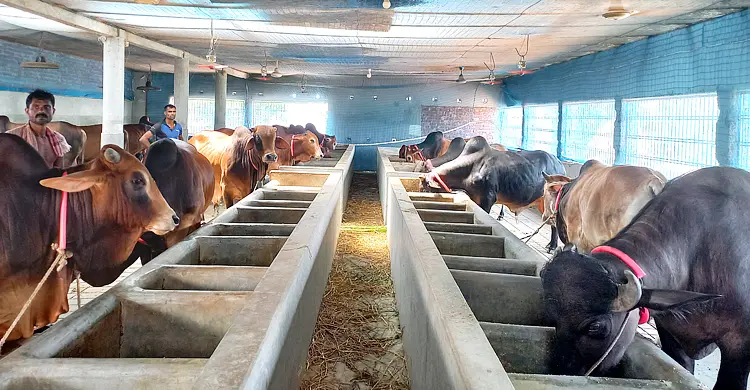
Farmers in Singra upazila of Natore have prepared 92 thousand animals for sacrifice at the coming holy Eid-ul-Azha. After meeting the upazila's own demand, animals can be sent to markets in the capital and elsewhere in the country. The animals are being raised by around 5,000 farmers in the municipality and 12 unions of the upazila, who say trade worth about Tk 200 crore is possible.
Those involved said the upazila needs 45,550 animals for sacrifice, while 92,566 are ready. The surplus will be supplied to other parts of the country, and farmers will profit if they get good prices.
Fattening without harmful drugs
Every year ahead of the Eid of sacrifice, Singra's farmers are busy fattening cattle, goats, sheep and buffaloes. This year too they are busy fattening local cattle and goats, and, as in past years, livestock keepers are hoping for good prices.
Meanwhile, to make sacrificial animals safe, the Department of Livestock Services is advising farmers and monitoring farms to stop the use of harmful drugs for fattening cattle.
Livestock are traded in permanent and temporary markets in Singra upazila. Traders come from various places to buy cattle and sell them in the capital and other districts. Local traders also go from farm to farm buying cattle to sell in different markets. About 10,000 people in the upazila (farmers, growers and traders) now work in this trade.
Farmers' hopes
Zahid Hasan, director of Arko Dairy Farm in Temukh Noydapara village of the upazila, said: "We raise cattle the local way. We feed them crushed wheat and maize, straw, bran and Napier grass as a rule. We sell cattle all year round. The upazila livestock office always gives us advice and help."
Farmer Mst Fatema Begum of Uttar Damdama in the municipality said: "I have been raising cattle for 22 years. I do not use fattening drugs or injections. I have prepared 35 cattle on my farm and hope to make a profit."
Farmer Najehal Shah of Chaksingra mahalla in the municipality said: "I have four cattle on my farm, which I bought a year ago. I am looking after them hoping for a good price. Cattle feed is somewhat expensive. If Indian animals are not allowed into the country, I hope to get a good price."
Singra upazila livestock officer Dr KM Iftekharul Islam told Jagonews that farmers in the upazila are busy preparing sacrificial animals. No harmful chemicals or drugs are being fed to the animals for fattening, and his office is keeping watch on this, he said.
Source: Jagonews24. First published in Bengali on The Agro News.
Comments
(0)