

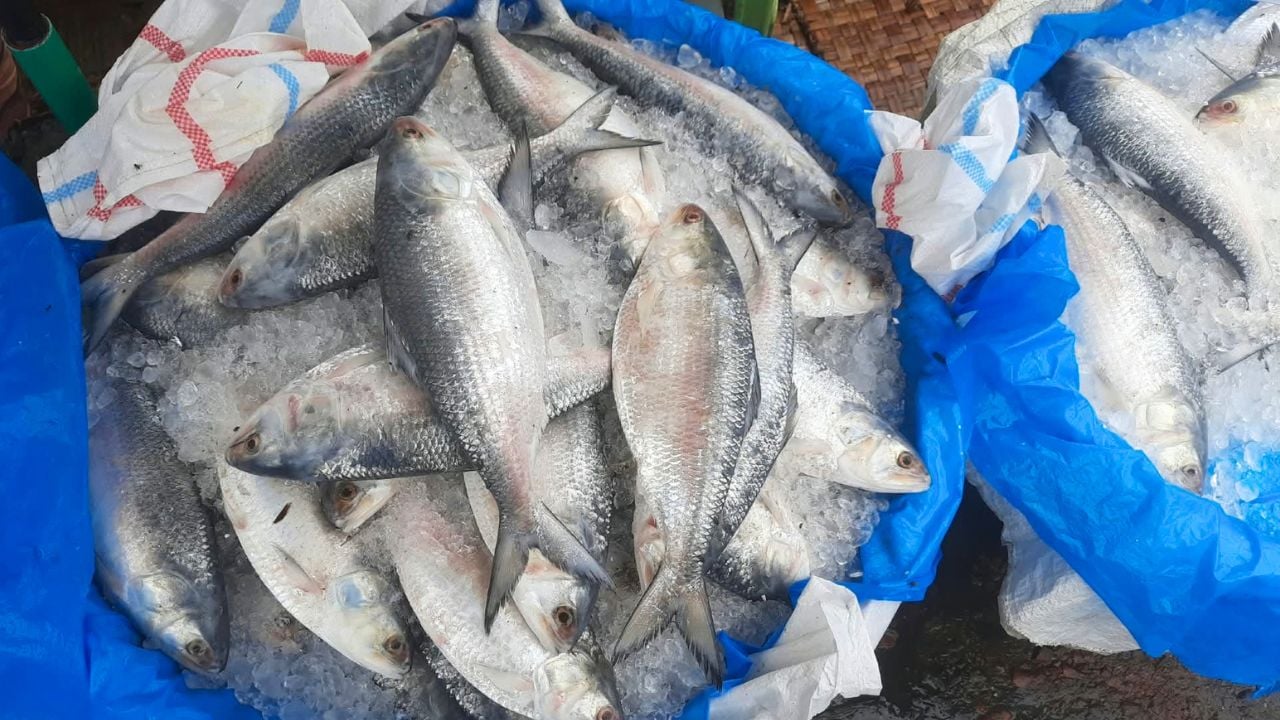
The government has imposed a 22-day ban on catching and selling hilsa to protect mother hilsa. But the ban is not being observed on the Padma and Meghna in Munshiganj. Hilsa is caught freely at night, and in the morning markets for buying and selling hilsa open in full view.
Because the local administration does not run drives at night for security reasons, the Padma and Meghna have been left unguarded. Unscrupulous fishermen are taking advantage of this to keep catching mother hilsa recklessly. Every day several hundred maunds of mother hilsa are caught and then sold freely at floating markets set up in villages along the Padma and Meghna.
Markets along the riverbanks
Inquiries found that the Padma and Meghna run along the Sadar, Louhajang, Sreenagar, Tongibari and Gazaria upazilas of Munshiganj. Every night the rivers become unguarded, and unscrupulous fishermen catch mother hilsa from all directions. In the morning they set up markets in riverside villages and sell the fish freely. Wholesale and retail fish traders flock daily to these unofficial markets on the Meghna bank, where floating wholesale stalls are opened to trade hilsa.
Several sources said 200 fishermen are active in catching mother hilsa on the Meghna next to Char Abdullah, Bakchar and Kalirchar villages in Munshiganj Sadar. Hilsa markets are held every day on the chars of Korhati, Shahinhati, Paikara and Teutia in Louhajang's Teutia union. The picture is the same at Bhagyakul, Baghra and Jasholdia in Sreenagar upazila and at Char Beherpara, Dighirpar and Hasail in Tongibari.
Hilsa is being caught on the largest scale at Chhidarchar and Baburchar on the Padma bank, on the border of Louhajang in Munshiganj and Zajira in Shariatpur. There, fishermen have set up floating markets on the Padma bank to sell the mother hilsa caught in their nets.
On the spot, the market was crowded with fishermen and buyers, with eight or nine engine-driven fishing trawlers moored at the bank.
At the char next to Baghra bazar in Sreenagar upazila, a hilsa market had been set up, with stalls made of awnings and tarpaulin. More than a hundred men and women were moving around buying fish, and some 50 trawlers were coming and going. As soon as a boat reached the ghat with fish, a few leader-like men rushed over, along with several traders from the Baghra fish wholesale market. They took the fish from the bank and handed it to buyers at a somewhat higher price.
"Who will pay for the household?"
A fisherman from Bakchar in Munshiganj Sadar upazila, who did not want to be named, told Jago News: "For 22 days catching all fish, including hilsa, is banned. The government gives some rice during this time. How much does it cost to run a household, and who will pay that? So I am forced to catch hilsa at night. But I have to be very careful, as the police also run drives at night. There is nothing else to do."
He said: "The fish in the river now don't stay; they go to the sea. Whatever fish I get now, we eat ourselves and sell to run the household."
A resident near Baghra bazar in Sreenagar upazila said fish had been sold here in past years too, but not like this year. Prices are not low, but it is like a festival here.
Without revealing his identity, this reporter spoke to a hilsa seller on the char, who asked what size hilsa was wanted. Told the size, he said hilsa of about one kilogram cost Tk 2,000 a kg, while hilsa at three to four fish per kilogram cost Tk 800.
Gazi Kausar of Bhagyakul told Jago News: "The fisheries office has failed completely this year. The government doesn't seem willing either. The char residents and fishermen are reckless. To stop them, law enforcers need to keep a strict watch."
District Fisheries Officer Golam Mehedi Hasan said: "Our drives to protect mother hilsa are continuing. Many fishermen have been jailed and fined. But some fishermen are defying the administration's ban."
Source: Jagonews24. First published in Bengali on The Agro News.

Comments
(0)