
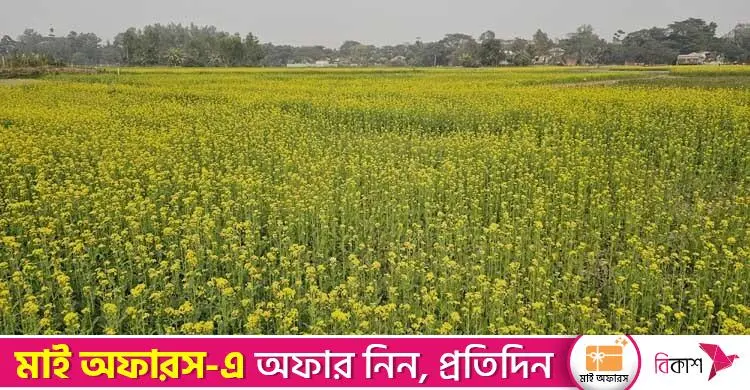
The vast fields of Munshiganj are awash with yellow. Field after field is covered in the flowers of early mustard varieties, swaying in the cold wind and adding a rare beauty to the landscape. The sight delights farmers, and those who collect honey from the mustard are happy too.
As in recent years, farmers in Munshiganj have turned to mustard this year because it brings more profit at lower cost and demand for oil is rising. Mustard oil has become one of the key items in the edible oil market, and demand for mustard oil and seed has sparked farmers' interest.
This season mustard has been grown on 4,793 hectares, and it can now be seen across the fields of all six upazilas of the district, a quiet revolution in potato country. To encourage farmers, the government has also distributed various improved mustard seed varieties and fertiliser free of charge this season through the Department of Agricultural Extension (DAE).
Target exceeded
According to the district DAE, the target for mustard this year in the six upazilas was 4,377 hectares, and 4,793 hectares were cultivated, which the department describes as about 400 hectares more than the target. Last year the target was 5,005 hectares and 4,977 hectares were cultivated. The year before, mustard was grown on 3,049 hectares in the district. The department says that, measured against the target, mustard cultivation has increased compared with last year.
According to the department, 4,600 farmers in the district received incentives this year of 1 kg of mustard seed, 10 kg of DAP fertiliser and 10 kg of MoP fertiliser. A further 243 farmers were given mustard demonstration plots and input support.
Farmers count the gains
Abu Sohan, a local grower, said: "We grow mustard mainly because the profit is higher and the cost is lower. Last year I spent Tk 5,000 on mustard and made a profit of Tk 10,000. Mustard seed and oil prices are good in the market now. The government has also distributed mustard seed and fertiliser."
Sabuj Molla, a grower from Panchgoriakandi in the district town area, said: "I used to grow potatoes but suffered losses. Mustard oil prices have gone up, so mustard fetches more, and growing it is better business. It costs Tk 10,000 and sells for Tk 20,000 to Tk 25,000. Cultivation has increased because the government has helped farmers with seed and fertiliser."
Nasir Uddin, a farmer from Dhamaran village in Tongibari, said: "This time I cut back on potatoes and grew more mustard. I have grown mustard on one kani of land. Mustard land does not need much ploughing, and it does not need many pesticides either. The cost is low."
Farmer Ibrahim Kazi told Jago News: "This time growing mustard on 4 ganda of land cost Tk 6,000. I hope the yield will be good."
Gafur Chan, a farmer in Banglabazar union, said: "Improved varieties yield more than local mustard varieties. Mustard cultivation has gone well this year, and I hope the mustard market will be good too. This time I have grown mustard on 5 bighas."
Dr Md Habibur Rahman, deputy director of the district DAE, said: "A good amount of mustard has been grown this time. Farmers have been encouraged to grow mustard as a supplementary rabi crop, and the government has given seed free of charge. If the weather stays favourable, production will exceed the target, and farmers will make extra profit from mustard this time."
Source: Jagonews24. First published in Bengali on The Agro News.
Comments
(0)