

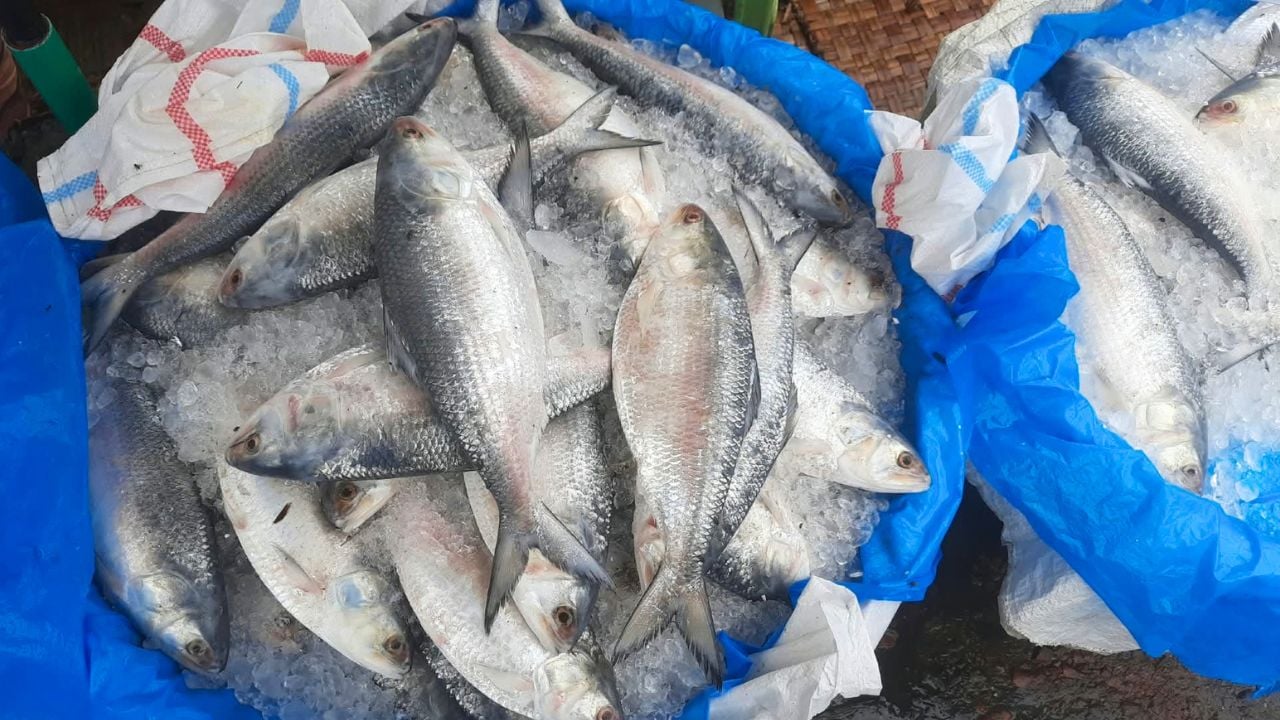
Unable to find hilsa at sea even in the peak season, fishermen in Mirsarai upazila of Chattogram are giving up their trade for other work. Mirsarai's Saherkhali point is one of the country's five breeding grounds, but those involved say the national economic zone built around it has changed where the fish range, so hilsa are no longer found as before.
Experts say changes in the flow and behaviour of fresh water coming down from upstream, environmental pollution and climate effects are reducing hilsa in the area.
Catch in steep decline
The picture of the hilsa catch changed over the five years from 2020 to 2024. Even in the season, the fish seem to have vanished from the sea. In five years the hilsa catch in Mirsarai has fallen by 227 tonnes. Local fishermen cannot understand why production is not rising even though the government bans fishing in the sea and rivers more than once a year to increase it, but they believe the economic zone set up on Mirsarai's char may be behind the fall.
According to the Mirsarai upazila fisheries office, there are 2,557 registered fishermen in 29 fishing villages, with about 5,000 families.
Figures from the senior upazila fisheries officer's office show the hilsa catch in Mirsarai was 327.4 tonnes in 2020. It took a hit in 2021, falling to 252.3 tonnes, and kept falling every year: 147.4 tonnes in 2022 and 116 tonnes in 2023. The thousands of fishermen in Mirsarai's 29 fishing villages could not recover. In 2024 the catch hit rock bottom at only 36.49 tonnes.
It is estimated that if perhaps another 44 tonnes are caught this year, the total will be 100 tonnes, meaning the catch has fallen by 227 tonnes over the past five years.
Fishermen in debt
Ratan Jaldas, a fisherman of Domkhali Jaldas Para, said he has a family of six. Every hilsa season he buys nets on dadon (advance credit) and repays it from his catch. But with the catch falling over the past few years, he has had to take loans from a local NGO to repay the dadon. With fishing also banned twice a year, his family is struggling.
Jodu Jaldas of Anandabazar in the upazila's Saherkhali union said hilsa is now a golden deer. "Sea and river pollution has increased, so hilsa is declining day by day. And because big dredgers are being used for land filling in the Mirsarai economic zone, hilsa is not being found," he said.
Ajoy Jaldas of the same area said: "Because we no longer find fish in the sea as before, I don't go fishing any more. I am doing farm work now. I have been more or less forced to give up my forefathers' trade."
What experts say
Experts believe the causes include changes in the flow and behaviour of fresh water from upstream, pollution, the rise in sea-surface temperature from climate change, disruption of the hilsa's natural habitat at sea and over-harvesting in previous years. Waste from the Mirsarai economic zone and other factors are also reducing hilsa.
Md Harunur Rashid, former chief scientific officer of the Bangladesh Fisheries Research Institute's Riverine Station in Chandpur, told Jagonews that several reasons have been identified for the fall in hilsa production. Among them, excessive pollution in rivers is damaging hilsa breeding and habitat.
He added that the formation of submerged chars and industrial zones on riverbanks are obstructing the fish's normal movement. Climate change is also affecting hilsa ranges and production, and dredging to extract sand from the sea is damaging hilsa habitat.
Asked about it, senior upazila fisheries officer Ariful Islam said fishermen did not catch as much hilsa as hoped this year and the fisheries department is worried about the decline.
"Hilsa is no longer found along the coast as it used to be. The main reason is that hilsa production and breeding grounds are being disrupted. Also, the landing ghats have been changed because of the economic zone, which has reduced the catch," he said.
Source: Jagonews24. First published in Bengali on The Agro News.

Comments
(0)