
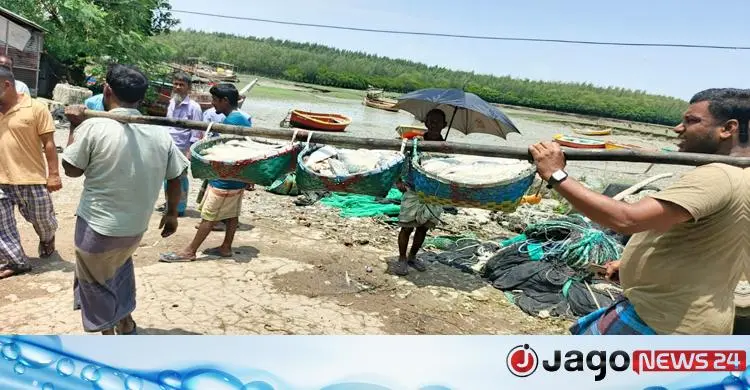
The hilsa catch has increased at the Domkhali-Sahebkhali estuary of the Bay of Bengal in Mirsarai, Chattogram, and fishers are pleased that it is up on recent years. Hilsa production had been falling significantly because industrialisation has disrupted the breeding ground there.
Bangladesh has four hilsa breeding grounds and six sanctuaries, and one of the four breeding grounds is at the Domkhali-Sahebkhali estuary. The encouraging news is that this year's catch is double last year's.
Five years of catches
According to the senior upazila fisheries office, Mirsarai's total hilsa catch was 147.4 tonnes in 2022 and 116 tonnes in 2023. The catch suffered a major blow in 2024, when only 36.49 tonnes were landed, a fall of 79.51 tonnes in a single year. In 2025 the catch was 25.805 tonnes. From January to August this year it reached 52.52 tonnes.
Every year the government takes various steps to increase hilsa production at sea: two fishing bans totalling 87 days, an eight-month ban on catching and a conservation drive for jatka (young hilsa), and a jatka conservation week. During these periods 2,126 fishing families in the upazila received 86kg of rice in two phases.
For the main hilsa breeding season, the government has banned catching, transporting, storing, marketing, buying, selling and exchanging hilsa for 22 days from 13 October to 3 November. During this ban 1,500 fishing families in the upazila get about 25kg of rice. During the eight-month jatka ban from November to June, 620 families receive 40kg of rice a month, but fishers get VGF support for only four of the eight months. Locals say hilsa production cannot rise if the breeding ground is damaged.
Fishers and officials
Jadu Jaldas, a fisher from Mayani union, said slightly more hilsa was being caught this year than last, but the fish are now found only in the deep sea, and the catch does not cover costs.
Sambhu Jaldas, a fisher from Bagachatar, said he had been very disappointed with hilsa last year, but compared with that, the catch this year had been good so far.
Ariful Islam, Mirsarai's senior upazila fisheries officer, said: "Hilsa production this year has doubled compared with last year. We are carrying out regular drives during the ban periods to increase hilsa production. From talking to fishers, what we have learned is that the main reason for the fall in catches is that hilsa production and breeding areas are being disrupted. The catch is also falling because landing ghats have been moved because of the economic zone."
Source: Jagonews24. First published in Bengali on The Agro News.

Comments
(0)