
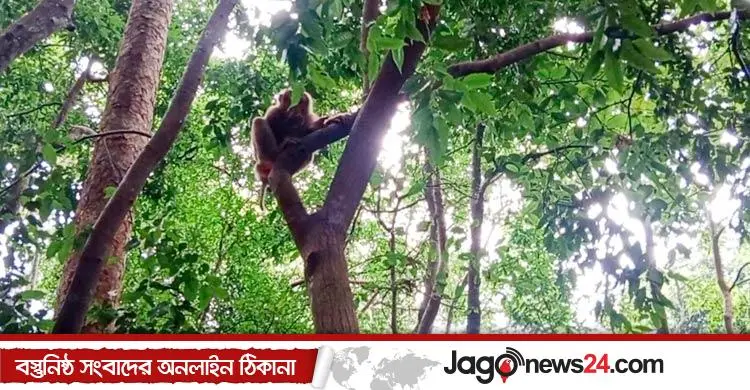
Animals no longer roam freely in Lawachara National Park at Kamalganj in Moulvibazar. Mismanagement, excessive human traffic, the theft of trees and bamboo, and the railway and road running through the forest are thought to be among the reasons. The forest department, however, refuses to accept that animal numbers in the forest have fallen.
The department says monkeys and wild boar have increased greatly in the forest. But no one knows how many other species live there or in what numbers.
Lawachara is one of the country's seven wildlife sanctuaries and 10 national parks. It is a reserved forest.
Uncertain numbers
Lawachara was declared a national park in 1996. At one time it held 460 species of rare plants and animals, including 167 plant species, four amphibian species, six reptile species, 246 bird species and 20 mammal species. How many plants and animals remain today is unclear.
The park's area is recorded as 1,250 hectares, but it has no boundary wall. Many people with homes and land beside the forest have occupied forest land, and some have built gardens on it. The forest department runs drives to recover the land, but the work is hampered because there are no boundary markers.
Environmental activists say there are several reasons why animals are declining and no longer move freely: excessive numbers of tourists, the theft of valuable trees and bamboo, and the railway and road running through the forest, among others. Many animals are killed by vehicles and trains on the road and railway.
The park was famous for the endangered hoolock gibbon, but the forest department does not know how many remain.
According to the findings, 1,35,812 tourists entered the park in 2018-2019. It was then closed for a year and a half because of the coronavirus. In 2023-2024 the number of visitors rose to 1,62,672. Most recently, 1,60,385 visitors bought tickets to enter the park between July 2024 and June this year.
A 2014 survey found 247 species of animals in Lawachara forest, 167 species of butterflies, 120 species of orchids, and 167 species of orchids and plants.
Forest department's view
The forest department says the number of animals has not fallen and that wildlife, birds, wild boar and other animals have increased. Even if animals are not seen during the day, many can be seen at dawn. Noise from large crowds of tourists, the sound of vehicles and trains, and population growth push the animals a little further from human areas, which is why fewer are seen. Protecting tourism and the forest's natural environment together is difficult, the department says.
Inside the forest, a troop of monkeys was seen moving about the park, with many tourists feeding them various foods. No other animals were seen.
Local people say the forest was once so dense that sunlight did not reach the ground directly. That density is gone. Many wild animals used to be seen in the forest, but now nothing but monkeys can be seen.
Saleh Sohel, president of the Moulvibazar district unit of Bangladesh Poribesh Andolon (BAPA), said: "Animals in Lawachara are no longer safe, and that is why they are declining. There is a particular shortage of food in the forest. Without enough food, animals will not stay."
Advising on wildlife protection, he said: "Water mixed with pesticides from the tea gardens flows into the streams, killing many animals. This must be stopped. Tourist entry must be reduced, and traffic on the railway and road brought under control. Then whatever animals remain can be protected."
Shahriar Caesar Rahman, chief executive of Creative Conservation Alliance and a wildlife researcher, said: "It is hard to say how many animals there are in Lawachara National Park. But the forest has a severe water shortage, and many animals are disappearing for lack of water."
Jamil Mohammad Khan, Assistant Conservator of Forests (ACF) of the Wildlife Management and Nature Conservation Division, maintained that monkeys and wild boar had increased greatly in Lawachara. Whether other animals have increased or decreased can only be known through research and surveys, he said.
Md Abul Kalam, Sylhet divisional forest officer of the Wildlife Management and Nature Conservation Division, said the forest department was doing its utmost to ensure the safe movement of wildlife.
He said fewer animals are now seen in the forest for various reasons, especially the large number of tourists, people moving through the forest and traffic on the road and railway. The noise of vehicles drives animals away to safety, as they always prefer quiet places, and for many reasons the animals of Lawachara cannot live safely. He added that a letter had been sent to the settlement office to fix the park's boundary.
Source: Jagonews24. First published in Bengali on The Agro News.
Comments
(0)