
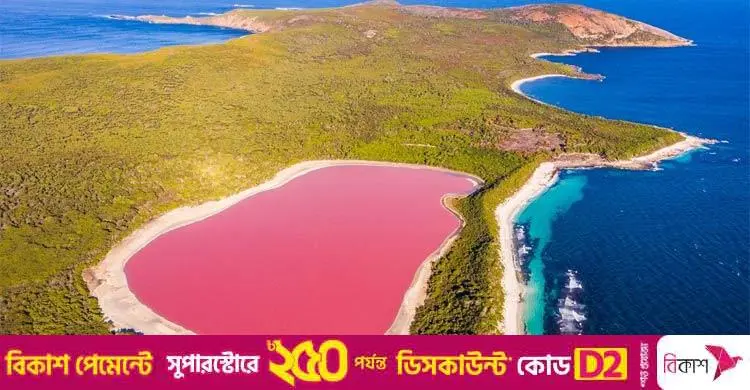
Nature never stops surprising us: coloured minerals in the hills, glowing blue light in the sea, fiery craters in the desert. There is also a lake whose water is neither blue nor green but bright pink. Australia's Lake Hillier is known as the world's only permanently pink lake.
Lake Hillier lies on Middle Island, off Australia's western coast, part of the Recherche Archipelago. The island sits on the shore of the Southern Ocean, somewhat cut off from the mainland. The lake is about 600 metres long and about 250 metres wide. It is not large, but its pink colour has made it one of the world's most striking natural wonders.
Why the water is pink
Scientists who have studied the lake for many years say the main cause of the colour is an alga called Dunaliella salina. It produces large amounts of carotenoids, the same kind of orange-red pigment found in carrots and tomatoes.
Some tiny bacteria living in the lake's salty water also help produce the colour. Remarkably, the water stays pink even when it is put in a bottle, not just when seen from above. Other pink lakes, such as Lake Retba in Senegal or Lake Kendi in Australia, change colour with the seasons. Only Lake Hillier stays bright pink all year round.
The water is extremely salty. The lake is ringed by a layer of white salt and dense eucalyptus and melaleuca trees. From the air, the bright pink lake between the green forest, the white salt and the deep blue sea makes a dreamlike scene. The water is not harmful to people: because of the salinity, fish and larger animals cannot easily survive there, but touching the water or swimming in it is not dangerous.
Discovery and visitors
Lake Hillier was first discovered in 1802, during the expedition of the British navigator Matthew Flinders. He was amazed by the strangely coloured lake and reported on it. Since then it has drawn tourists and scientists alike.
Today it is one of Australia's tourist attractions, but because it is cut off from the mainland it is not easy to reach. Visitors usually see it from the air by small plane or helicopter. Some can land on the island with special permission to see the lake up close, but the government controls visitor numbers under strict rules to protect its ecological balance.
Researchers are also studying the lake's microbes and algae, which could in future be used in the food or pharmaceutical industries. It is also an important example for understanding the world's environmental diversity. Where we usually picture a lake as blue or green, this one, glittering pink in the sun between green trees and white salt, breaks that expectation.
The article draws on Live Science.
Source: Jagonews24. First published in Bengali on The Agro News.

Comments
(0)