
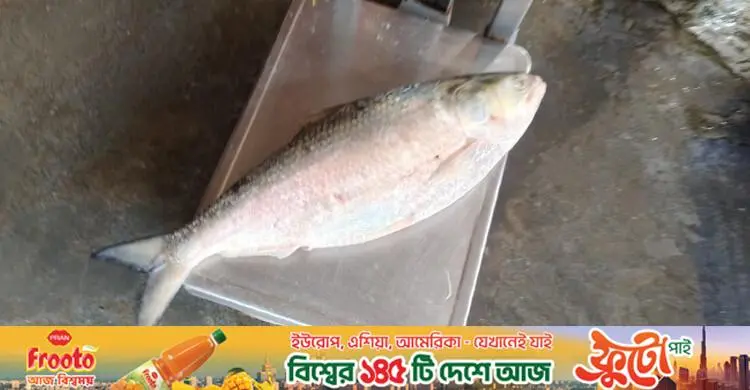
A large hilsa weighing 2 kg 100 grams has been caught in fisherman Sohraf Gazi's net in the Bay of Bengal off Kuakata, Patuakhali. The fish sold at auction at the Kuakata fish market for a total of Tk 7,200, at a rate of Tk 3,625 a kg.
Sohraf Gazi brought the fish to the Kuakata fish market at about 9am on Wednesday (16 September). It was bought at auction by Mizan, manager of Kuakata Ma Moni Fish.
The fish had been caught on Tuesday (15 September) in the deep sea at the pipe buoy near Payra port in the Bay of Bengal.
"First this big in seven years"
Sohraf Gazi said: "I've been fishing for hilsa deep in the Bay of Bengal for about 10 years. When I pulled up the net, this big hilsa came up with other fish. At auction it sold at Tk 1,45,000 a maund, or Tk 3,625 a kg. You don't usually get such a big hilsa. I've got a fish this big after about seven years."
Mizan, the manager of Kuakata Ma Moni Fish who bought it, said: "Hilsa this big are rarely seen in this market now, so I bought it at auction. The fish will be sent to the home of an expatriate's brother in Shariatpur. When big fish like this are caught, aratdars, fishermen and everyone can benefit."
Local resident Jamal Gharami said: "Buying hilsa at Tk 3,000 to Tk 4,000 a kg is not possible for low-income people like us. We used to have hilsa at home at least once a year. Now that's become a dream."
Why big hilsa are scarce
Dr Rajib Sarkar, a professor in the Faculty of Fisheries at Patuakhali Science and Technology University, said the number of large hilsa is falling because of unregulated catching of small hilsa, reduced river flow, dams and sluice gates blocking migration, illegal nets and the lack of co-management committees. Water pollution, plankton shortages, climate change and changing salinity are also affecting hilsa breeding and food supply.
Patuakhali district fisheries officer Bijon Kumar Nandi said: "This is very good news. It can be called a benefit of the fishing ban. Large hilsa have more fat, so they contain omega-3 and various vitamins that are good for the heart, eyes and brain. If the mesh size of nets is widened, more large hilsa like this may be caught."
Source: Jagonews24. First published in Bengali on The Agro News.


Comments
(0)