
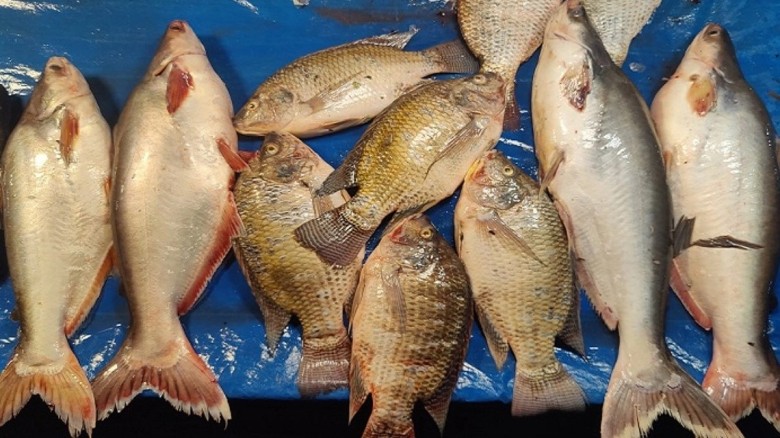
The tasty koral, or bhetki, is prized across the country. A fish of the deep waters of the Bay of Bengal, koral is not always available in markets, and there has been little scope to produce it through farming as is done with shrimp. But now anyone who wishes can try koral farming: koral fry are being produced in Cox's Bazar through artificial breeding.
Fisheries scientists have for the first time in Bangladesh succeeded in producing koral fry through artificial breeding. They have also identified a koral breeding ground covering 23 square kilometres along the Cox's Bazar–Sonadia coast of the Bay of Bengal. The success came from a year of research by scientists of the Bangladesh Fisheries Research Institute (BFRI).
An early success
Dr Yahia Mahmud, director general of BFRI and a noted fisheries scientist, regards it as a preliminary success.
He said research that began in April 2018 had for the first time succeeded in producing koral fry artificially in a hatchery, but more research is needed. If commercial koral farming begins, it will start a revolution in the economy and in marine fisheries, he said.
Fisheries scientists said BFRI scientists in Cox's Bazar had earlier, through research, succeeded for the first time in producing crab fry, and there is no longer a shortage of crab fry in the country. Alongside koral, scientists are now trying to produce fry of other valuable, commercially important fish artificially.
According to BFRI, a project titled "Research on developing bhetki brood fish and producing fry through artificial breeding" is being run with funding from the Strengthening Marine Fisheries Research and Infrastructure Development project. The research is led by Mohammad Ashraful Haque, senior scientific officer at BFRI's Marine Fisheries and Technology Station in Cox's Bazar. After more than a year of research, the first success in artificial breeding of bhetki came last May. In the course of the research, scientists were also able for the first time to identify a koral breeding ground in the Bay of Bengal covering 23 square kilometres from Kolatoli in Cox's Bazar to Sonadia.
High value, short of fry
A fisheries official said koral is a well-known, tasty fish of the coastal areas. It has few bones, grows fast and tastes good, so it fetches a high price. It is in wide demand internationally and has economic importance. Neighbouring countries including Thailand and Malaysia were already able to produce koral fry artificially in hatcheries, while Bangladeshi scientists had lagged behind until now.
Koral has, however, long been farmed to some extent alongside shrimp in ghers in coastal areas including Cox's Bazar, Chattogram, Satkhira, Khulna and Bagerhat. It can be raised in saline, brackish and even fresh water. Because it suffers few diseases, many people have recently given up shrimp farming for koral. But a shortage of fry keeps many from taking up profitable koral farming. If koral fry produced by breeding reach the market, a revolution in its farming will begin.
How koral breeds
Mohammad Ashraful Haque said a mature female koral can lay between 6 million and 20 million eggs, so only a small number of brood fish are needed to produce fry in a hatchery. The challenge, however, is protecting the fish for the four to five years it takes a brood female to develop.
He said koral are born male, and after four to five years some turn into females. Once they change, they move close to coastal river estuaries to breed. The breeding season begins in April, but most eggs are laid in May. On 23 May, while carrying out research off the Sonadia coast, he saw koral spawning with his own eyes, brought a brood fish collected there to the hatchery and was able to produce fry artificially.
Source: Prothom Alo. First published in Bengali on The Agro News.
Comments
(0)