
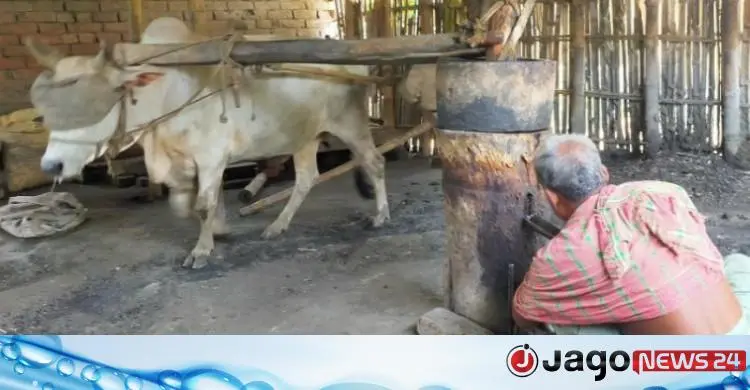
Today's generation hardly knows the word 'kolu', and the kolu community is seldom seen any more. In the past, pure mustard oil pressed in wooden ghanis was sold in clay pots at village markets. Under the lid of the pot was an orong, a scoop made from a palm-seed shell with a bamboo handle, used to ladle out the oil. This pure mustard oil was closely tied to the kolu community.
The kolus are a community linked to oil. The indigenous machine they use, driven by animals, to press mustard or other oilseeds is the 'ghani'. To pull the ghani the kolus use cattle or horses. These oxen are known locally as 'bolod'. While working, the animals' eyes were covered with cloth so they could be made to work harder, and from this came the saying 'kolur bolod', the kolu's ox.
How a wooden ghani is built
A ghani is made of wood, without a single speck of iron. Building one takes practically a whole tree, and each part needs a different kind of wood. Each part also has its own name.
More than half of a trunk eight to ten feet long is buried in the ground. This is the main part of the ghani and is called the 'gachh'. Seasoned koroi wood is best for it. A ring of wood around the top of the gachh is known as the 'ora'. Pressing the mustard needs a long wooden pestle, rather like the pounder of a dhenki or a thari mallet, called the 'jait'. Wood of the bel tree is most suitable for this.
To press on the jait, a piece of wood a cubit to a cubit and a half long, curved at one end, is needed; this is the 'deka'. The curved head of the deka sits on the head of the jait like a cap, and its other end is tied to one end of a heavy, thick plank called the 'katari'. A hole is made in the lower part of the gachh, and a thin stick called the 'patari' is fitted into it, down which oil drips drop by drop into a pot placed below. Something heavy is placed on the katari so the mustard can be pressed for oil. When cattle or horses are yoked to the katari and start walking, the weight on the katari presses down on the jait, and as the jait grinds the mustard, the oil flows out down the patari and collects in the pot.
A craft on the way out
With advances in technology, oil pressed in wooden ghanis is disappearing from almost every part of the country, and oil is now made in iron mills. With adulterated and artificial mustard oil taking over the market, people no longer get the taste of pure mustard oil. New technology has arrived everywhere with changing times, and various industries have grown up. Some dishonest traders are making mustard oil by mixing in chemicals.
Today's traders can sell oil pressed in iron mills with electric motors at a low price, but the kolus, who work day and night to produce pure mustard oil squeezed drop by drop in wooden ghanis turned by cattle or horses, cannot sell theirs at that price. Unable to survive this unequal competition in the machine age, the traditional kolu community is now on the verge of extinction, and it is now very hard to find an ox-driven ghani. Still, out of sentiment, some people keep this traditional craft alive as their ancestral trade.
Even today many people, without counting profit and loss, look for 100 percent natural purity. Although demand for pure mustard oil from wooden ghanis is high, it is hard for kolus to make it pay. So, against the tide of technology, this organic trade of buyer and seller seems almost extinct.
Source: Jagonews24. First published in Bengali on The Agro News.
Comments
(0)