
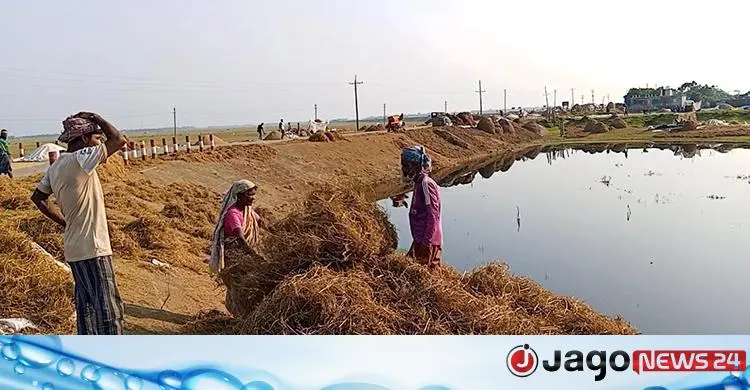
Farmer Mohammad Amir of Itna sighs as he looks at his empty straw loft. His three cows tied in the shed keep lowing for food, but there is no dry straw to give them and no green grass in the fields. The haor fields are under water after the flood, the paddy on the threshing floor is wet, the straw has rotted and straw prices in the market are abnormally high. Having lost his paddy to the flood, his biggest worry now is keeping his cattle alive.
"Losing the paddy, everything is gone. Now the family's last asset will go too. I can't feed them, so I'll have to sell the cows for want of straw," Mohammad Amir said.
Heavy rain and hill runoff from upstream have damaged not only the boro crop this time but also created a fodder crisis in Kishoreganj's haor areas. Unable to harvest on time, with straw soaked and ruined and water standing in the fields, thousands of farmers and livestock keepers face a shortage of animal feed. Many are being forced to sell cattle and goats, and many believe this could affect the sacrificial animal markets at the coming Eid.
Straw rotted, fattening disrupted
Farmers say the fodder shortage and higher costs are disrupting cattle fattening and forcing them to sell animals early. This could cut meat production and push up the price of sacrificial animals.
People involved in farming say the haor is a source not only of rice for people but also of the main feed for livestock. Farmers depend on boro straw for much of the year, so this year's flooding of the paddy has hit fodder directly.
Just as paddy was ruined under the haor water, continuous rain rotted the straw. With straw scarce, farmers cannot feed their cattle enough, raising fears that the animals will lose health and weight. If the situation lasts, the supply of animals to the Eid markets could fall.
Visits to Itna, Mithamain, Austagram, Nikli and Tarail upazilas found that many farmers could not store straw because they had nowhere to dry it; in places it has rotted black in the water. With the haor flooded there is no fresh grass either, and farmers are barely keeping animals alive on small amounts of feed. Many are selling their cattle for lack of straw, and wheat bran prices have risen by Tk 200 to Tk 300 a sack.
Mamun Mia, a livestock farmer in Abdullahpur, Austagram, told Jagonews that the straw brought into the cowshed each boro season normally feeds the cattle for about six months. This year rain ruined most of it, and he now has to buy straw at double the price, and even then there is not enough to meet demand.
"It is hard to keep cattle buying straw at these prices," he said. "The cows I was preparing for Eid won't gain weight if I can't feed them properly, so I have to sell them now."
Safura Khatun, a farm woman from Chhatirchar in Nikli, said: "I couldn't save the paddy, and the straw is ruined too. I can't sleep for worrying about what to feed the cows. This time I have to sell them cheap."
Women and small farmers under strain
In many haor families, women look after the livestock, and the fodder crisis has left them at a loss too.
Rashida Begum, a housewife of Boribari village in Itna, said: "I had two cows and helped the family by selling milk. Now the milk has dropped for want of feed. If I buy feed from the market, forget profit, I make a loss."
Local markets show that not only straw but also bran and oil-cake prices have risen. Alal Mia, a livestock farmer of Gopdighi in Mithamain, said: "Milk prices haven't gone up but feed prices have. Bran, oil cake, straw, everything is dearer. Keeping cattle is now a burden. Many are thinking of selling before Eid."
Local traders say most of the haor's straw has rotted, so straw is being brought in from other districts, and higher transport costs are feeding into market prices.
Farmers say many small farmers could not fatten cattle for Eid this year and some are selling early, which could reduce the supply of animals in local markets at Eid.
Nabi Hossain, a cattle trader in Austagram, said the way feed prices are rising, cattle prices may rise too. "Small farmers are under more pressure this time. We have already started buying cattle from the haor."
Farmers complain that they have received no visible help yet. They are demanding emergency fodder aid at union level, arrangements for storing straw and low-cost animal feed.
In some areas a few farmers are trying Napier grass and silage as alternatives, but on a very limited scale; most farmers have neither the opportunity nor the training.
Veterinary expert Dr ABM Jalal Uddin said that without modern straw storage at union level, alternative fodder production and support during disasters, the crisis could become worse in the long run. The straw shortage will push up the prices of bran, oil cake and other feed in haor markets, he said.
Official figures
Boro was grown on 1 lakh 68 thousand hectares in Kishoreganj this season. Heavy rain and runoff have already damaged crops on about 13,500 hectares, affecting about 52,000 farmers, who fear a big impact on livestock too.
In the haor now, the cry is not only over lost paddy but over the struggle to save cattle. Looking at empty straw lofts and hungry animals, farmers have one fear: "The crop is gone. How will we keep the cows alive now?"
According to the district livestock office, demand for sacrificial animals in the district this year is 1 lakh 52 thousand and the production target is 1 lakh 93 thousand, 39,000 more than demand.
Kishoreganj District Livestock Officer Dr Md Abdul Mannan told Jagonews that just as paddy rotted in the haor's heavy rain, rotting straw has caused a temporary fodder shortage, and higher authorities have been informed. It will not have much effect on the Eid market, he said, because people in the haor are already selling cattle and goats for lack of fodder, though they may not get the right price.
He said the situation is being monitored and farmers are being encouraged to manage alternative feed and grow grass. "We are advising farmers in the field," he said.
Source: Jagonews24. First published in Bengali on The Agro News.


Comments
(0)