
By Benazir Ahmed Siddiqui
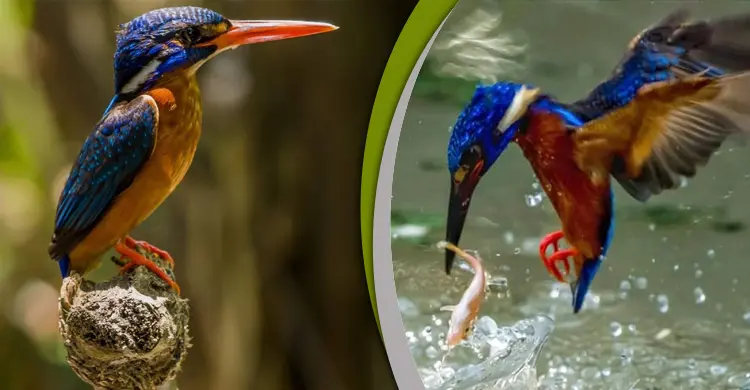
On a quiet afternoon, a dazzlingly bright kingfisher waits motionless on a thin branch of a small tree or a bamboo pole beside a pond or pool. When it sits silently staring at the water in hope of prey, from a distance it looks like a painting on an artist's canvas.
The kingfisher's eyes are specially adapted to see prey under water. Using this ability, as soon as it senses where a fish is, it dives head-first into the water at arrow speed. Before the fish knows what is happening, the kingfisher has caught it. Moments later a small fish can be seen struggling in the bird's beak. It then beats the fish several times, tosses it into the air and swallows it head first.
Its name means "fish-catcher", but does it hunt only fish? No, it hunts many kinds of animals, though fish make up a large share. Other prey includes insects, frogs and reptiles. Such clever hunting by the beautiful kingfisher can still be seen in rural Bengal.
Habitat and species
Kingfishers usually live beside water and in forests. They like to nest in earth banks, in holes dug by other birds in termite mounds, or in hollows in rotten tree stumps. Both male and female loosen the soil or rotten wood with their beaks to dig the hole, and kick the soil or wood dust out with their feet to build the nest.
About 90 species of kingfisher are found in the world, and about 12 of them exist in Bangladesh: the small blue kingfisher, white-breasted kingfisher, red kingfisher, spotted or pied kingfisher, megh-hou (stork-billed) kingfisher, green kingfisher, black kingfisher, brown kingfisher, cinnamon kingfisher, blue-eared kingfisher, white-throated kingfisher and wild kingfisher. Almost all have a large head for their body, a long, sharp, pointed bill, short legs and a short tail. Most kingfishers have brightly coloured bodies, with slight differences between males and females.
Breeding and hunting
Their breeding season begins at the end of the monsoon or in autumn. At this time they pair up and stay together. They lay five to seven eggs at a time, glossy white in colour. Both parents incubate the eggs by day, but only the mother sits on them at night. The eggs take 19 to 20 days to hatch, and the chicks stay in the nest for another 24 to 25 days. Both parents do everything together, from building the nest to caring for the chicks. The blue kingfisher, however, lays its eggs just before the monsoon arrives. It builds its nest by digging a hole a foot long in a pond bank or a steep earth bank, wider at the far end. In this nest the blue kingfisher lays five or six white eggs.
The blue kingfisher lives alone or in a pair in one place. Kingfishers follow a set rule for gathering food: each marks out a particular feeding area, which other kingfishers are strictly forbidden to enter. The bird's hunting style is also quite remarkable. It sits on a thin branch leaning over the water or a bamboo pole planted in it and keeps a watchful eye on the movement of fish below. From a distance it looks like a sage deep in meditation. The moment its aim is set, the meditation breaks, and it plunges at great speed to catch the fish. Sometimes it hovers in one place two to three metres above the water, beating its wings, as it targets prey. The blue kingfisher flies along the edges of water bodies calling "chichi-chichi-chichi". Its favourite foods are small fish, aquatic insects and tadpoles.
The kingfisher, the legendary halcyon bird of Greek mythology, is considered globally endangered. Deforestation is destroying its habitat, and shrinking wetlands have put its future under serious threat. As a result, the numbers of the various species of this bird that once roamed freely around us are falling day by day.
The writer, Benazir Ahmed Siddiqui, is a pharmacist and social worker.
Source: Jagonews24. First published in Bengali on The Agro News.


Comments
(0)