
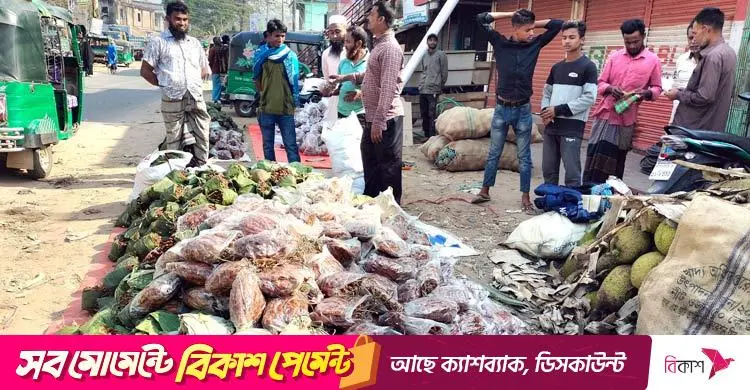
In the hill district of Khagrachhari, known as the land of bananas and jackfruit, tamarind has become another source of income. The sweet-and-sour fruit has found a place in local markets alongside mango, jackfruit, banana, bael, ginger and turmeric. Tamarind that once lay on the ground under the trees is now contributing to the prosperity of the hills.
The very name of tamarind makes mouths water, and few people do not love it. Tamarind pickle made from Khagrachhari's sweet-and-sour fruit is selling widely under various companies' brands.
Weekly markets at Guimara and Matiranga
Tamarind trading is in full swing in Khagrachhari's markets. The fruit is going to Dhaka, Chattogram, Feni, Noakhali, Cumilla, Narsingdi, Mymensingh and other districts, and the markets bustle with traders from Dhaka, Narsingdi, Mymensingh and elsewhere.
This was the scene on a recent visit to Guimara and Matiranga, known as the mother markets for Khagrachhari's bananas, jackfruit and other farm produce. Local and wholesale traders said that locals bring tamarind to market from dawn every Tuesday at Guimara and every Saturday at Matiranga.
By noon the tamarind has passed from local traders to buyers from Dhaka, Chattogram, Narsingdi, Mymensingh and other districts. After purchase it is packed in the market in separate cartons, shelled and unshelled. At least 40–50 tonnes of tamarind are sold every week at Guimara and Matiranga markets.
Tamarind once sold at Tk 20–25 a kg in Khagrachhari's markets, but strong demand in the plains districts has pushed the price to Tk 120 to Tk 130. Because naturally grown tamarind, needing no pesticide or care, is profitable, locals are turning to growing it commercially.
Traders and sellers
Md Nur Nabi of Dhaka, Abul Hossain of Narsingdi and Jamal Uddin of Chattogram have been buying tamarind at Guimara for several years. "Demand for Khagrachhari tamarind has grown steadily in Dhaka, Chattogram and nearby districts, and as demand has risen, the local price has gone up too," they said.
Saying that the country's pickle factories also have strong demand for Khagrachhari tamarind, Md Abul Hossain, a wholesaler from Narsingdi, said: "There is huge demand for hill tamarind in Narsingdi. No pesticide is used on it, so its quality stays good."
Hlapru Marma of Hafchhari in Guimara, happy with the local price, said: "Selling tamarind without any investment or risk has brought financial comfort to my family."
Not only Hlapru Marma: many others, such as Md Abdul Hai of Borpilak in Guimara and Abdur Rahman of Tobolchhari, have turned their household finances around by selling naturally grown tamarind. "Tamarind never makes a loss, so commercial cultivation now looks promising," they said.
They said: "We used to have to sell to local traders and did not get a good price. Now wholesalers come from Dhaka, Chattogram, Narsingdi and other districts, so tamarind fetches a good price and local people are benefiting."
Local seller Sunuipru Marma said: "We used to sit for hours with our tamarind. Not any more. As soon as we reach the market, traders buy it. Along with a good price, the days of waiting for a buyer are over."
Scope for agro-industry
As a nationwide market for Khagrachhari tamarind develops, there is also great potential for tamarind-based agro-industry in the hills. People involved believe that with government support the economic well-being of the hill people would grow faster.
Saying there is no specific variety of tamarind grown in the hills, Matiranga upazila agriculture officer, agriculturist Md Sabuj Ali, said: "Tamarind trees grow naturally. Over time, hill people have come to profit by selling tamarind."
Once a tamarind tree is planted it needs little work, he said: "A big tamarind tree yields several hundred maunds of fruit every year."
Source: Jagonews24. First published in Bengali on The Agro News.
Comments
(0)