
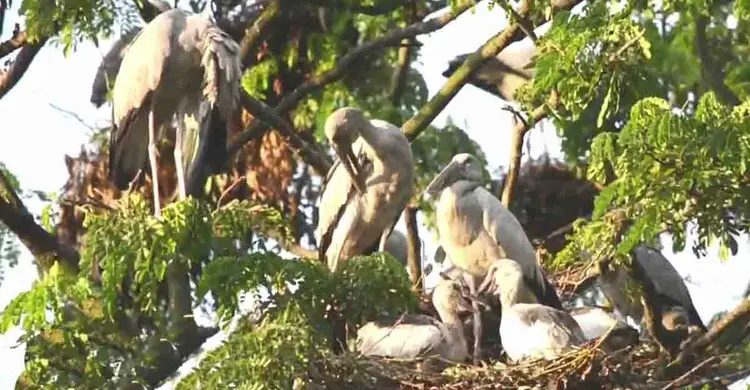
Khagorkuri, a shady village surrounded by greenery, has become known as a bird village. The birds that were once guests are now permanent residents. They began coming eight to 10 years ago. They come and go every year, but this year they have built nests in the trees, laid eggs and raised chicks, and are living there without a care.
The village rings with their chirping morning and evening. The birds go out to feed just after sunrise and come back by afternoon. Visitors come to the village every day to enjoy their calls.
The village, Khagorkuri Dakkhin Para, lies about 5 km north-east of Naogaon town. It is also known as Hatipota. In the zamindari era, an elephant brought to collect rent died there and was buried in the southern part of the village, which is why the area is also called Hatipota ("where the elephant was buried").
A colony in one man's garden
A villager named Akhtar Faruk has a garden with shimul (silk cotton), mango and koroi trees and bamboo clumps. Eight to 10 years ago, various species of birds began coming to his garden and a bird colony grew up there. Among the species that have taken shelter are Asian openbills, white egrets, night herons, cormorants and various kinds of dove.
Feeling safe, they come at a set time each year and leave in winter, though some stay all year round. This year the birds have built nests in the trees, laid eggs and raised chicks, and the village is always full of their calls. The villagers have become bird lovers too. They do not disturb the birds, and everyone in the village takes part in protecting them.
They do not let anyone disturb or hunt the birds, and the villagers have taken various steps to stop bird hunting. As a result, thousands of birds come there throughout the year. At the entrance to the village, the Wildlife Management and Nature Conservation Division has put up a signboard: "Bird colonies are the nation's wealth; protecting them is the responsibility of us all."
What the villagers say
Local housewives Lima and Najma said: "We know them as guest birds. They come in the hot season, and most of them leave in the winter. But unlike every other time, none of the birds has left this time. They have built countless nests in the trees and had chicks. From dawn to morning and from afternoon to evening the place is full of their calls."
They said: "They go out to feed just after sunrise and come back by afternoon. They eat snails and drop the shells, and the ducks below eat those. You could say we wake up to the birds' calls at dawn. At first it was a bit annoying, but now we are used to it."
Mofazzal Hossain said: "We enjoy it now. People also come from different places every day to see the birds. Because the area is close to town, more people come from the town looking for a little peace. We have taken various steps to stop bird hunting."
Source: Jagonews24. First published in Bengali on The Agro News.
Comments
(0)