
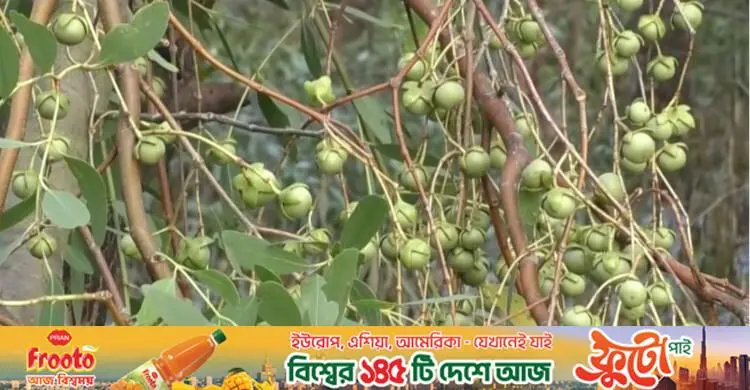
Among countless trees, keora is one of the best known. A plant of mangrove, saline environments, keora is essentially the chief tree of the Sundarbans. It grows most abundantly at the river mouths of the Sundarbans and on the muddy banks of the many canals running through the forest and on chars rich in fresh organic matter. The Sundarbans is also where the keora tree originated; beyond it, the tree has spread to the saline coastal woodlands of the country.
Recently plantations have been raised in saline coastal areas such as Moheshkhali and Chakaria's Badarkhali in Cox's Bazar. Keora trees now grow in the saline coastal forests of three countries, Bangladesh, India and Myanmar, and there is information that they grow in China too. According to various sources, the Chinese government signed a forest conservation agreement with Bangladesh in the 1990s, under which seeds of keora and baen were taken from this country and planted in Chinese forests. Wild species of the keora family with similar fruit are together called mangrove apple in English.
Tree, flower and fruit
Besides keora, another mangrove apple species of the Bangladesh Sundarbans is ora or chhaila. The scientific name of keora is Sonneratia apetala. Keora and ora grow side by side, entwined like friends and rivals. Both produce an edible, tasty sour fruit after flowering. Around the base of the keora tree stand countless upright breathing roots, which help with air exchange. In the right environment the plant grows quickly into a big tree, about 20 metres tall and about 2.5 metres wide. Its green leaves are narrow and long, rather like bay leaves.
In spring the evergreen keora bears small yellow flowers. The flowers are bisexual and look like a woman's jhumka earrings, and their fragrance carries on the breeze. Sundarbans honey is world famous, and keora flowers are a major source of it, so at this time the forest hums with bees. After flowering in Falgun, the fruit slowly forms in Chaitra and Baishakh. Mature keora fruit can be found and eaten through the rains of Asharh and Srabon until the month of Ashwin. The round, fig-shaped greenish fruit is at most 2 to 3 millimetres across, and one fruit holds from 25 to about 125 seeds. Apart from the large seeds inside, the green fleshy outer part is full of sour flavour.
The leaves and fruit of keora are favourite foods of the deer and monkeys of the Sundarbans, and the tree underpins a friendship between the two. Some other animals and birds, and fish such as pangas, also eat the fruit. People in coastal communities near the Sundarbans have long eaten keora raw, and also cooked it into a sour dish with egg-bearing goda prawns and lentils. On a small scale, some housewives make pickles and chutney from it.
What the research found
Professor Dr Sheikh Zulfikar Hossain of the Biotechnology and Genetic Engineering Discipline at Khulna University has carried out valuable research on the wild flowers and fruits of the Sundarbans, funded by grants from the Ministry of Science and Technology and the Khulna University Research Cell. His published findings show that, like tea, the fruit contains beneficial catechins and a large amount of various polyphenols.
Among fruits found in this country, amla has the most polyphenols, followed by keora. Keora has far more polyphenols and nutrients than the same amount of apple or orange. Polyphenols help prevent diabetes, cancer, arthritis, heart disease, allergies, cataracts and various inflammations. Full of vitamin C and its derivatives, keora is a richer source of potassium, iron, calcium, phosphorus, magnesium and zinc than amla, apple and orange.
The fruit is rich in polyphenols, flavonoids, anthocyanins, antioxidants and unsaturated omega fatty acids, especially linoleic acid, which is why it keeps body and mind fresh and helps prevent various diseases. Each fruit contains about 12 per cent carbohydrate, 4 per cent protein and 1.5 per cent fat. It has anti-diarrhoeal, anti-diabetic and pain-relieving properties, and can effectively suppress the bacteria responsible for diarrhoea, dysentery and stomach ailments.
Keora fruit also contains plenty of palmitic acid, ascorbyl palmitate and stearic acid, substances that are now imported for food processing and preserving prepared food. Because of this wealth of qualities, Professor Sheikh Zulfikar Hossain believes that if the fruit were widely grown on uncultivated saline land in coastal areas, it would create a source of income, protect public health and improve the environment of those regions.
Sale banned, but sold in coastal markets
Because keora is a Sundarbans tree, the sale of its fruit, like its wood, is banned under Bangladesh's forest law. Spreading its benefits across the country would therefore need a major initiative at state level, along with research, analysis and awareness so that the Sundarbans is not plundered. Keora has also been seen to thrive in freshwater settings as well as saline mud, needing only a little more care.
Although the legal ban remains, some keora fruit is usually sold in coastal markets in season at Tk 30–50 a kg. Most of this fruit comes from local keora plantations rather than the Sundarbans. The writer calls for keora plantations to be raised from the coast to the whole country, to transform the environment and quality of life.
Source: Jagonews24. First published in Bengali on The Agro News.
Comments
(0)