
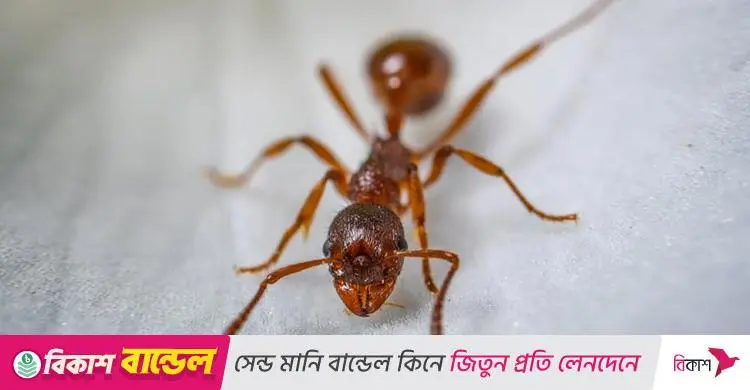
Around the world, dishonest traders and criminal gangs smuggle everything from people to goods and animals. Now not even ants are safe from them: people have started smuggling these tiny creatures packed in tubes in the hope of making money, and environmentalists have voiced concern.
The case took place in Kenya, whose forests are already notorious for the smuggling of wildlife. Early this month officials of the Kenya Wildlife Service (KWS) were carrying out their daily duties when they arrested two young Belgians smuggling 5,000 ants.
Ants packed in tubes and syringes
According to a report in Britain's The Guardian, the operation was the biggest ever to stop the smuggling of the smallest creatures, because the animals seized were ants 18 to 25 millimetres long.
KWS officials said the two young men were carrying the ants in a covered van to be smuggled to markets in Asia and Europe. The ants were kept in syringes and tubes filled with cotton wool, an environment in which, officials said, ants can survive for several days.
One of the young men, Lorni David, said: "We did not do this to break any law. We did it by accident, out of foolishness."
David and his associate Seppe Lodewijks are both 19 and have been detained on charges of smuggling ants. Earlier, Kenyan forest officials had arrested two other men on the same charge with 400 ants. On 23 April, after reviewing the charges brought against them, the court ordered them held in custody.
A shift in wildlife trafficking
A KWS statement said these ant-smuggling cases point to a change in animal trafficking in recent times, away from large mammals towards smaller, less visible creatures.
Kenyan forest officials also believe the trade is linked to an unusual hobby that has grown over several decades, with more people keeping and collecting ants.
According to the KWS statement, the ants seized included the large red African ant Messor cephalotes, known for harvesting seeds. Queens of this species grow 20 to 24 millimetres long.
According to Ant R Us, a website that sells ants, these ants have some unique behavioural traits and are very skilled at building colonies, which makes them many people's "dream species". KWS believes these traits have raised demand for them abroad.
An ant seller who did not want to be named said the ant market is growing steadily, with sales and prices rising every year. In a technology-driven world, many people like to keep ants for a touch of nature.
Threat to biodiversity
Experts, however, believe such activity could put biodiversity at risk. They say that if ants are kept in controlled environments outside their natural habitat, they may become invasive, with dire consequences for both the environment and the economy. KWS believes that removing ants from their natural environment will harm the environment.
Kenyan biologist Dino Martin said the harvester ants of the African savannah are the ones most smuggled, and this will harm natural ecosystems.
"Harvester ants collect crop seeds as their food," he said. "Several kilograms of seed can be found in a single colony. As the ants carry seeds back to the colony, some fall on the ground, and other animals eat them too."
"It surprises me that smugglers have now turned their attention to Kenya's ants," Martin said.
He advised that anyone wanting to market such insects should do so in a planned way, which he believes would improve the local economy. The insects can be produced and sold in controlled environments, he said, citing Kenya's Kepepo project as an example.
Philip Murothi, vice-president of an African wildlife conservation organisation, said ants are vital to nature: they enrich the soil, help crop production and provide food for other animals.
"Everyone likes to see a beautiful forest, but few think about how it came to be," he said. "Behind it lies the interrelationship of everything from small organisms like ants or bacteria to huge animals."
Source: Jagonews24. First published in Bengali on The Agro News.

Comments
(0)