
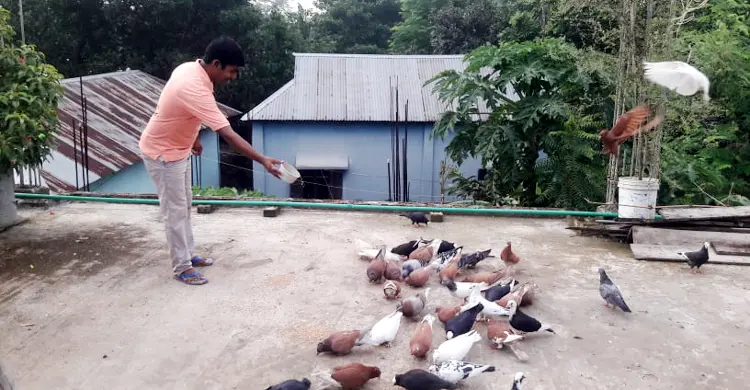
Md Biplob Hossain lives in Panjora village in Nagari union of Kaliganj upazila, in a two-storey house beside the Asian Highway. Everyone in the area calls him Biplob Master. He teaches at St Nicholas High School, one of the upazila's oldest schools.
Some 21 years ago, Biplob started keeping pigeons purely as a hobby, when he was a class eight pupil. He now teaches at the school where he studied. Saving from the tiffin money his parents gave him, he bought just four pairs of pigeons from the local market. Their numbers slowly grew, but one night a civet ate his beloved pigeons and the teenage Biplob's dream was shattered.
As a student he had no spare money, so the hobby came to a sudden stop. But Biplob is not one to give up easily. After a break of several years, in 2018, having built his own house, he set up his present pigeon farm with six pairs under a corrugated-iron shelter on the roof. Now about 100 pairs of pigeons grace his shed. The hobby now brings in income and also goes a long way to meeting his family's nutritional needs.
A rooftop loft
A visit to his home in Panjora found a pigeon house built on two sides of the roof from wood and corrugated iron, with around a hundred nesting boxes inside. The larger foreign pigeons have separate iron cages, with feed and clean water below.
The pigeons eat as they please and fly back to their own compartments. Some sit on eggs, some feed their chicks, some squabble with their neighbours and some splash about in groups.
An ordinary pigeon may produce 13 pairs of young in 12 months, but improved breeds usually manage no more than three pairs a year. Using his long experience, however, Biplob pairs one pair of an improved breed with five pairs of foster pigeons and swaps the eggs at a set time, producing at least eight to ten pairs of improved-breed squabs a year.
Biplob invested only Tk 34,000 when he began, but the capital in his hobby farm now stands at about Tk 5 lakh. Spending about Tk 6,000 to 7,000 a month on 100 pairs of pigeons, he earns a net monthly profit of at least Tk 1.5 lakh. The cheapest pair on the farm costs Tk 2,000, while various improved breeds there are worth Tk 7,000 to 8,000 a pair. In feeding, treating, protecting and housing his pigeons, he relies mainly on his long experience.
Housing and feed
Drawing on his experience, Biplob says pigeon housing needs a temperature-controlled shed on a roof or in an open space. Small pigeons should be kept in iron cages two and a half feet square and large ones in cages three and a half feet square, with regular water and feed and regular cleaning of the shed.
He makes a balanced feed from equal parts of 11 grains, including white mustard, wheat, broken maize, safflower seed, lentils, grass pea, mung bean, black gram, "reinkol" and chickpea. In winter, to protect the birds from cold-related illness, he leaves the reinkol, chickpea and black gram out of the mix. He says this balanced feed keeps the pigeons healthy and helps them lay and hatch regularly.
He said he had dreamed of keeping pigeons since childhood and loved watching them fly, so he built the farm as a hobby. The farm has about 10 breeds of pigeon, and the number of birds has passed 200. He has collected them from various districts of the country.
At times he has grown his collection by exchange, swapping one breed for another. A pair of King pigeons on his farm is currently worth Tk 8,000 on the market and a pair of Mukkhi pigeons Tk 3,000, though he says prices are set by a pigeon's flying ability.
But his farm is not a commercial one, and he does not expect to earn from it; it is purely a hobby. In his view, anyone who wished could run such a pigeon farm commercially and earn Tk 30,000 to 40,000 a month.
Treatment and advice
He said his pigeons rarely fall ill. Even so, he claims to have had good results treating colds, coughs, dysentery and worms with one-eighth of the dose of medicines made for people, and other illnesses with a quarter of the dose of poultry medicines.
With help from the Kaliganj Upazila Livestock Office in treating his birds, he has been able to overcome various difficulties and keep pigeons alongside his teaching.
With pigeons and advice from Biplob, local people Tamzim Khan, Taskin Khan, Sajal and Sohel now keep pigeons as a hobby too. Their homes are now graced with about 10 breeds in various colours, including King, Mukkhi, Bumbe, Giribaj, Giarchholi, Musaldom and Golla.
Now and then he lets all the pigeons out of their boxes to fly. When 200 pigeons take to the sky together, some of them tumbling, he finds the joy and reward of keeping them, and the sight fills his heart. Every day he gets up at 5.30am to tend the birds and works without a break until 9am.
His wife, Silvia Hossain Sumi, and their only son, three-and-a-half-year-old Md Sayad Hossain Chhoyad, help him in many ways. He says he could not manage such a farm alone without the two of them.
His wife said Biplob raises the pigeons like his own children; the farm is his passion, and he spends all his spare time on it and on the rooftop garden. He has kept pigeons since childhood and was often scolded by family members for it. But he never gave up his hobby, and today he has a pigeon farm at home which now brings in good money as well as meeting the family's nutritional needs. Everyone at home now helps him.
Beside the loft are stacked wheat, maize, paddy, wheat and maize husks, mustard, eggshells, brick dust, lime and other feeds. The pigeons also love green vegetables, so Biplob grows various plants and vegetables on the roof beside the farm, and the birds fly over to eat the leaves. Although his pigeons seldom fall ill, he takes advice from the local livestock doctor.
Interestingly, he does not sell pigeons; now and then he gives them free to close acquaintances who ask. He does sell squabs, and the hobby also meets the nutritional needs of his own family and relatives. He advises unemployed local young people to take up pigeon rearing and become entrepreneurs.
He believes pigeon rearing is very profitable, and that with time, effort and proper care one can get on one's feet quickly. He thinks the unemployment of thousands of young people could be ended by coordinating marketing among farmers and encouraging them to raise improved breeds through public or private investment.
Upazila livestock officer Dr Md Kamruzzaman said pigeons are most often affected by Ranikhet (Newcastle disease) and pox, and the livestock office has enough vaccine for these. Pigeons also get pigeon malaria, for which the medicine used to treat people works on pigeons too.
He added that farmers often come to the livestock office only after their ducks, chickens or pigeons fall ill. But as a rule these birds must be vaccinated every three to four months, so farmers should contact the livestock office before their birds are affected.
Source: Jagonews24. First published in Bengali on The Agro News.

Comments
(0)