
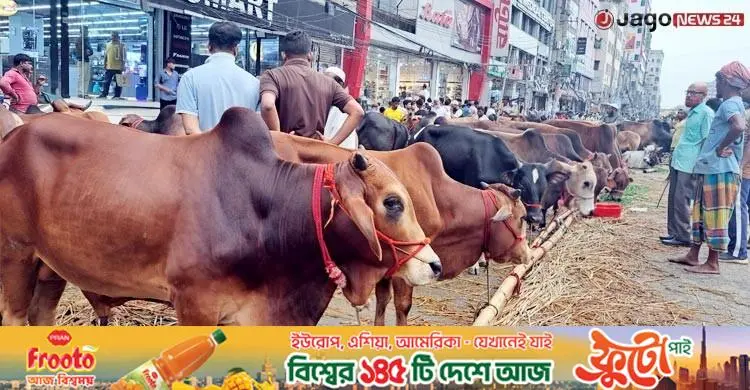
Rabiul Islam is a seasonal cattle trader from Jamalpur. He brought 22 cattle to the sacrificial animal market at Kachukhet in Dhaka and has been there for several days with three business partners. Every year before Eid-ul-Azha they buy cattle from villages, farms and local markets in Jamalpur and bring them to Dhaka, aiming for a quick profit. This year they came with the same hope, but the situation is entirely different.
Rabiul looks worried. By the previous day only seven cattle had sold, and not at the prices he expected. A wide gap between his prices and what buyers are offering has left them anxious.
"People come, ask the price and leave. At the prices buyers are offering, we will not even recover our costs," Rabiul Islam told Jagonews.
He said feed, transport and labour costs had risen sharply this year, and bringing cattle to Dhaka by truck alone had cost far more than before. "We do not want an abnormal profit. A small profit after costs will do. But buyers want to buy at last year's prices," he said.
Buyers say budgets fall short
The frustration is not only the sellers'. Buyers speak of a different kind of crisis.
Mominul Haque, an officer at a private bank in the capital, came to Kachukhet with a budget of Tk 1 lakh to buy a cow for his family. After several hours he had found none that suited both his taste and his budget. "I thought I would get a good cow for Tk 1 lakh. But the ones I like are priced at Tk 1.3 or 1.4 lakh," he said.
In Mominul Haque's view, the sacrifice budget has become hard for middle-class families to manage this year. Prices of goods have been high all year and other expenses have risen too. These calculations have opened a wide gap between buyers and sellers, so sales at the market are not moving at the expected pace.
Farmers and traders fear losses because of higher fodder prices and transport costs, while buyers say animals are still beyond their means. So despite more bargaining, sales are not picking up.
Around the market, long bargaining sessions were seen ending without agreement. One buyer haggled for about 20 minutes over a medium-sized cow; when the trader agreed to cut only Tk 5,000, the buyer walked off angry. Such scenes were common.
Ashraful Alam, a resident of Kazipara, said: "Prices may rise somewhat because fodder and other costs have gone up. But traders are asking far too much. Sales cannot happen like this."
Some bought after bargaining but with regret. "Although the price was somewhat high, I had to buy. After long haggling I finally bought a cow for Tk 1.7 lakh. As it is a one-off expense, I had to buy even at an unreasonable price," said Tarikul Islam of Shewrapara.
Traders say they cannot go lower
Cattle farmers and traders say they have no room to go lower either.
Jabbar Hossain, a farmer from Kushtia, said: "Feed prices, medicine prices, transport, everything has gone up. People think we make a lot of profit, but the reality is different. If we sell at buyers' prices we will lose a lot, and in future we will not raise cattle any more."
Mohammad Taleb Matbar, an assistant to the market leaseholder who helps collect the hasil (market fee), said the effects of inflation and economic pressure were showing most at the cattle market: traders are asking more because of higher costs, while buyers on limited budgets are looking for cheaper animals. He said that although Kachukhet was crowded, sales were not as expected.
On the other side of the market, Lablu Mia, a trader from Sirajganj, voiced the same frustration. "Many traders bought cattle on credit. If the cattle do not sell today or tomorrow, we will be in trouble. Keeping cattle in Dhaka every day means extra cost," he said.
Sellers, however, hope sales will pick up over the next two days and that they will get the prices they want.
Source: Jagonews24. First published in Bengali on The Agro News.

Comments
(0)