
John Deere has bought Orchard AI, a San Francisco start-up whose tractor-mounted AI cameras count the fruit on every tree in an orchard or vineyard and estimate the harvest before it happens. The American farm machinery maker announced the purchase of Orchard Robotics, which trades as Orchard AI, from its headquarters in Moline, Illinois, on 19 November 2026, and did not disclose the price.
For growers of apples, grapes, cherries, almonds and other high-value crops, the deal joins a system that sees each plant to the company that builds the sprayers, tractors and in-cab displays that act on what is seen. Deere says the combination will let a grower spot, for example, the parts of an orchard with heavy bloom and receive a prescription for where to spray, delivered to a phone in the field or to the tractor's screen.
The purchase also continues a nine-year buying run in which Deere has bought computer vision, autonomy and robotics companies. And it raises questions that go well beyond California's fruit belt: how accurate camera-based yield estimates really are, who controls the data, and whether plant-by-plant intelligence can reach smaller growers in Asia and Africa.
What Orchard AI's cameras measure in orchards and vineyards
Orchard AI was founded in 2022 by Charlie Wu, a computer science student who left Cornell University to become a Thiel Fellow. TechCrunch reported in September 2025 that Wu's grandparents were apple farmers in China, and that his conversations with Cornell's fruit researchers convinced him that even large American farms had little real view of their crops. Most still estimated yields by sampling a small share of trees by hand.
The company's answer is a camera unit about the size of a large tissue box, weighing about five pounds according to AgFunderNews, that bolts onto a tractor, an all-terrain vehicle or any other farm vehicle. As the vehicle drives the rows at between one and twelve miles an hour, the cameras photograph every tree, vine or plant. Deere's announcement says the system analyses hundreds of images per tree on every pass, producing yield estimates, fruit counts, fruit size and colour, canopy measurements and more.
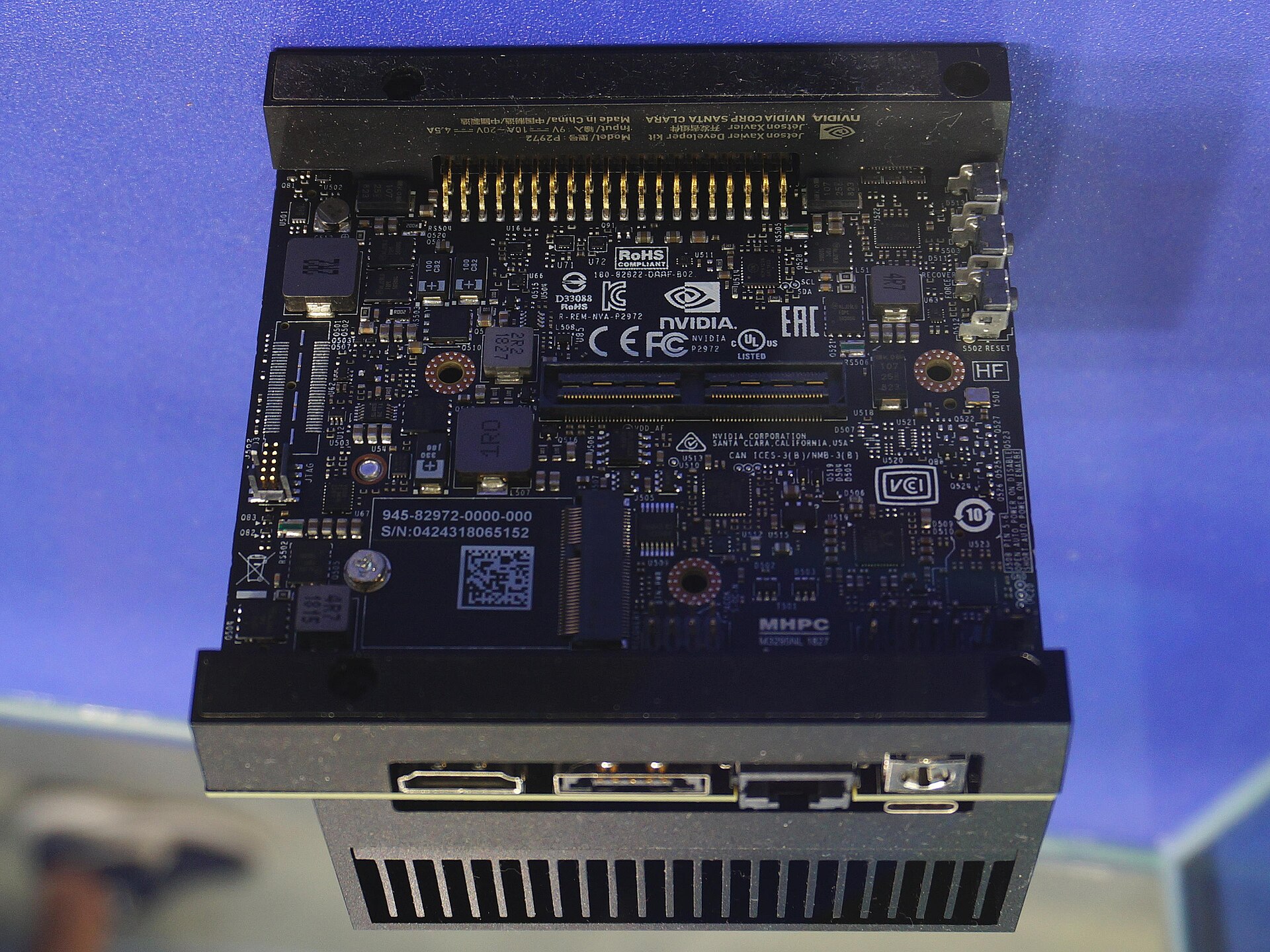
Wu told AgFunderNews that the images are processed on board, on an NVIDIA Jetson computer, because many farms lack the connectivity to upload terabytes of raw imagery. The results flow into Orchard's FruitScope software, where a grower can inspect conditions down to an individual tree. The company's website says results are ready the morning after a scan.
Orchard started in apples and has since moved into wine and table grapes, cherries, blueberries, almonds, pistachios and citrus, according to its website and AgFunderNews, which reported that it is now exploring olives and stone fruit. Wu said the company has "hundreds of systems in the field" and scans tens of thousands of acres. Most customers are in the United States.
In September 2025 Orchard raised a 22 million dollar Series A round led by Quiet Capital and Shine Capital, with General Catalyst and Contrary returning as investors, TechCrunch reported at the time. The company sells its service as a single per-acre annual subscription that includes the camera hardware, rather than selling the cameras outright.
Deere's string of AI and robotics purchases since Blue River
Deere has been buying farm technology companies for nearly a decade. In September 2017 it agreed to buy Blue River Technology, the Sunnyvale developer of the computer-vision See & Spray system, for 305 million dollars. In August 2021 it signed an agreement to buy Bear Flag Robotics, which built autonomous driving kits for existing tractors, for 250 million dollars. In July 2023 it bought Smart Apply, an Indianapolis maker of precision spraying equipment.
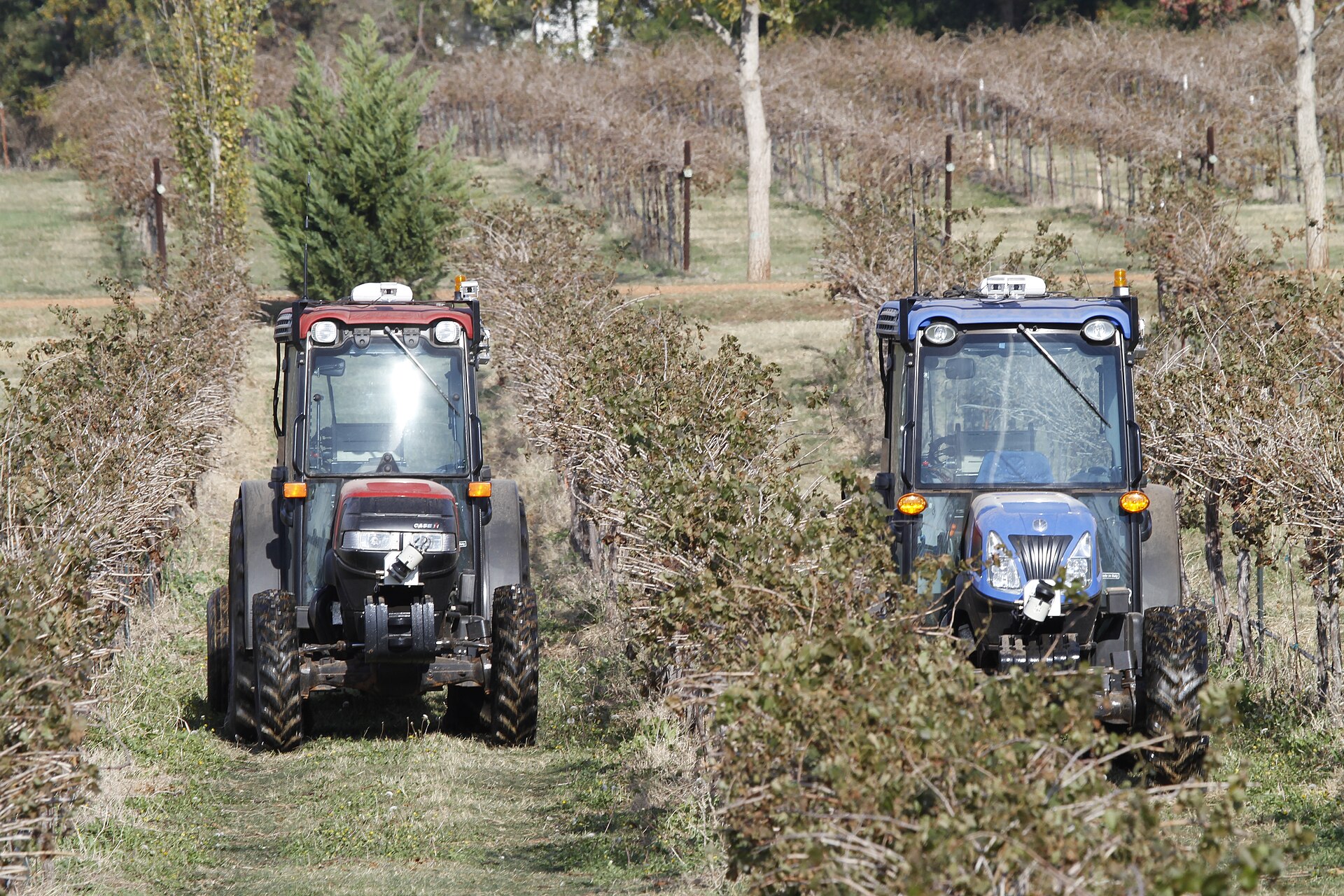
The pace picked up in 2025. In May, Deere announced the purchase of Sentera, a St. Paul, Minnesota, company whose drone cameras and software produce weed maps and crop scouting data. In August it took full ownership of GUSS Automation, a Kingsburg, California, maker of autonomous orchard and vineyard sprayers that one operator can supervise from a laptop, with which it had run a joint venture since 2022.
Seen against that list, the logic of the Orchard deal is easy to read. GUSS and Smart Apply give Deere machines that spray permanent crops; Orchard gives it eyes on each tree. Shane Thomas, an agronomist and analyst at Upstream Ag Insights, told AgFunderNews that Orchard gives Deere "the plant-by-plant crop vision in orchards and vineyards that Blue River and See & Spray gave it in row crops", so that the company "can now see, decide and execute in permanent crops." Thomas also guessed that the sale price ran to nine figures; that is his speculation, and neither company has said what Deere paid.
Jorge Heraud, who sold Blue River to Deere in 2017 and went on to become Deere's vice president of automation and autonomy, told AgFunderNews the deal was "further validation that large companies in agriculture are finding that actionable data is very valuable to farmers."
Deere is not alone. In September 2024 Kubota's North American arm bought Bloomfield Robotics, a Pittsburgh company that also uses cameras and AI to assess specialty crops plant by plant.
From a blossom map to a variable-rate spray: how Deere says it will use the data
"This acquisition connects crop-level intelligence with John Deere technology and equipment that can precisely execute the work in the field," said Tim Marquis, Deere's director of farm systems innovation, in the announcement. "By bringing these capabilities together, we have an opportunity to help growers make more informed decisions across their operations and get more value from the technology they already rely on."
The clearest example both companies give is bloom thinning in apples. Growers apply chemical thinners to remove excess blossoms. Thin too little and the tree produces many small apples that fail market standards; thin too much and yield and revenue fall, AgFunderNews explained.
Marquis told AgFunderNews that Orchard's cameras can see the blossoms as they bud, categorise them and build a variable-rate map that is passed directly to the machine, so that the sprayer applies more thinner where bloom is heavy and less where it is light. Deere's announcement says the recommendations can be sent to a mobile device for in-field application or into the in-cab G5 display on its tractors. The companies envisage connecting FruitScope with the John Deere Operations Center, the company's farm data platform, and with its variable-rate application controllers.
Deere's announcement says a missed spray or mistimed harvest can affect fruit quality, yield and a season's profit, and that plant-level data is meant to inform pruning, thinning, targeted treatments and the choice of which blocks are ready to pick.
"Your average grower does not want to be, nor should they be, a data analyst," Wu told AgFunderNews. He said the biggest return comes from cutting labour and inputs, with yield forecasts also helping growers plan how many pickers to hire, how many bins to buy and what to promise buyers.
Orchard says it will carry on under its own name. "Orchard will be the same team you've always known," Wu said, according to AgFunderNews, which also reported that the company will operate as a Deere subsidiary with its existing team and products. Justin Rose, president of Deere's worldwide agriculture and turf division for small agriculture and turf, said in the announcement that Deere wanted to preserve Orchard's "speed of innovation and the close relationships it has built directly with customers."
What the accuracy claims rest on, and what research says about fruit-counting AI
Orchard's website claims yield and size estimates that are more than 95 per cent accurate, and Wu repeated the figure to AgFunderNews. The site also carries customer results: a Pacific Northwest farm that reports a 63 per cent cut in input costs from compost applied precisely with the help of its data, a fruit grower estimating chemical savings of 33 to 50 per cent on a bloom-thinning pass, and a wine grape grower that cut scouting for grapevine red blotch disease from eight days to a few hours. Tyler Klick of Redwood Empire Vineyard Management, quoted in Deere's announcement, said he had been "very impressed with the insights the scans are providing us from a precision farming standpoint."
These figures come from the company and its customers. No independent, published trial of Orchard's system was found for this report, and the website does not say how the accuracy was measured, over how many farms or seasons, or against what.
That matters because counting fruit with cameras is a hard problem. A 2021 review in Frontiers in Plant Science by P. Maheswari and colleagues, which surveyed deep-learning methods for estimating orchard yields, named occlusion, where leaves and other fruit hide part of the crop, overlapping fruit and changing light as the persistent difficulties. It noted that models trained on one set of images can generalise poorly to different conditions, that small training datasets lead to overfitting, and that labelling images for training is slow and tedious.
Orchard's answer is volume: its website describes a 100 per cent sample of every acre rather than a hand-counted subset, and one large apple operation quoted there says the estimates matched its harvest packouts. But until results are published or tested by a third party, buyers have to rely on their own trials, which is why the company offers growers a free scan of two blocks.
Why fruit and vine growers are the next frontier for farm AI
Deere's earlier vision work, Blue River's See & Spray, was built for row crops such as maize and soybeans. Orchards and vineyards are different: every tree is a long-term asset, and jobs such as thinning and scouting still rely heavily on people. AgFunderNews noted that more precise chemical thinning could reduce the manual thinning in which workers pull off excess fruitlets by hand. Deere's announcement points to the pressures growers face: weather, labour constraints and changing crop conditions that leave little time to work out what each block needs.
Wu put the market for fruit and vegetable data at 1.5 billion dollars in his 2025 interview with TechCrunch; that is his own estimate. TechCrunch named Bloomfield, now owned by Kubota, and the younger start-ups Vivid Robotics and Green Atlas as competitors at the time.
For a grower who already runs Deere tractors and the Operations Center, the integration may save time. For one who runs a mix of brands, the question is how open the platform stays. When Deere bought Sentera in 2025 its announcement said the Operations Center would continue to be open to other drone imagery providers; the Orchard announcement makes no similar statement about FruitScope.
Control over Deere's machines has also drawn regulators. On 8 July 2026 the US Federal Trade Commission, joined by Illinois, Arizona, Michigan, Minnesota and Wisconsin, settled its right-to-repair case against Deere. The FTC said the order, which runs for 10 years, requires Deere to give farmers and independent repair providers repair resources equivalent to those it gives its own dealers. That settlement covers repair tools, not crop data, but it shows that regulators are watching how Deere controls access to its technology.
What crop scanning could mean for fruit growers in India, Bangladesh and beyond
The deal is American, but the problem it addresses is global. Wu told AgFunderNews that Orchard sees "some pretty tremendous pull internationally" and plans to push further into Latin America and Australia with Deere's resources. In the announcement he said the aim is "to bring the benefits of AI-powered crop intelligence to every grower across the globe."
Fruit is also a large and growing business far from the orchards Orchard serves today. India's agriculture minister, Shivraj Singh Chouhan, released third advance estimates on 17 November 2026 that put the country's 2025-26 fruit output at more than 123 million tonnes, up 4.6 per cent on the year, within total horticulture production of about 387 million tonnes, according to All India Radio. The same estimates showed the area under horticulture falling, from 30.14 million hectares to 29.72 million, even as output rose. Growing more on less land is exactly the kind of intensification that plant-level data is meant to support.
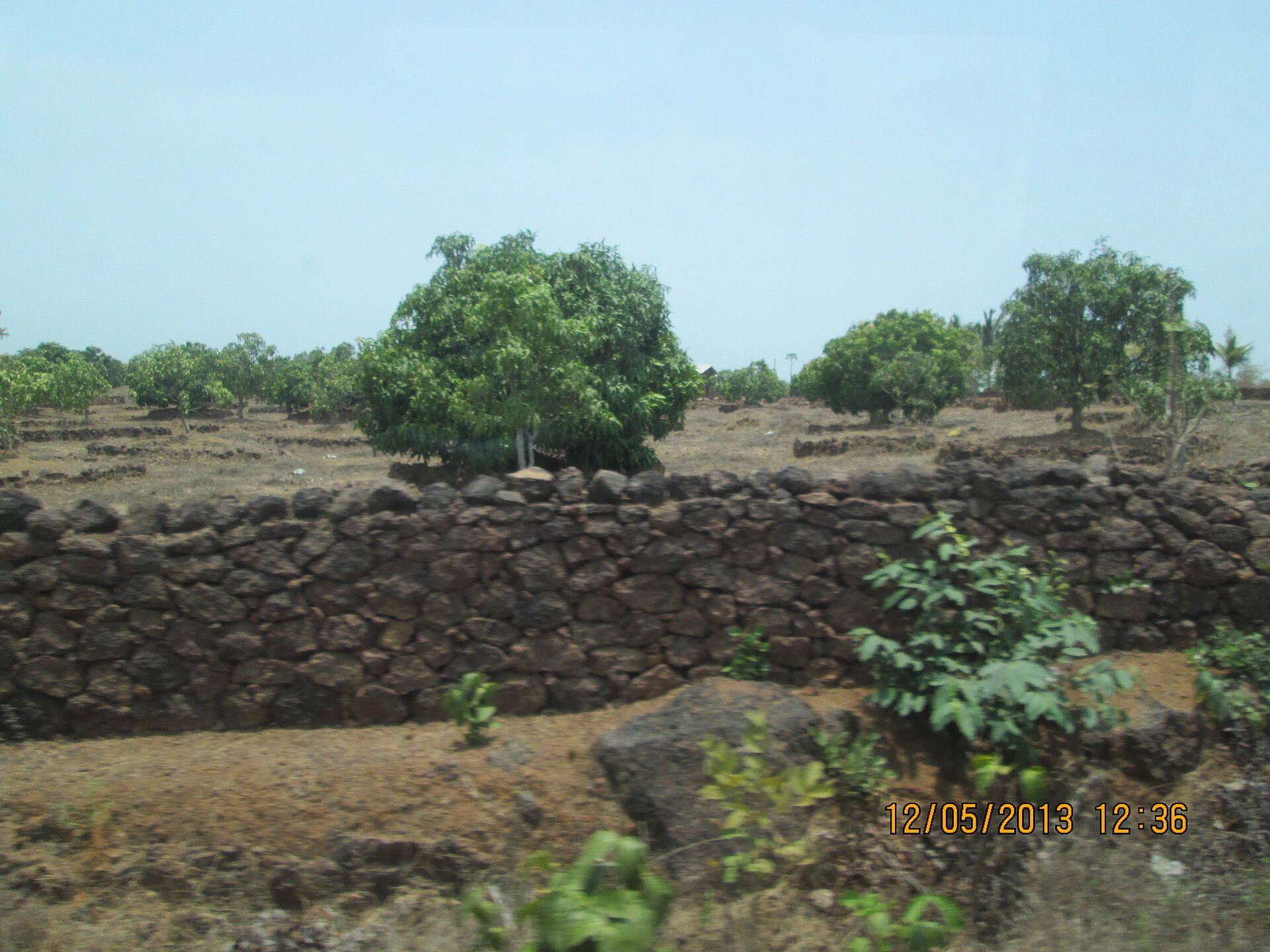
In Bangladesh, data from the Department of Agricultural Extension reported by The Daily Star in February 2026 show fruit production rising from 10.3 million tonnes in 2008-09 to 15.1 million tonnes in 2024-25, while the land under fruit shrank from 935,000 hectares to 779,000. The Financial Express reported in December 2025 that the extension department regards post-harvest losses as a critical bottleneck.
Better forecasts could help with exactly those losses. The UN Food and Agriculture Organization estimated in its State of Food and Agriculture 2019 report, and repeated in 2021, that around 14 per cent of the world's food is lost after harvest and before it reaches retail, on farms, in storage and in transport. A grower or exporter who knows weeks ahead how much fruit is coming, and of what size, can book labour, crates, cold storage and buyers accordingly.
The tools now being bought by Deere and Kubota are built for a different scale. Orchard's website describes hardware that scales from 100 acres to more than 10,000, mounted on tractors and all-terrain vehicles. The company has published no results from small, irregularly planted orchards tended without machines. For such growers, plant-level data may arrive, if at all, through a smartphone camera, a drone service or a government extension programme rather than a camera on a tractor.
Costs, connectivity and other barriers to adoption
Orchard does not publish its prices, and Deere has not said whether the subscription model will change. The value of plant-level data also depends on a grower being able to act on it, with a variable-rate sprayer or with crews sent to specific trees.
Connectivity is the second barrier. By processing images on the vehicle rather than in the cloud, Orchard sidesteps the lack of mobile data in many rural areas, an approach that could suit developing regions. But the models still have to be trained for each crop, variety and growing system.
Data ownership is the third. The more a grower's tree-by-tree records live in one company's platform, the harder it may become to switch suppliers. The announcement says nothing about data portability.
What to watch: Deere's 25 November results and Orchard's international plans
Deere holds its fourth-quarter 2026 earnings call on 25 November, when analysts may ask about the price and how Orchard will be sold through dealers. The first field test of the combined system is likely to come with next spring's bloom in the Northern Hemisphere; that is an expectation, not an announced date.
Why the plant-level farm matters beyond one acquisition
Deere spent most of the past decade teaching machines to see weeds in row crops. With Orchard, it is betting that the same approach can work in orchards and vineyards, where each tree is counted and treated as an individual. If the accuracy claims hold up under independent scrutiny, growers could spray less, plan harvests better and waste less fruit. For fruit growers who farm small plots without tractors, the real question is whether this kind of intelligence will one day arrive in a form and at a price they can use.
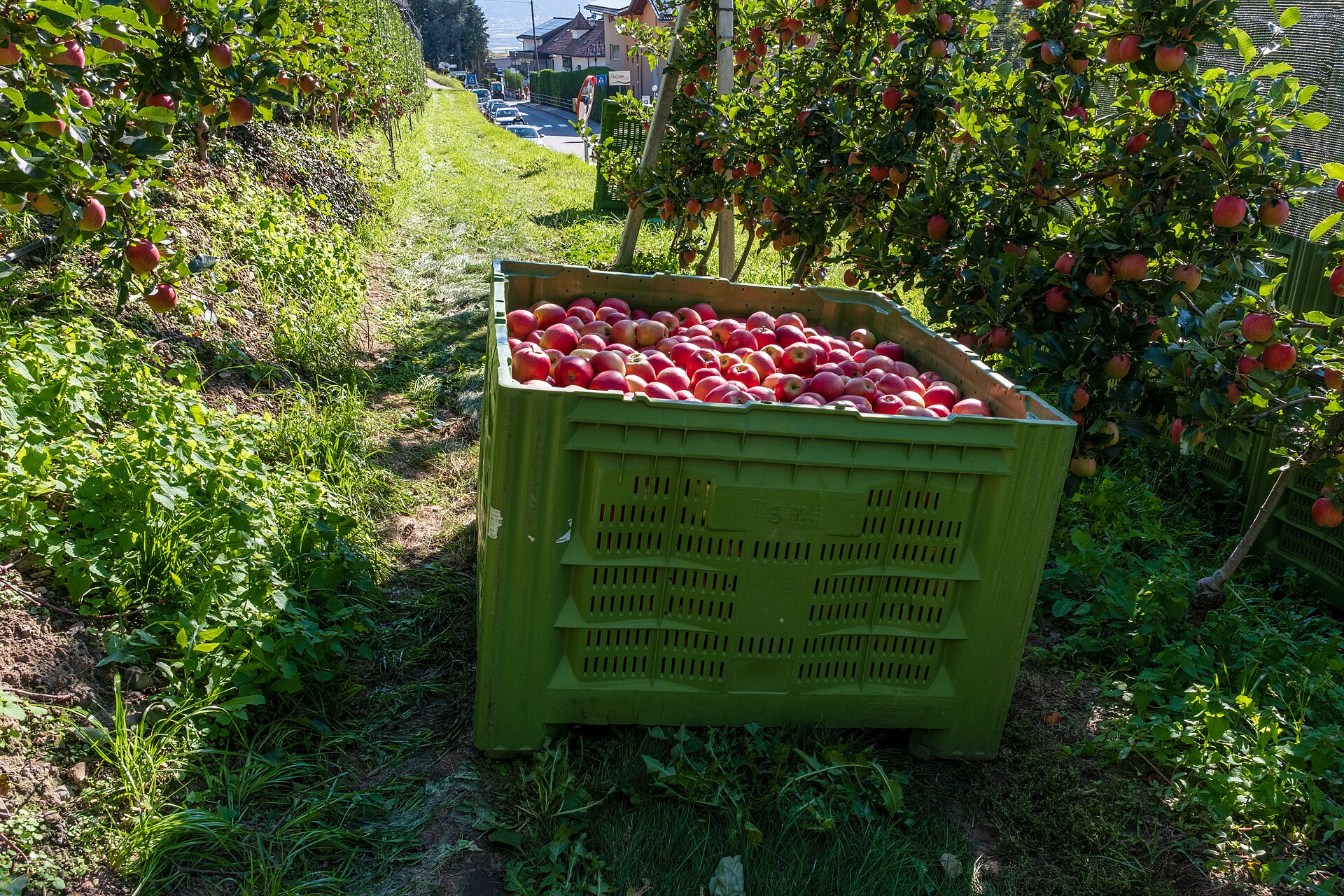
Photo: Dietmar Rabich / Wikimedia Commons (CC BY-SA 4.0). The top picture shows a bin of freshly picked apples between rows of a densely planted orchard near Schenna in South Tyrol, Italy, on 23 September 2026, as background.
Comments
(0)