
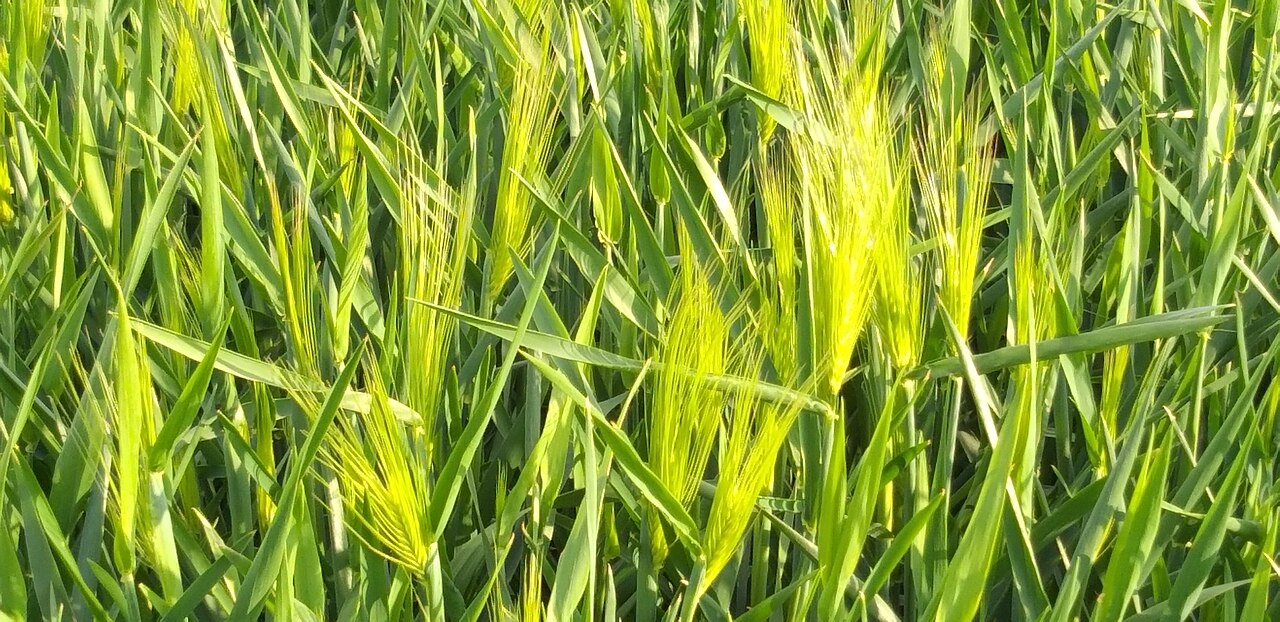
Researchers at the Chinese Academy of Agricultural Sciences (CAAS) and Germany's Leibniz Institute of Plant Genetics and Crop Plant Research (IPK Gatersleben) have identified a combination of two genes that lets barley mature early enough for two harvests a year from the same field, without the yield penalty that usually comes with faster-flowering varieties. The work was published in the journal Nature on 5 November.
Double cropping is one of the main ways farmers in parts of China raise output from their land, but each crop has to mature in time to leave room for the next planting. Breeders have long found that pushing flowering earlier cuts yield, because the plant has less time to build grain.
The team, led by Dr Ping Yang of CAAS's Institute of Crop Science with first author G. Gao and IPK co-authors Dr Martin Mascher and Dr Nils Stein, found a single amino acid change in PHYTOCHROME C (PhyC), a gene that helps the plant sense day length. On its own, the change brought faster flowering, smaller plants and lower yield. Paired with the winter form of VERNALIZATION 1 (VRN1), the gene that sets a plant's need for a cold spell before flowering, the barley matured earlier and still gave a full yield in field trials. With the spring form of VRN1, the yield loss returned.
To prove that PhyC itself was responsible, the researchers used base editing, a genome-editing method that rewrites a single DNA letter without cutting the double helix, and reproduced the early, full-yield plants in a controlled genetic background.
Looking back over about 80 years of breeding, the team examined 505 Chinese barley varieties and 27 reference lines and found the early-PhyC and winter-VRN1 pairing in more than 60% of modern Chinese autumn-sown varieties released since the 1990s. Breeders had been selecting for it for decades without knowing why it worked.
In rice, a short-day plant, the same PhyC change delayed flowering instead; early results in wheat point to a pattern like barley's but are described as preliminary. For breeders, the finding turns a trait picked blindly into a genetic marker that can be tested early, rather than waiting on years of field trials.
Photo: Melsj / Wikimedia Commons (CC BY-SA 4.0)
Source: Global Agriculture

Comments
(0)