
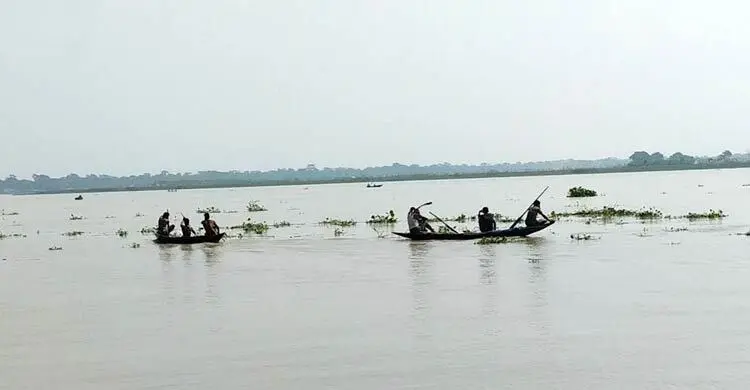
Despite the government ban, seasonal fishers are freely catching mother hilsa on the Sugandha and Bishkhali rivers in Jhalakathi, slipping past the eyes of the enforcement teams. This has raised concern over whether the purpose of the fishing ban will be achieved.
As every year, the government has imposed a 22-day ban on catching, selling and transporting hilsa to boost production. The ban began on 13 October and runs until 3 November. The government allocates rice to fishers for the ban period. Even so, many are defying it and fishing on the Sugandha and Bishkhali rivers in Nalchhiti upazila of Jhalakathi.
Fishing under the protection of influential people
On a visit, mother hilsa were being caught freely during the ban at Bhabanipur, Chandpura, Hadua launch ghat, Puran Hadua bazar, Nalbunia, Islampur and Tentulbaria launch ghat on the Bishkhali, and at the Magar Jangalia brickfield, Anurag, Dapdapia and Matibhanga areas on the Sugandha. Fishers are working under the shelter of some local political party leaders and activists and influential fish traders. Large numbers of small fishing dinghies are roaming the river.
Several traders at Bhabanipur bazar, speaking on condition of anonymity, said that from the day after the ban began, some influential people from Bhabanipur, Chandpura and Nachanmahal have come to the riverbank at the end of the bazar after 10pm, made deals with fishers and sent them out to catch mother hilsa. They sit on the bank keeping watch. The enforcement patrol team is never seen near Bhabanipur.
A number of workers employed at companies in Dhaka and elsewhere have come home and joined in killing mother hilsa. Previously a net cast in the river would bring up two or four hilsa, but now if a net is cast at a particular spot on the river, egg-laden hilsa come up along with plenty of jatka (juvenile hilsa). Fishers unload the fish from their boats and hide them in bushes and water hyacinth along the bank. Buyers from far away come on motorcycles and bicycles and carry off bagfuls cheaply.
Card-holding fishers, rented boats and paid lookouts
Locals said that if a card-holding fisher is caught catching mother hilsa during the ban, his "fisher card" will be cancelled and he will face punishment. Because of this warning from the administration, many card-holding fishers do not go on the river themselves but help seasonal fishers with boats and nets, in return for a share of the catch. Some people in the area build boats and rent them to seasonal fishers for Tk 300-400 a day. The fishers cast their nets after making deals of Tk 20,000-25,000 per boat with some local influential people.
Several informers have been hired to phone them immediately whenever the administration launches a drive on the river. Each is paid Tk 500-600 in return. Their job is to roam the riverbank and warn the seasonal fishers as soon as a drive begins.
Fishers said plenty of hilsa are now coming up in the nets. Night is safer than day, so they cast their nets mostly at night. They do not have to worry about selling: ordinary buyers wait at various spots on the riverbank to buy fish, and some contact them by mobile phone and come to collect the fish when called.
What officials say
Upazila fisheries officer Ramani Kumar Mistry said: "We encouraged fishers to follow the government rules even before the breeding season began. Along with regular patrols, we carry out drives whenever we get information."
District fisheries officer Rabiul Islam said: "Our drives are continuing. So far 20,000 metres of net have been seized, and two fishers have been detained and sent to jail through mobile courts."
Source: Jagonews24. First published in Bengali on The Agro News.
Comments
(0)