
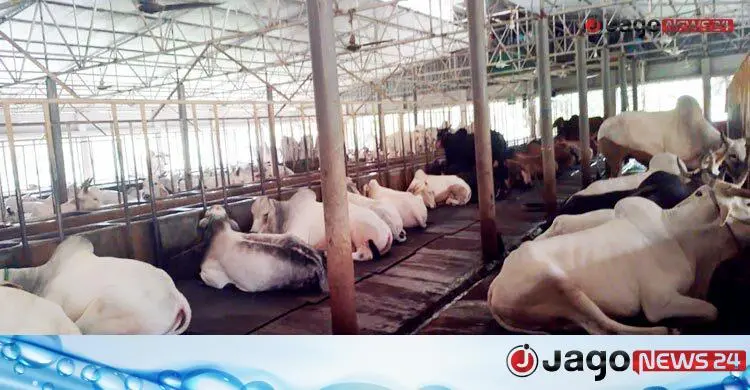
An unusual business has grown up around the traditional Satmail cattle market in Bagachra union of Sharsha upazila, Jashore. About 70 "cattle hotels", known locally as khatals, now operate in the area to shelter cattle before they go to market and animals left unsold. They have become very popular with traders from far away because they cut hassle and transport costs.
The market sits every Saturday and Tuesday and is the largest cattle market in the south-west. Because of a leasing dispute, animals are currently not being brought into the market itself, but they are sold in the surrounding area. Around the market are some 70 cattle hotels where cattle rest while their owners pay a fee.
Rates and facilities
Rates vary with the size of the animal and the length of stay: Tk 200 a day for a large animal, Tk 150 for a medium one and Tk 100 for a small one. Cattle left for a short rest cost just Tk 30.
The khatals have also modernised to ensure good service. Electric machines have been installed to chop straw quickly, and each hotel has at least 30 nanda (feeding troughs).
If cattle brought to market go unsold, taking them back is costly and difficult for traders. To solve this, local entrepreneurs have built cattle hotels on their own or rented land.
Owners' accounts
Khatal owner Ibrahim Khalil Rasel said he runs his cattle hotel on land leased with an advance of about Tk 5.5 lakh and monthly rent of Tk 6,500. As in a hotel for people, there are arrangements for the cattle to stay, eat and bathe. The business has created jobs for many unemployed local young men; some run it with family labour, others hire workers.
Khatal owners said their income and workload were much higher when Indian cattle came in large numbers. With fewer Indian cattle now arriving, income has fallen somewhat, but they are holding on to the business.
Monirujjaman Sujan built his hotel about four years ago. "I rented the land and built a shed at my own cost. It holds 25 bulls, a few more if they are cows," he said. Owners who come from far away leave unsold cattle here and take them to the next market from here. He charges Tk 200 a day per bull and Tk 100 per cow, providing safe shelter, straw and water; owners who wish can feed oil cake, bran and the like along with the straw.
Asked about his monthly income, Sujan said he is just getting by. After paying Tk 5,000 a month to the madrasa that owns the land, the electricity bill and one worker's wages, he makes ends meet.
Abdul Khaleque, a khatal owner in Satmail, said: "Local people call these places for cattle khatals, but I call them cattle rest houses." He has been in the business for 10-12 years and has been running it at a loss for about a year and a half. When the market was good, about Tk 5,000-6,000 was left after all costs on each market day. "Now I am subsidising the business I used to run. If cattle come into Bangladesh from India or Myanmar again, business at this market will be brisk once more," he said.
Who uses them
Hotel owners said traders from outside the area use the hotels most. Mominur Rahman, a trader from Noakhali, and Nazrul Nazu from Dhaka said they buy many cattle at once, and because of a shortage of vehicles cannot send them all together, so they leave some in these hotels. The hotels supply water and straw, and the traders sometimes provide bran, oil cake, broken rice or other feed.
Market problems
Though the initiative is praiseworthy, the market still has infrastructure problems. Traders suffer from the lack of drainage, too few sheds and poor access roads. Those involved believe that if these were solved, Satmail market and its cattle hotels could play an even bigger role in the country's livestock trade.
Local sources said the Bagachra Satmail cattle market in Sharsha has long been caught in leasing disputes. In the past, an influential group collected tolls without a lease by depositing a nominal sum, and this time too a syndicate is alleged to be disrupting the market's normal operation. The upazila administration has invited tenders several times but failed to lease out the market. When the administration most recently began collecting tolls itself, cattle stopped being brought into the market on Saturdays and Tuesdays.
Source: Jagonews24. First published in Bengali on The Agro News.

Comments
(0)