
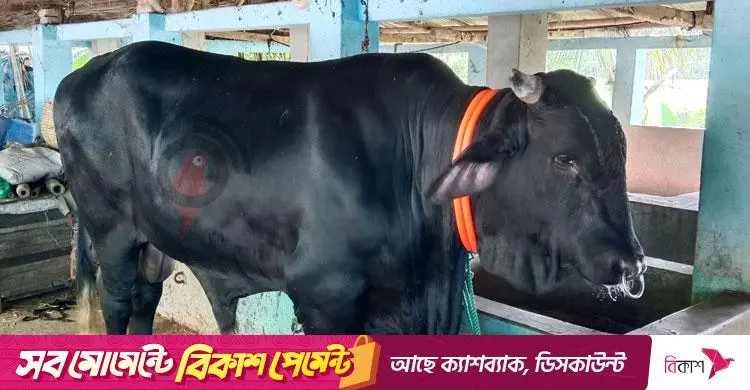
"Banglar Boss-5" is not the name of a film. It is the name of a huge black bull weighing about 30 maunds. Its owner is Asmat Ali Gain, a farmer from Hurgati village in Bhojgati union of Manirampur upazila, Jashore. The asking price for the bull, prepared for sale at the Eid-ul-Azha market, is Tk 12 lakh. Within a day or two, Asmat Ali will take it to Dhaka's Gabtoli cattle market.
Asmat Ali is hopeful that Jashore's Banglar Boss-5 will catch the eye at this year's Gabtoli market. Even before reaching the market, the huge black Friesian bull has drawn attention. It is 65 inches tall and 96 inches long, and weighs about 30 maunds.
A line of named bulls
Asmat Ali said last year he sold "Banglar Boss-4" at the Gabtoli market for Tk 15 lakh; the owner of Labib Group of the Shafipur area of Tangail bought it. This year he has prepared six bulls for the Eid market and will take them to Gabtoli within a day or two. He hopes to sell them at the expected prices again.
He said bulls from his farm have caused a stir at various sacrificial markets several times, and he has been taking bulls to Gabtoli for several years. He names them Banglar Boss, Banglar Samrat and Jolhosti. The first bull he raised and took to Gabtoli was Banglar Boss-1, and the names have now reached Banglar Boss-5. He previously sold Jolhosti-1 and 2. This time another bull is going under a new name, Banglar Samrat, weighing 25 maunds, with an asking price of Tk 10 lakh.
From rickshaw puller to farm owner
Asmat Ali is 39. As a teenager he pulled a rickshaw and sold peanuts for a living, but his interest in and love for cattle rearing since childhood brought him success. His business is mainly a dairy farm, and besides the bulls he has 25 cows and calves.
He said the farm began with only two cattle. For the past 4-5 years he has kept 45 to 60 cattle, and has three sheds. From one decimal of ancestral land, he now owns 171 decimals.
Recalling his early struggle, Asmat Ali Gain said he started rearing and trading cattle in 2004 on borrowed money, but received only a small share of the profit; most went to those who had invested the capital. Forced by debt, he went to Dhaka that same year and made a living pulling a rickshaw for about two years. He returned home after his father died, and his uncles told him there was no need to go back to Dhaka and that he should stay home and rear cattle. In 2006 he began buying, rearing and selling cattle, and in 2008 the farm began in full. At that time, alongside selling cattle, his main business was selling milk.
His wife, Ferdousi Begum, has always helped him. She said she cleans the cowsheds and arranges three meals a day for the cattle. In the morning they are fed grass and straw mixed with oilcake; at noon and night they are given boiled broken rice, along with maize flour and molasses.
Asmat Ali said feed costs Tk 500 to 550 per head a day. When the animals fall ill he gives first aid himself, based on his long experience of rearing cattle.
Call for government support
He said if the government stood by small farmers like him, they too could raise high-quality bulls and help meet the country's demand for meat. "Although the bulls I have raised have become well known, livestock officials have never come to my farm," he said.
Manirampur upazila livestock officer Dr Md Touhidul Islam said the upazila is large, making it difficult to reach every farm and household, as they face a shortage of staff (six people). Even so, advice and overall support are given to farms and to individuals who rear cattle, he said.
Source: Jagonews24. First published in Bengali on The Agro News.

Comments
(0)