
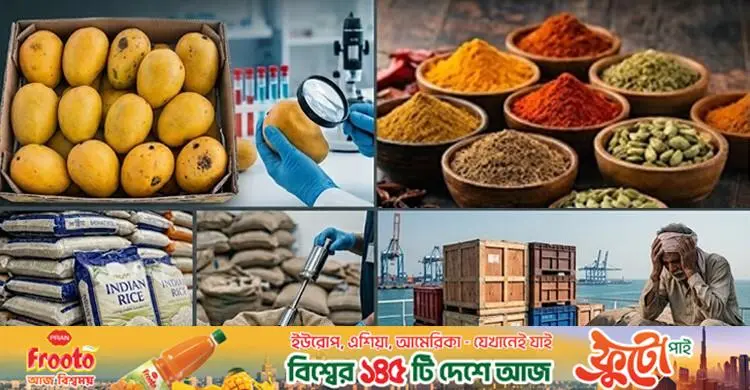
India was preparing for the busiest time of the year. At a facility in Rehmanpur village near Lucknow, work to disinfect mangoes and vegetables was in full swing. Farmers in Maharashtra and Gujarat were ready, with Alphonso and Kesar mangoes set aside for the Japanese market. Export papers were ready and shipping schedules were final. Then Japan's quarantine inspectors arrived.
After their visit in March, the whole process stopped. Japan questioned the methods used to disinfect, test and certify the mangoes, and then temporarily halted mango imports from India.
Japan halts mango imports
On 31 March the Yokohama authorities in Japan wrote to India's plant protection authority saying consignments of Indian mangoes with inspection certificates issued on or after 25 March would not be accepted. Imports will resume only once it is confirmed that the facility is operating to the required standard.
This is the biggest barrier to India-Japan mango trade in nearly two decades. Japan banned Indian mangoes in 1986 over fruit fly fears and lifted the ban in 2006, after India built vapour heat treatment (VHT) facilities and agreed to stronger pest surveillance and regular inspections.
The 2026 suspension affects six Indian varieties: Alphonso, Kesar, Langra, Banganapalli, Chausa and Mallika. The main export season runs from April to June. In 2025-26 Japan imported about USD 1.54 million worth of fresh and processed mangoes from India.
The figure is not large, but Japan matters to Indian exporters because it usually pays high prices for quality mangoes, and access to its market builds confidence in product quality in other international markets.
Mumbai mango exporter Vikram Shah said Japan was not their largest market by volume, but it had built the credibility of their products. He said it took him six years to build relationships with Japanese buyers.
Rajesh Patil's family in Ratnagiri, Maharashtra, has grown mangoes on the Konkan coast for two generations. Hoping for good prices in Japan, he invested in orchards and packaging, bought grading and handling equipment to meet Japan's strict standards, and trained in pest control. Patil says the Japanese market earned nearly twice as much as the local one, so they expected the export system to stay reliable. That hope has come to nothing.
China acts on rice
After mangoes, India's rice exports took a hit. On 17 April China cancelled the import licences of three Indian rice exporters. China's customs authority said traces of genetically modified organisms (GMOs) had been found in rice consignments from India.
Indian exporters deny this, saying GMO-free certificates were obtained before shipment. The Indian government has also said there are no genetically modified crops in the country's paddy and rice fields.
Rice makes up a large share of India's farm exports; in 2025-26 India exported a record of about USD 12.5 billion worth. China's decision has worried exporters. On 8 June India's Agricultural and Processed Food Products Export Development Authority (APEDA) published a list of laboratories approved to carry out GMO tests for exports to China.
According to agricultural scientist S K Singh, the episode has exposed weaknesses in India's testing system. Indian laboratories have long built expertise in testing for pesticide residues and aflatoxins, but meeting China's GMO testing demands requires far greater capacity. Exporters in northern states such as Punjab and Haryana often have to send samples hundreds of kilometres away because few laboratories can carry out the protein analysis needed.
Warnings on spices
Beyond mangoes and rice, there have been warning signs for Indian spices. Hong Kong suspended imports of several Indian spice products over pesticide residues, with about 12 per cent of samples failing to meet standards in tests.
The European Union has also stepped up checks on Indian cumin, testing 30 per cent of consignments since January 2025. In 2024 the EU's rapid alert system issued 312 alerts about Indian spices.
A fragmented supply chain
Food safety scientist Ananya Bose says India's farm supply chain is highly fragmented. A farmer sells to an aggregator, who sells to a trader, from whom the produce reaches a processor or exporter. Along this long chain, information about which pesticides were used on the farm risks being lost.
Foreign markets now want more than good produce: exporters must show which land it was grown on, what was used and when it was harvested. Such digital traceability is still not mandatory in many Indian states.
India's competitors are moving fast. Thailand has built a nationwide traceability system, Vietnam has increased investment in training farmers, and Brazil and Chile have invested heavily in cold chains.
India, by contrast, has only 207 registered pack houses, 72 per cent of them in Maharashtra. Shortages of cold storage and transport costs are also major problems, eating up about 15 per cent of export value, nearly twice the level in developed countries.
India is the world's second-largest producer of farm goods, and agriculture employs about 42 per cent of its workforce. Yet its share of global farm exports is only 2.4 per cent. Processed products make up only about 17 per cent of its farm exports, against about 25 per cent in the United States and about 50 per cent in China.
Agricultural economist Anil Gupta says India has so far focused on producing more, but advanced markets now want proof that quality is maintained throughout the process, not just higher output.
Some progress, real costs
There has been some progress. Over the past decade the number of accredited laboratories has risen from 22 to 89, and export certificates from about 61,000 to more than 1.7 lakh.
The barriers are hitting farmers directly. Kesar mango growers in Gujarat have lost an important buyer in Japan. A basmati paddy farmer in Karnal, Haryana, said local prices have already fallen by eight per cent. A turmeric processor in Ernakulam, Kerala, spent Rs 15,000 in one quarter on residue testing alone, about 10 per cent of his profit.
Indian farmers have long shown they can produce for the world. The challenge now is to reassure world markets consistently about the quality of that produce. Food safety, traceability and certification standards are becoming ever stricter in markets such as Japan, the EU, the UK, the US and Canada, with climate-driven pest risks, consumer demands for transparency and food security adding to them.
The Indian government says it is expanding laboratory capacity, controlling pesticide and antibiotic residues and strengthening digital traceability. But experts say the change is still at an early stage. As one of the world's largest farm producers, India must now strengthen its systems for quality, safety and transparency as well as production, because in international markets producing good farm goods is not enough: there must also be credible proof of why they are safe and up to standard.
Source: Jagonews24. First published in Bengali on The Agro News.
Comments
(0)