
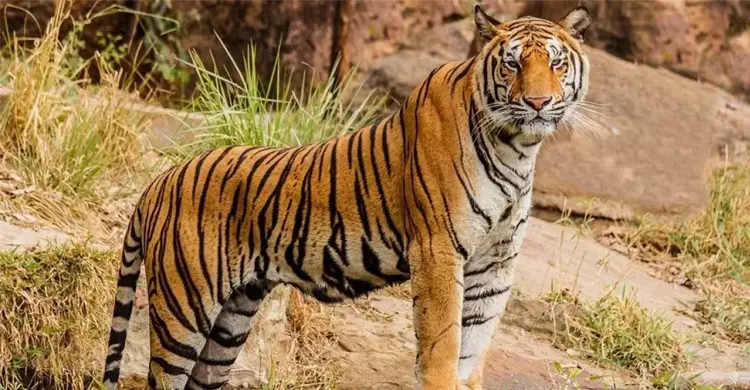
India and Bhutan have had notable success in increasing tiger numbers, and tigers have also increased in Nepal. They have doubled their tiger numbers in a decade.
Statistics show India now has a total of 3,682 tigers, meaning about 75% of the world's tigers now live in South Asia's largest country. India's Ministry of Environment, Forest and Climate Change released the figures to mark International Tiger Day on 29 July. It said India's tiger population is growing by six percent a year.
Gains across the region
The increase is seen as a big success for India, as indiscriminate hunting and habitat destruction had pushed the country's tiger numbers below 2,000 in the 1970s.
India's Union Minister for Environment, Forest and Climate Change Bhupender Yadav said India's exemplary tiger conservation effort and the rise in numbers is not just a statistic but proof of the whole nation's resolve and commitment.
Tiger numbers are also rising fast in the small Himalayan country of Bhutan. They have grown 27% since 2015, and the country now has 131 tigers.
According to Chimi Rinzin, country director of WWF-Bhutan, it is a remarkable achievement and a sign of a very healthy ecosystem.
But the fastest growth has been in Nepal, another South Asian country. It had 121 tigers in 2009, and by 2022 the number had risen to 355.
The whole world has welcomed the rise in tiger numbers in the region. A hundred years ago Asia had around one lakh tigers, but by the start of this century that figure had fallen by 95%. Experts blame legal and illegal hunting as well as habitat loss.
According to the International Union for Conservation of Nature, Asia now has between 3,726 and 5,578 tigers.
Target and cost
To save tigers from extinction, 13 countries including Bangladesh set a goal in 2010 of doubling tiger numbers by 2022. So far only Nepal has met that target.
But local people are paying a heavy price, as attacks and deaths caused by the animal have increased in areas where tigers are being conserved.
According to official figures, more than 100 people in India were killed in tiger attacks between 2019 and 2021.
Nepal and Bhutan face the same fear. Bhutan's national tiger survey report and WWF say human-tiger conflict must be resolved if tigers are to keep thriving. When conflict increases, tolerance of tigers falls, and it becomes a threat to both local people and tigers.
Jagonews24 cited the BBC.
Source: Jagonews24. First published in Bengali on The Agro News.

Comments
(0)