
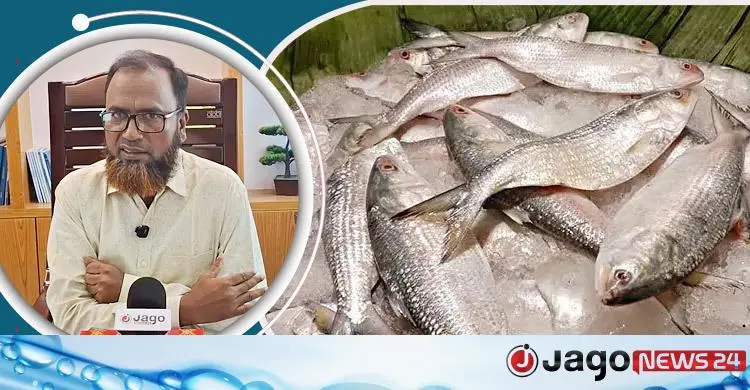
Hilsa production in the country has risen significantly in recent years, but keeping up this growth will need emphasis on sustainable management, protecting mother hilsa, ending the killing of jatka, maintaining river navigability and controlling pollution, according to Dr Md Amirul Islam, chief scientific officer of the Chandpur river centre of the Bangladesh Fisheries Research Institute (BFRI).
In an exclusive interview with Jagonews, he said production improved after the government took effective hilsa management measures from 2003-04. Before that, indiscriminate killing of mother hilsa and jatka had pushed production down to about 2 lakh metric tonnes. Research-based management and conservation then set production rising again.
He said production was about 5 lakh 32 thousand metric tonnes in 2018-19, rising in the following years to 5 lakh 50 thousand, 5 lakh 65 thousand and 5 lakh 66 thousand, and most recently reaching about 5 lakh 70 thousand metric tonnes. According to government data, this steady growth proves the success of hilsa management, he said.
Official figures
Dr Amirul Islam said hilsa was not just a fish but tied to the economy, culture and food security. It makes a significant contribution to total fish production and plays an important role in earning foreign exchange.
Asked about differences between reality and research data, he said information is published on the basis of government research. Many people say various things, but fishers or traders do not say that fewer hilsa came into their nets, he said. Government data are what is acceptable.
Protecting breeding
On conservation, he said hilsa is a migratory fish that comes from the sea into rivers to spawn, so protecting its breeding and habitat is vital, and it must be caught in a way that does not disrupt natural breeding and growth.
There are currently six hilsa sanctuaries in the country. In five of them all fishing is banned for two months, March and April, giving jatka a chance to grow safely. There is also a ban on catching mother hilsa at a set time each year, which plays an important role in raising production.
On artificial production, he said nowhere in the world has it yet been possible to produce hilsa fry artificially, so the fish depends on natural breeding, and protecting mother hilsa and jatka is the only way.
He named several priorities for raising production: protecting mother hilsa, stopping jatka killing, ending the use of illegal nets, controlling pollution in rivers and the sea, and ensuring alternative work for fishers.
Describing falling river depth as a major challenge, he said about 6 billion tonnes of silt are deposited in the rivers every year, obstructing the hilsa's migration routes. Without enough current, silt settles and breeding suffers, so planned river excavation and dredging are urgent. He also voiced concern about pollution, saying industrial waste, plastics and chemicals are degrading river and sea water, a serious threat to hilsa.
Stressing public involvement, Dr Amirul Islam said conservation was not only the government's job but a social responsibility. Awareness and a social movement must be built with everyone, including people in hilsa areas, and everyone must obey the government's bans.
Asked about the decline of large hilsa in the Padma-Meghna at Chandpur, he declined to comment.
Hilsa researchers say the fish is Bangladesh's national pride. Sustaining it needs strict law enforcement along with coordinated work on awareness, research and environmental protection. Only by protecting mother hilsa and jatka and keeping rivers flowing naturally will production rise further.
Source: Jagonews24. First published in Bengali on The Agro News.
Comments
(0)