
Hilsa production has taken a hit, and the fish are getting smaller by the day. Because of pollution and shrinking river depth, fish in Bangladesh's waters are moving elsewhere. As a result, even at the height of the season ordinary people cannot put the prized hilsa on their plates, and the silver fish seems to be heading back towards its old "rare" status.
From scarcity to a milestone
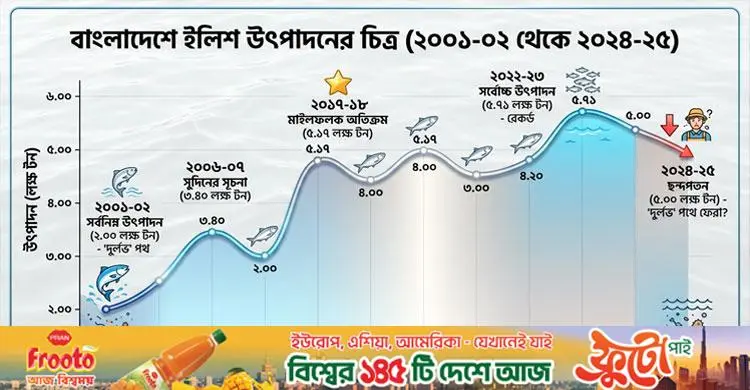
Data show that hilsa was once found in abundance in nearly a hundred rivers of the country, and production is said to have reached as much as 20 lakh tonnes at that time. For various reasons, in the 30 years after independence, production fell to a low of 2 lakh tonnes in the 2001-02 fiscal year.
Better days returned after 2006-07, and production rose sharply over a decade. From 2 lakh 98 thousand tonnes in 2008-09, it passed the 5 lakh tonne milestone in 2017-18 and stayed positive for several more years.
Now, however, production has turned negative again. Experts fear that without quick, effective action the fish could again become as "rare" as it was two decades ago. After the 2017-18 milestone, production grew for several consecutive years, but it has fallen in the past two years, and last fiscal year it dropped to its lowest in eight years.
According to the data, hilsa production was 5 lakh tonnes in 2024-25, against 5 lakh 29 thousand tonnes in 2023-24. In 2022-23 it was 5 lakh 71 thousand tonnes, the highest. Before that, production was 5 lakh 66 thousand tonnes in 2021-22, 5 lakh 65 thousand in 2020-21, 5 lakh 50 thousand in 2019-20, 5 lakh 32 thousand in 2018-19 and 5 lakh 17 thousand in 2017-18.
Blocked routes, warmer and dirtier water
Hilsa is by nature a migratory fish, and its growth suffers if it cannot move freely from sea to river and back. A survey by the Department of Fisheries has found that hilsa movement is obstructed at 17 places in all, including 14 in the Meghna, where numerous submerged shoals and chars block the fish's normal passage. Reduced flow and water pollution in the Padma-Meghna, the main breeding and feeding grounds, are reducing reproduction.
Several hilsa researchers say climate change and various human causes have produced this negative result. Rising water temperatures in the Bay of Bengal are hampering breeding, reduced river flow is limiting the fish's range, and more submerged shoals at the Meghna estuary are narrowing its main routes. River and coastal pollution, unsafe sanctuaries and overfishing are also major causes. Industrial waste and plastic particles in particular threaten the hilsa's habitat and food chain, and the fish's migration routes are changing.
Md Anisur Rahman, a former chief scientific officer of the Fisheries Research Institute who has long researched hilsa, said several factors together had created the negative trend and there was no longer a proper environment for hilsa.
He said silt deposits, loss of navigability and the formation of chars and submerged shoals were obstructing the fish's movement, and the food produced through sunlight penetration was being disrupted. Rain in recent years has not come on time, with less in the monsoon and more at other times, complicating breeding. Salinity in river water is rising, so hilsa cannot find the fresh water they need to spawn.
Industrial waste, excessive pesticide use in farming and plastic waste have reduced river clarity, and dissolved oxygen has fallen, affecting the fish's breathing and feeding. Many fish cannot breed. Scientists have also recently found microplastics in hilsa, which is a major obstacle to reproduction. Human causes such as pollution, excessive catching of jatka (young hilsa) and of egg-bearing hilsa continue, even during ban periods, and hilsa no longer come into small rivers as before.
About 80 percent of hilsa are now concentrated in the Meghna and its coast, but many researchers say major obstacles there are blocking the fish's route. Although a total of 432 kilometres in Chandpur, Bhola, Patuakhali, Shariatpur and Barishal has been designated as hilsa sanctuaries, the fish are not safe even there.
Mohammad Ashraful Alam, chief scientific officer of the Bangladesh Fisheries Research Institute (BFRI), said river depth had fallen and the number of submerged shoals at the estuaries had risen alarmingly. The chars block the fish's route, and in the spawning season in particular the mother hilsa's upstream journey with the current is obstructed. Many fish get caught in nets even while crossing the chars at high tide.
Smaller fish, more fishers
The Department of Fisheries runs a project called "Hilsa Resource Development and Management". An evaluation under the project found that seven years ago the average weight of a hilsa in Bangladesh was 500-550 grams, and it has now fallen to 300-350 grams.
Project director Molla Emdadullah told Jagonews that total production had fallen because of the smaller size: the number of hilsa may be rising, but large hilsa are not being found. Hilsa researcher Anisur Rahman agreed, saying a hilsa can live up to seven years, but fish older than three to four years can hardly be found now.
Molla Emdadullah added that the amount of hilsa caught in this country is rare in the world. The number of fishers is rising faster than the population; fishers carry on the trade across generations and new ones keep joining. About six lakh fishers are now directly engaged in catching hilsa.
Their uncontrolled use of modern nets, especially "current nets" and large trap-like char nets, catches hilsa of every size. The nets are so fine that everything from jatka to small fish gets caught, destroying the future breeding stock before the fish reach adulthood.
The official also said India had caught large amounts of hilsa from Bangladesh's waters in the past. Until a year ago the two countries' ban periods did not coincide, and India fished heavily, indiscriminately, until 2025. He said Bangladesh had been unable to stop overfishing at home or by others, as the government has limited ships and trawlers and little capacity for monitoring.
What needs to be done
Anisur Rahman said he had always stressed three things: protecting jatka, giving hilsa the chance to spawn, and fully safe sanctuaries, a three-layer protection ring. Overfishing and river pollution must then be stopped quickly, the effects of global climatic change must be addressed, alternative ideas are needed, and fishers need training, awareness and support during ban periods.
Dr Md Masud Rana, assistant professor at Sher-e-Bangla Agricultural University, said existing laws on hilsa fishing must be enforced more effectively, with regular surveillance, mobile courts and sure punishment to stop the catching of jatka and mother hilsa, alongside awareness among fishers.
He said illegal encroachment on rivers must be removed, natural flow maintained and industrial and urban waste treated, with regular excavation and dredging to protect the rivers. Because climate change is raising salinity, changing water temperatures and disrupting breeding, adaptive strategies are needed: habitat conservation, sustainable policies, disaster-resilient infrastructure for vulnerable fishing communities and early warning systems.
The Department of Fisheries said river excavation, fish-friendly embankments and fish passes are being built so that hilsa can migrate unhindered, and sanctuaries have been set up in the Meghna, Padma and Tentulia rivers using scientific models. Digital platforms are used for fishing licences, registration and control of fishing during bans; smart cards and e-monitoring bring transparency; and government support such as rice distribution is delivered on time through mobile banking.
Eco-friendly nets with set mesh sizes have been introduced to protect jatka, and catching jatka is banned from 1 November to 30 June. Solar-powered boats and fuel-efficient engines are cutting carbon emissions, and fishers receive VGF cards, food aid and financial assistance as alternative support.
Source: Jagonews24. First published in Bengali on The Agro News.

Comments
(0)