
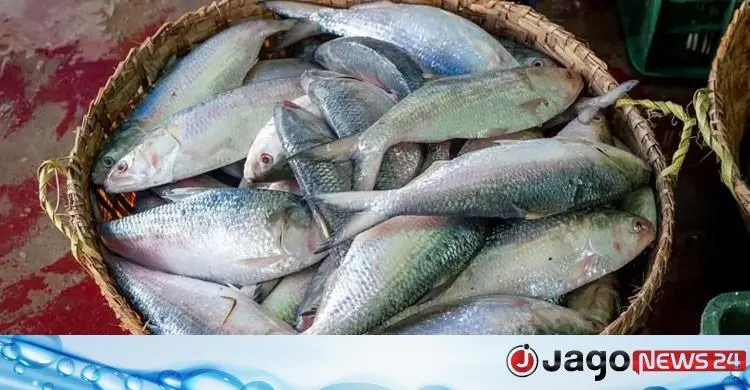
Over the past two months, 19 importing firms have brought more than 3.5 lakh kg (350 tonnes) of hilsa, worth about Tk 7 crore, into Bangladesh through Benapole port. There are complaints that in many markets these fish are being sold as Bangladeshi hilsa.
Importers, customs clearing and forwarding (C&F) agents and government officials say more hilsa from India is on its way to Bangladesh.
According to them, most of the hilsa coming to Bangladesh is from Gujarat in India. Every year there is diplomatic debate over sending hilsa from Bangladesh to West Bengal before Durga Puja, but this year, instead of Padma hilsa, large quantities of Gujarati hilsa are going from West Bengal to Bangladesh through the Petrapole-Benapole border.
Syed Anwar Maksud, secretary of the West Bengal Chilled Fish Exporters Association, said about 500 tonnes of hilsa had been exported to Bangladesh through West Bengal in almost two months. He said nearly all of it came from Gujarat.
People involved in Bangladesh say traders were encouraged to import mainly because hilsa from India costs several times less than the price in the Bangladeshi market.
Officials unsure why
Jashore district fisheries officer Monirul Mamun says some firms are importing hilsa with proper permission from the Department of Fisheries, but the department has no idea why the imports are being made.
Dr Md Khaled Konok, director general of the Department of Fisheries, said limited permission to import hilsa had been given on traders' applications.
Hilsa researcher Dr Anisur Rahman says that because of river pollution, the killing of jatka (young hilsa) with current nets, sand extraction and other causes, not enough hilsa is found in Bangladeshi waters, creating a shortage in the market. He believes that is why hilsa is coming in by various routes.
Bangladesh has been known as a hilsa-exporting country. Now it turns out it is also importing large quantities of hilsa from India.
The Jashore district fisheries office says that in the first two months of the current fiscal year, July and August, 19 importers brought 3,52,484 kg of hilsa from India, worth about Tk 7 crore. Ashwadul Alam, fisheries quarantine inspector at Benapole land port, confirmed the figures.
Asked why the fish is being imported from India, Monirul Mamun said this was the first time they had seen hilsa imported like this. "We do not know the exact reason. Perhaps more was caught over there. Traders are importing with permission from our authority, so we are also giving permission," he said.
Falling production at home
After almost two decades of continuous growth, Bangladesh's hilsa production has fallen steadily for the past three years and the average weight of the fish has also begun to decline, a trend researchers have been worried about.
News of imports from India has caused a stir, along with curiosity about why hilsa is being imported at a time when it is hilsa season in Bangladesh. The question arises partly because, after scientists at Bangladesh's agricultural university decoded the fish's complete genome in 2018, major progress had been expected in hilsa conservation, production and quality.
Kamruzzaman, head of a C&F firm working for hilsa importers, says traders are importing because supply is short of demand. "They are importing with the government's permission. And why would traders import if there were no profit?" he said.
Nor is this the first hilsa import from India: imports began in July last year. And Bangladesh is not only importing. In the last fiscal year it badly missed its hilsa export target; officials say that against a target of 1,200 tonnes, it exported less than 110 tonnes.
A six-year project to increase hilsa production was taken up in 2020, but Department of Fisheries director general Khaled Konok himself has questioned how effective it has been. "There was a Tk 400 crore project to increase hilsa production. We have to examine how useful it was under the previous government, or whether there was negligence. We have to find out why hilsa production fell," he said.
Asked how the government views imports from India, the director general said hilsa imports are not banned and small quantities have come at various times before. "This time less hilsa is seen in the market. On traders' applications, limited imports have been allowed. Hilsa is a sea fish that comes to the rivers to breed. Perhaps they [the Indians] are catching it at sea. Our stock is falling. For these reasons, small imports have been allowed," he said.
Cheap fish, high local prices
According to fisheries officials and several importers, the maximum purchase price of hilsa from India is two dollars (about Tk 246) or less. Even after customs duties and other costs, it is much cheaper than a hilsa of the same weight in the Bangladeshi market.
"Traders make a big profit if they can import. For the last two months there has been very little hilsa in the market. Imported fish is selling freely in the Jashore region," said one official.
People who bought or tried to buy hilsa in Dhaka markets in recent weeks said they were asked about Tk 1,600 for fish over 500 grams, Tk 2,800 for fish over 1 kg, Tk 2,200-2,400 for fish of 800-900 grams and Tk 1,800 for 700-gram fish, or prices close to these.
According to the Bangladesh Fisheries Research Institute, hilsa accounts for about 12 per cent of the country's total fish production, and about 60 per cent of the world's hilsa is produced in Bangladesh. The Ministry of Fisheries and Livestock claims that 70 to 80 per cent of the world's hilsa is now produced in Bangladesh.
Officials say 5.71 lakh tonnes of hilsa were produced in 2022-23, 5.29 lakh tonnes in 2023-24 and 5.04 lakh tonnes in 2024-25. Official figures for 2025-26 are not yet available, but officials estimate production at less than 5 lakh tonnes.
Hilsa expert Dr Anisur Rahman says the government should identify the causes and take effective action quickly. He thinks damage to the hilsa's migratory route from the sea to the rivers may also play a role. "Various harmful fishing methods and the use of pesticides have also threatened the hilsa's breeding and nursery grounds," he said.
A glut in Gujarat
West Bengal fish exporter Syed Anwar Maksud says Gujarat has had a huge hilsa supply this year, creating a surplus and bringing prices down there. He says Bangladesh has strong demand not only for hilsa but also for hilsa roe, and the Gujarat fish carry plenty of roe.
"Buyers in Bangladesh like large hilsa with roe. Factories there also process and package hilsa roe for export to international markets such as the United States and Britain. Gujarat hilsa are large and full of roe, so there is great demand in Bangladesh for both the fish and the roe, which we are meeting with Gujarat fish," he said.
According to Maksud, the trade route now runs from Bharuch in Gujarat through the wholesale market in Howrah, West Bengal, to the Petrapole-Benapole border.
Chiman Tandel, president of a fish traders' association near Vadbhut in Bharuch, said hilsa catches had been very good for the past five years. The fish is mainly sent to West Bengal and from there also exported to Bangladesh. He said demand for Gujarat hilsa is highest in West Bengal. Fish is also sent directly to Bangladesh from Vadbhut in refrigerated trucks; small quantities go in railway containers, but trucks are usually used for large volumes. Three trucks leave Bharuch every day, each carrying about 250 boxes of 60 kg of hilsa.
Fisherman Deepakbhai Machhi said the hilsa season runs from mid-June to Navratri, and hilsa currently sells for 600 to 700 Indian rupees a kg. He claimed that even small fishermen earn up to about five lakh rupees in the three-month season.
Most of Gujarat's hilsa is caught near Vadbhut, where the Narmada river meets the sea, with some also from Jambusar and Hansot.
Rathikanta Bar, president of the Kalibabur Bazar fish traders' association in Howrah, claimed that Bangladeshi traders are also coming to West Bengal markets this year and buying hilsa in retail quantities of about 1.5 to 3 tonnes, mostly preferring large fish from Gujarat and Maharashtra.
Jaykrishna Haldar, a leader of several West Bengal fishermen's organisations, blamed water pollution and industrial fishing for the change in hilsa supply. "We keep saying: stop using banned pesticides, stop dumping city waste in the water. But who listens?" He added that industrial fishing with large motorised vessels for 11 months of the year has also hurt the catch of ordinary fishermen.
Source: Jagonews24. First published in Bengali on The Agro News.


Comments
(0)