
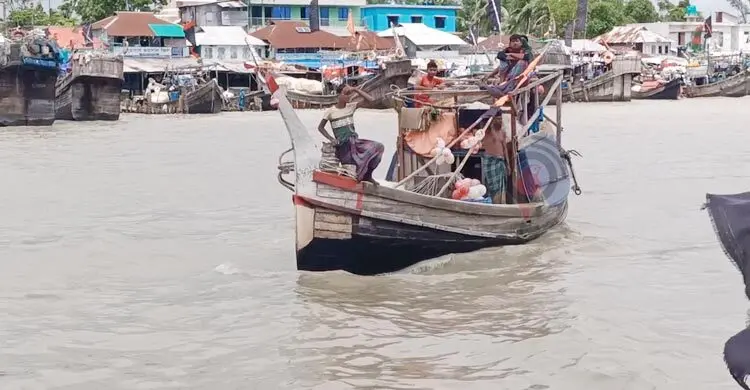
"The government imposes a 22-day ban to protect mother hilsa, and mother hilsa take 10 to 16 days to lay eggs. Then the government suddenly imposed another 65-day ban. I can't understand why the government took this decision. Since the 65-day ban started, my trawler has been making losses. I am 63 now and have fished at sea since I was 17. Then I became a trawler skipper, and one by one I came to own two trawlers. Now, just because of this 65-day ban and bad weather, a lifetime's earnings are running out. Dragging the burden of losses for the past few years, I have fallen into debt of Tk 70-80 lakh. Even if I sell every last bit of capital I have, I won't be free of debt."
Kamrul Islam, alias Kalu Majhi, a fisherman from Banshkhali in Chattogram, said this in frustration at Alipur ghat, the large fish landing centre in Patuakhali, where he had come to shelter from bad weather.
Kamrul Islam, owner and skipper of the trawler "Sumi Akter", said: "Ten days ago I went to sea from Banshkhali with 22 fishermen, with Tk 5.5 lakh worth of provisions and fishing gear, and got the chance to fish for 10 days. Then the weather turned bad and the sea grew rough, and it was no longer possible to stay out. So we came to the nearby Alipur ghat for shelter. The fish we caught fetched Tk 3.25 lakh. That is a loss of Tk 2 lakh, and then there are the staff wages. Going on like this, I have decided to sell one trawler to repay the debt, otherwise one day I will lose everything."
"No alternative to scrapping the 65-day ban"
It is not only Kamrul Majhi. Inquiries at the Alipur-Mohipur ghats show that while one or two trawlers are getting the catch they need, most are returning empty-handed. Fishermen's debts are growing, and hardship is making them reluctant to stay in the trade. Seventy to eighty per cent of fishermen are struggling to run their households, and the fishing trade faces a deepening crisis and many other problems.
Talking to most people in the fishing trade at the ghats, including fishermen, skippers, wholesalers, traders and trawler owners, all complain about the 65-day ban and about Indian fishermen fishing in Bangladeshi waters during the ban. They say that because of climate change the weather is repeatedly turning bad anyway, and on top of that a continuous 65-day ban is leaving fishermen destitute. This has become a major problem in Bangladesh now, and to get out of it there is no alternative to scrapping the 65-day ban.
Fishermen said the 65-day ban at sea ran from 20 May to 23 July. Since then they have been hit by bad weather three or four times, every 10-12 days. Unable to stay at sea, they are missing out on hilsa, while their nets and trawler gear are being damaged, and there is always the risk to their lives.
A fisherman named A Karim Molla said: "I took a loan of Tk 50,000 during the last 65-day ban. To repay it, I have not gone home since the 65 days ended. Forget repaying the loan, I haven't even made enough to run my household with my children. At sea we can't stay more than four or five days, and if the weather turns bad in between we have to come back. This way our debt keeps growing every year."
Md Kamal Bepari, director of Bepari Fish, said fishermen catch the fish, but it is not only fishermen who are tied to hilsa: people in every trade in the southern region are connected to it. If there is hilsa, people of all classes are well off; if hilsa cannot be found, everyone has hard days. If the 65-day ban were lifted they would have no more complaints, and he hoped fishermen would see good days again once it was lifted.
Weather keeps boats out for no more than five days
Md Mizanur Rahman, director of Bhai Bhai Fisheries at Alipur fishing port, said fishermen are satisfied with current market prices for fish, but they are not getting the catch they need, so everyone is getting by in hardship.
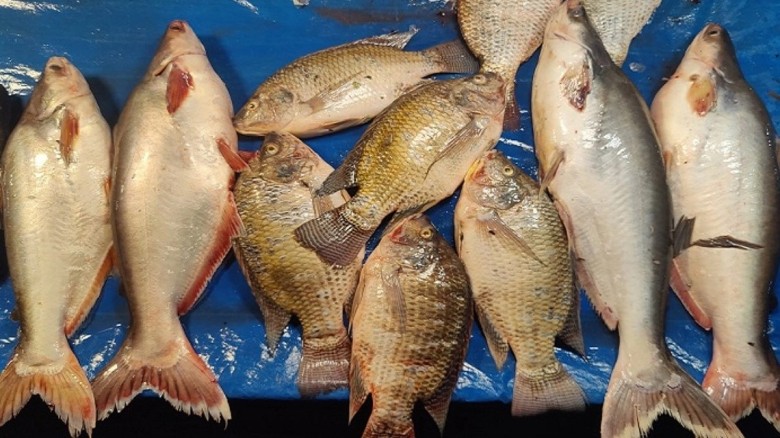
He said all the fishermen had come back on Sunday, many with fish and many empty-handed. That day hilsa over 1 kg sold for Tk 60,000 to 65,000 a maund, 800 g to 1 kg hilsa for Tk 55,000-60,000, 700-800 g hilsa for Tk 43,000 to 45,000, 400 to 500 g hilsa for Tk 35,000 to 37,000, and jatka (juvenile hilsa) for Tk 21,000 to 23,000 a maund. Fishermen are happy with the prices but not with the hilsa catch.
Call for easy-term microcredit
Md Anisur Rahman Mamun, owner of Messrs Anisha Enterprise and a leader of the fishermen's association, said that at the start of every hilsa season fishermen, trawler owners and fish wholesalers spend crores of taka to go fishing at sea. But after counting losses for the past four or five years, the trade is in crisis. If the government lifts the 65-day ban and brings fishermen under easy-term microcredit, there is a chance they will recover. He said their demand is that, to protect the reputation of the country's hilsa, the government accept fishermen's demands and also keep them alive by stopping Indian fishermen from entering Bangladeshi waters.
Apu Saha, senior upazila fisheries officer in Kalapara, said there are 30,000 fishermen in Kalapara, of whom 18,300 are registered. During the 65-day ban the government gave registered fishermen 85 kg of rice each in two phases. Because of the overall situation in the country, rice distribution has not yet been completed.
He said leaders of the country's fishing sector have already met the advisers of the relevant ministry about scrapping the 65-day ban, and a good solution on the matter will come very soon.
Source: Jagonews24. First published in Bengali on The Agro News.
Comments
(0)