
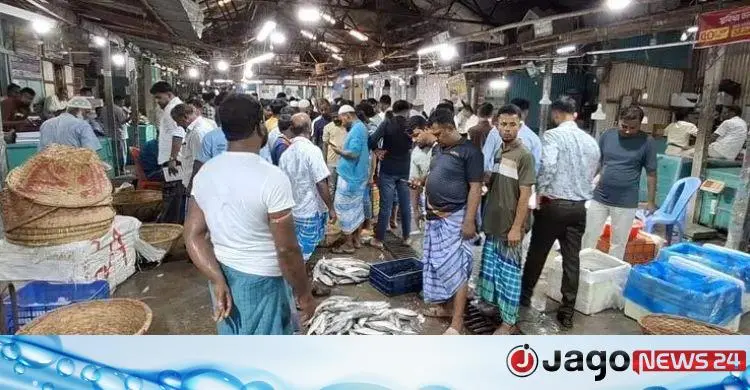
The peak hilsa season is under way, but the expected hilsa are not showing up in the rivers, estuaries and sea of the Barishal region. Supply at landing centres and retail markets is limited and prices are beyond ordinary people's reach. Yet Department of Fisheries statistics show that in June this year the southern region landed almost three times as much hilsa as a year earlier, the highest June catch in six years.
The gap between the official figures and the market has fishers, wholesalers, traders and buyers asking questions. They say small fish and jatka (young hilsa) are being caught instead of large hilsa, and banned trawling is raising fears for the future of the fishery.
What the figures say
According to the Barishal divisional fisheries office, the June catch broke past records. Last June the division's six districts landed 40,516 tonnes of hilsa, against 14,496 tonnes in the same month a year earlier, an increase of 26,320 tonnes. Earlier June catches were 21,827 tonnes in 2024, 15,482 tonnes in 2023, 30,820 tonnes in 2022 and 15,892 tonnes in 2021. Even so, supply in the market remains limited.
Fishers say the catch has risen somewhat, but the way the fish are being caught is destroying the hilsa resource itself. Banned trawlers are now sieving jatka out of the estuaries, and if this continues, they say, even jatka will be gone within a few years.
People in the fisheries trade say two-thirds of the hilsa landed are jatka (under 10 inches) or small fish. Catching and selling jatka is a punishable offence, and it is being done with banned trawlers. In other words, the department's catch has risen on the back of hilsa whose capture and sale are prohibited.
According to the Department of Fisheries, the monsoon counts as the hilsa season. To protect breeding and let jatka grow, fishing bans of various lengths apply in the rivers and sea for eight months of the year. The latest 58-day ban at sea ended on 11 June, and there will be no ban in rivers or sea until the first week of October, so these four months are treated as the peak season. Seventy per cent of the country's hilsa comes from the rivers and sea of the south.
A long-term decline
Beyond June's figures, the longer picture shows the Barishal division's hilsa catch falling steadily. Divisional fisheries data show that about 3.69 lakh tonnes were landed in the 2020-21 fiscal year, but this fell to about 2.66 lakh tonnes in the just-ended 2025-26 fiscal year, a drop of more than one lakh tonnes in five years.
The latest fiscal year's catch was also about 68,000 tonnes lower than in 2024-25, although the division set a five-year record in 2022-23. So there is a claim of record June production on one hand and a steady annual decline on the other, and both are being questioned.
Another feature of the figures also stands out. For the past two years, more than half of the division's total hilsa catch has been recorded under Bhola district. A large share of June's total this year was attributed to Bhola, and the same was true last June. But people involved say these figures do not match the shortage in the market, the scarcity of fish at the wholesale centres and what traders say, raising fresh questions about the accuracy of the official count and the gap with conditions on the ground.
Fishers and traders
Nasir Uddin, a fisherman at Mohipur fish port near the tourist centre of Kuakata, speaking from long experience at sea, told Jago News in his local dialect: "We used to see big hilsa at sea, but now we catch small ones. Even the small hilsa used to weigh half a kilo. Now it takes six of what we catch to make a kilo."
According to him, fishermen used to use nets with a four-inch mesh to catch large hilsa. Now, as there are enough large hilsa, they use nets with a mesh of three to three and a half inches, and catch a lot of jatka.
Rana, a fisherman from Patharghata upazila in Barguna, said hilsa fry used to be left alone at sea. Now, with fewer fish in the sea, hilsa fry are also being caught to cover the costs of wooden trawlers, and that is why there are fewer large hilsa.
Zahidul Islam of Tulatoli Abdullah fish wholesale centre at the Meghna estuary in Bhola said he has traded hilsa at this landing ghat for 47 years and has never seen such a dire situation in the Meghna. Trawlers that go to sea cannot even cover their supply costs, he said, while the Department of Fisheries shows bureaucratic figures.
Prices up Tk 500 to Tk 700 a kg
Despite the claimed rise in the official catch, it has had no positive effect on the market. Prices of almost every size of hilsa have risen by Tk 500 to Tk 700 a kg compared with last year, putting the national fish out of ordinary buyers' reach even in the peak season.
At wholesale, one-kilogram hilsa are selling for Tk 2,800 to Tk 3,000 a kg. Fish of 700 to 900 grams cost Tk 2,500 to Tk 2,800 a kg, 500-gram fish about Tk 1,800 and 400-gram fish Tk 1,500 to Tk 1,600.
Most of what arrives at the wholesale centres is jatka under 300 grams, which by law may not be caught or sold. Even so, these fish sell for Tk 800 at wholesale and more than Tk 900 at retail, against less than Tk 500 for the same size last year. The market reality, then, is that despite the claimed rise in production on paper, supply shortages and high prices keep hilsa out of ordinary people's reach even in the peak season.
A buyer named Saiful said hilsa that used to cost Tk 1,400 to Tk 1,600 now cost Tk 2,500 to Tk 2,800. He accused some traders of keeping prices unreasonably high, taking advantage of the low supply.
Another buyer, Mamun, said he came to the wholesale market hoping to pay a little less than at retail, but prices there were almost the same. In the end, four hilsa of 700 to 800 grams cost him about Tk 3,500.
Sohel, another buyer, said he had been forced to buy pangas because hilsa had become unaffordable. A 500-gram hilsa that used to cost Tk 800 to Tk 900 now costs Tk 1,800 to Tk 2,000, he said.
Md Zahir Sikder, president of the Barishal Port Road Fish Aratdars' Association, told Jago News: "This Port Road wholesale centre depends mainly on hilsa. But with hilsa production falling over the past few years, the situation has become dire. After counting losses, our association's membership has fallen from 160 to 120 in the past two years. Those 40 aratdars have changed profession, and many more are preparing to leave."
Altaf Hossain, a hilsa trader on Port Road, said: "At this time of the season we used to have no time to breathe. Now we sit idle all day. There are no fish, no buying and selling. It has become hard to keep the business going. If it carries on like this, I will have to give it up."
Officials respond
Barishal district fisheries officer Dr Hadiuzzaman told Jago News that although the hilsa season begins in June, the real peak usually starts in July. With enough rain, more hilsa will come from the sea into the rivers, and he hopes prices will then fall.
Md Mohsin, deputy director of the Department of Fisheries in Barishal, acknowledged to Jago News that hilsa have declined because of jatka fishing, and said his office faces a shortage of staff and other limitations. But he gave no specific explanation of how June's catch could be three times last year's while the market faces a shortage, saying only that the data had been collected from the field.
Source: Jagonews24. First published in Bengali on The Agro News.



Comments
(0)