
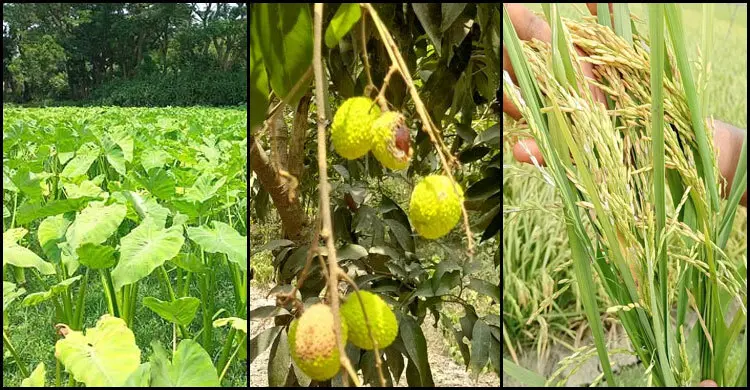
The mild-to-severe heatwave that has swept the country for nearly a month has damaged boro rice and other crops in some areas. Jute fields are cracked and parched, mango and lychee fruitlets are dropping in large numbers, and seasonal vegetable production has also been affected. Cattle, goats, chickens and other animals are suffering. The poultry industry has been hit hardest, and cattle and goat farmers face losses as their animals lose weight.
Boro rice at risk
Boro rice was at risk of heat shock from the start of the heatwave. According to the Bangladesh Rice Research Institute (BRRI), boro has been grown on 5,058,000 hectares nationwide this season, with a production target of 22.2 million tonnes. Because of the intense heat of recent weeks, production across the country is feared to fall by about 1 million tonnes. The losses are greatest in the northern region, where rice on three to four per cent of land has turned to chaff so far. The haors have seen less damage.
Dr Md Sazzadur Rahman, chief scientific officer and head of BRRI's plant physiology division, told Jago News: "On average, about three per cent of rice across the country has been damaged so far. If the heatwave continues, the damage may rise. Apart from the haors, rice across the country was in the flowering stage, which is a very delicate state. Pollination is not happening properly, because normal pollination takes place between 9:30 and 11:30 in the morning, and at that time the temperature has been above 35 degrees."
"So rice in areas that flowered from early to mid-April has been damaged. But the worst hit are areas where rice flowered from mid-April until last week, such as the north. Production there will fall by up to 4 per cent. Those northern districts account for 30-35 per cent of total production," he said.
While BRRI has voiced this concern, the Department of Agricultural Extension (DAE) has not yet made a final estimate of the damage. DAE Director General Badal Chandra Biswas said the final account of agricultural losses has not yet been prepared. He told Jago News: "There may be some damage, but it will not be very large. Today I spent the whole day looking at Bhanga, Faridpur and Barishal. I don't see much of a problem. It's just that more irrigation is needed, so farmers' costs are rising. Eighty per cent of the rice in the haors has been harvested."
Asked about losses in the north, he said: "Even in the heat, farmers are watering their fields. I don't think there will be a problem. Still, I have instructed offices across the country to report damage. I will be able to say then."
Rois Uddin, a farmer from Paricha village in Badalgachhi upazila of Naogaon, planted boro late after mustard. His rice is burning in the extreme heat. Even with irrigation he cannot keep water in the field, which dries out repeatedly, and load-shedding means he cannot irrigate as often as needed. "If I could keep water in the field, at least some of the crop would be saved. But it isn't happening, and costs are rising. In the heat, labourers don't even want to irrigate from the river. It seems there is no way this rice won't turn to chaff," he said.
Salam Mia, a farmer in the Nawabganj upazila headquarters of Dinajpur, said the rice is turning to chaff in the sun. "Even with so much water, the field can't hold it. And water isn't available either. The yield will clearly be very low this time. I'm very worried."
Jute stunted, fruit dropping
Jute plants across the country are drooping in the sun and their growth has slowed. Farmers say fields are cracked by the excessive drought; water given in the morning dries up before afternoon. Jute is not growing for lack of water, and shallow machines are not drawing water. Because of the heat, fields need more irrigation than before, and farmers fear lower yields.
Jute farmer Nurul Islam told Jago News: "I'm in real trouble with jute this time. I bought fertiliser, seed, pesticide and everything else at high prices, but the jute isn't doing well. The field dries out in the drought and the jute doesn't grow."
Abdul Mannan, a farmer in Rajbari, said: "Where we used to irrigate twice at this time, this year we can't keep up even with four or five waterings. Water given in the morning dries by the afternoon. Wetting the field takes more time and more money."
In the extreme heat, mango and lychee fruitlets are dropping in Rajshahi, Chapainawabganj, Pabna, Meherpur and other areas. Orchard owners are expected to face heavy losses if this continues, and owners and leaseholders are in difficulty.
According to the Chuadanga meteorological office, the country's highest temperatures have been recorded in Chuadanga and Meherpur, at 40 to over 42 degrees. Naturally, mango and lychee trees produced blossom on 65 per cent this season; the rest put out new leaves. The weather is now unfavourable for mango and lychee, and yields are feared to fall somewhat.
According to the DAE in Meherpur, the district has 800 hectares of lychee orchards, growing Ati, Bombai, Chili Bombai, Ata Bombai and China-3 varieties. The lychee production target this year is 8,500 tonnes. The district has 3,336 hectares of mango orchards.
Saifuddin Yahia, sub-assistant agriculture officer of Salimpur union in Ishwardi, said the local Mozaffar lychee cannot tolerate high temperatures and turns dark and scorched in excessive heat. This can be partly prevented by ample irrigation at the base of the tree and spraying water over the canopy. Farmers can also use fungicide to prevent the darkening.
Ishwardi upazila agriculture officer Mita Sarkar said that without rain the skin of lychee fruitlets will burn. There has been no rain in Ishwardi this season, so regular irrigation at the base of trees must be kept up, and water sprayed over the trees where possible. During the ripening season, lychees can dry up and drop if the temperature goes above 35 degrees.
Northern districts parched
Nilphamari and other northern districts are burning in a prolonged drought. Crops are losing their colour in the excessive heat, and farmers fear widespread losses in rice, peanut, chilli, maize, banana and vegetables.
According to agriculture officials, rice grains risk turning chaff when the temperature goes above 35 degrees Celsius. In Nilphamari, maximum and minimum temperatures are ranging between 40 and 20 degrees Celsius.
Anowarul Islam, a peanut grower from Chikonmati in Domar, told Jago News that his peanut plants are wilting in the intense heat. The soil where he grows gold seems to have dried up and become lifeless, and the crop he planted with money borrowed from a moneylender is being ruined before his eyes. "There is no moisture in the soil. There is no rain either. So the peanut kernels are getting smaller. When I irrigate with the machine, the water doesn't last even five days. The sun dries everything up," he said.
Poultry and cattle hit hardest
Those in the poultry industry have been hit hardest by the continuous heatwave. Thousands of chickens have died every day in the intense heat, and this has affected the market. Milk production has fallen as cows eat less in the heat, and cattle being prepared for Qurbani are losing weight, worrying farmers. Deaths of various birds in the extreme heat have also been reported.
In a statement on 25 April, the Bangladesh Poultry Association (BPA) said marginal farmers had lost Tk 200 crore in 10 days of intense heat. The association claimed that about 100,000 chickens are dying of heatstroke across the country every day, with an estimated loss of Tk 20 crore a day.
Cattle farmers are not doing well either. The Department of Livestock Services said 13 million head of livestock are being prepared for Qurbani this month. Meanwhile about 2,000 head of livestock have died across the country in the intense heat. Cattle fit for Qurbani are losing 30 to 70 kg on average, and milk production has fallen by 20 to 25 per cent.
Touhid Parvez Biplob raises 140 cattle on his farm at Dargahat in Kahalu upazila of Bogura, 120 of them fit for Qurbani. Jago News spoke to him on Monday (29 April). No cattle had died on his farm so far, but nine cattle died in Kahalu upazila that day. He also reported that seven cattle died the same day at a farm he knows in Gaibandha.
"I'm anxious about my own cattle. I'm bathing every large animal on the farm seven times a day instead of twice. Every day I'm giving various vitamin C foods and regular saline. I'm spending a lot trying to keep them well. Even so, the cattle are distressed by the heat and not eating normally. When they should be gaining weight, they are losing it," Biplob said.
Source: Jagonews24. First published in Bengali on The Agro News.
Comments
(0)