
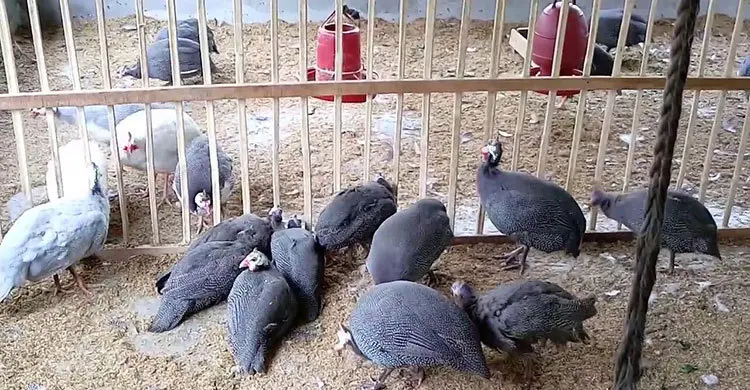
The guinea fowl, or titir, is much like any other domestic bird and is reared in the same way as ducks and chickens. In rural areas it is known as the "China hen". Yet it seems to be disappearing day by day, even though there is money to be made from rearing it.
Origin: the guinea fowl is originally African. It came to South Asia from Europe with the English during British colonial rule.
Nearly endangered in Bangladesh
Near-endangered: although the IUCN has declared the species of no concern, in Bangladesh it is considered nearly endangered and is protected under the country's wildlife law. Three decades ago guinea fowl still roamed rural yards alongside local hens, but then suddenly they were no longer seen. Today they are found not in village homes but in the bird shops of Dhaka, where each caged bird sells for Tk 1,000 to Tk 1,500.
Initiative: since 2010 guinea fowl have been reared, observed and studied at the poultry farm of Bangladesh Agricultural University (BAU). A conservation effort was launched through a project funded by BAU and the University Grants Commission. Over a long period, Professor Dr Subash has completed every stage at this research farm, from hatching chicks from eggs to rearing them.
Distribution: to spread the birds across the country, Dr Subash is distributing them free of charge, and he is now also working to spread guinea fowl rearing among entrepreneurs. Farmers are already becoming interested.
Why it pays
Rearing: guinea fowl can be raised just like local chickens. Their disease resistance is higher than that of other birds, infections and parasites do not easily take hold, and no special vaccines or medicines are needed. Their need for supplementary feed is also low, and they adapt to harsh conditions.
Meat production: where a local hen reaches at most 1 kg in six months, a guinea fowl reaches 1.5 kg or more. And while a local hen lays 50 to 60 eggs a year, a guinea fowl lays about 100 to 120.
Profitable: the guinea fowl is highly disease-resistant and fetches a much higher market price than local ducks and chickens, so it is more profitable to rear than local hens. Rearing it can help reduce poverty and will also help conserve this nearly endangered species.
Source: Jagonews24. First published in Bengali on The Agro News.

Comments
(0)