
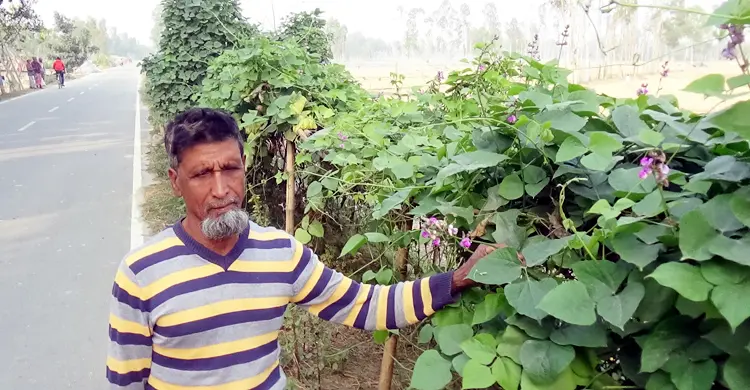
Most of the abandoned land along both sides of the country's roads and highways is overgrown with weeds. At the same time, the country's farmland is shrinking as the population grows and climate change takes effect. So the prime minister has instructed those concerned that not an inch of land in the country should lie unused. In line with that instruction, the agriculture department is implementing an innovation idea titled "Vegetable and fruit farming on unused land, money and nutrition all year round".
The idea is bearing fruit along both sides of the Gaibandha-Saghata regional highway. Vegetable gardens have been set up on unused land along several kilometres of the road, growing flat bean, bottle gourd, bitter gourd, brinjal, chilli and other vegetables.
With the agriculture department's help, local people can both eat the vegetables themselves and earn money by selling them in the market. Agriculture department officials say the initiative will be implemented across the country in future to meet the country's demand for vegetables.
Roads with room to grow
According to sources, the country has 3,790 km of national roads, 4,206 km of regional roads, 13,121 km of district roads and 3,33,589 km of local roads. The abandoned land along both sides of these roads is overgrown with weeds, so in line with the prime minister's instruction the agriculture department is putting this land to use for farming.
Asadul Islam, a roadside vegetable grower from Jadurtair village in Saghata, told Jagonews24: "We never imagined it would be possible to meet our families' needs by growing vegetables beside the highway. But with the agriculture department's help it has become possible."
Aij Uddin, a farmer from the same village, said: "This year we grew all kinds of vegetables, including flat bean, bottle gourd, bitter gourd, brinjal and chilli, and met our families' needs. We also sold some in the market. In future we will grow vegetables with even more attention."
Golam Mawla, sub-assistant agriculture officer at the Saghata upazila Department of Agricultural Extension (DAE), told Jagonews24 that farmers are being given every kind of help to implement the project.
Md Rezwanul Islam, the official who came up with the innovation idea and Blue Gold programme officer at the DAE, said: "I am very happy to have been able to implement this project in Saghata, Gaibandha, after Mithapukur upazila of Rangpur in the north of the country. As the population grows, so do homes, and climate change is also shrinking the country's farmland. In this situation the prime minister has instructed that not an inch of land in the country should lie abandoned. In line with that instruction, work is under way to implement this programme of growing vegetables beside the country's roads and highways."
Source: Jagonews24. First published in Bengali on The Agro News.
Comments
(0)