
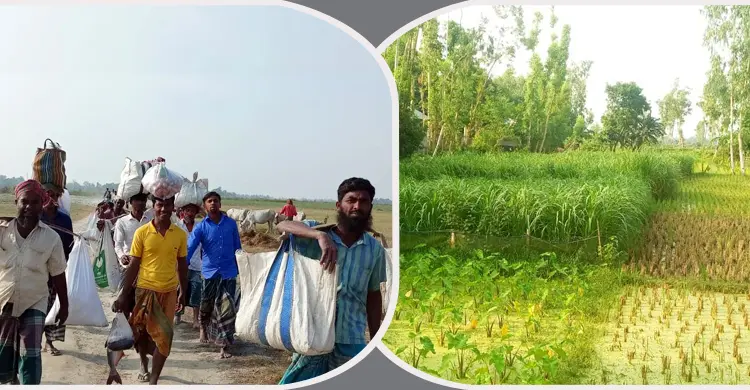
Although the chars of Gaibandha in the north produce plentiful harvests, farmers cannot sell their produce at the right price for lack of transport. They are deprived of almost all civic amenities, and the only means of transport for the hard-working people of the chars is the boat.
Still, the poor people of the chars carry on. In floods everything is submerged, while in the dry season the river shrinks and they must walk two to three miles to reach the boat ghat, with no choice but to carry their produce on their heads.
They then have to bring the produce by boat, and later by auto-rickshaw or van, to various markets. After covering transport costs, and with no fixed buying and selling centres, they do not get a fair price for their labour even though they grow crops all year round.
No transport, no roads
There are no vehicles there, and if anyone falls ill, getting treatment becomes extremely difficult. However, the upazila administration says the government has started the "Amar Gram, Amar Shohor" (My Village, My Town) project on a trial basis to ensure civic amenities.
Statistics show that erosion by the Brahmaputra, Teesta and Jamuna rivers has given rise to 165 large and small chars and island chars in Gaibandha Sadar, Sundarganj, Fulchhari and Saghata upazilas. About 4 lakh people live on them, and farming is their only occupation.
Grocer Moslem Ali told Jagonews24 in the local dialect that he goes to Kabilpur and trades in raw goods at his general store. He can carry ten seers on his shoulder, but the load is a maund, and his legs now ache. "It is hard for us here. There is no transport, no auto-rickshaw, no van; getting there is very difficult. Horse carts used to be available, but with no road they no longer are," he said.
Rahman Mia said: "We live on the char and farm. The flood season is convenient, and the dry season is difficult. We have to walk a long way."
Government projects
Conscious citizens say that if the "Amar Gram, Amar Shohor" project is applied to the chars, farmers will easily sell the crops they grow and get fair prices, and all civic amenities, including healthcare for pregnant mothers, will be ensured for char dwellers.
Mohammad Alauddin, acting upazila nirbahi officer of Fulchhari, told Jagonews24 that the government has taken up a project called the Char Development Board on a trial basis, through which steps have been taken so that farmers can easily sell the crops they grow on the chars. The government has also launched another project called "Amar Gram, Amar Shohor", which will provide agricultural produce buying and selling centres and all civic amenities.
The aim of "Amar Gram, Amar Shohor" is to bring urban amenities to villages while keeping rural Bengal's natural character intact. It is to provide all the facilities of a modern town, including better roads and communication, safe drinking water, modern healthcare and treatment, quality education, better sanitation and waste management, increased electricity and fuel supply, computers and high-speed internet, and wider markets for quality consumer goods including electrical equipment.
Earlier, on 20 May 1999, the government took up the "Ghore Fera" (Return Home) programme to send neglected, helpless and destitute homeless people living in various parts of towns back to their village homes. But for mysterious reasons, the "Ghore Fera" programme was stopped.
Source: Jagonews24. First published in Bengali on The Agro News.

Comments
(0)