
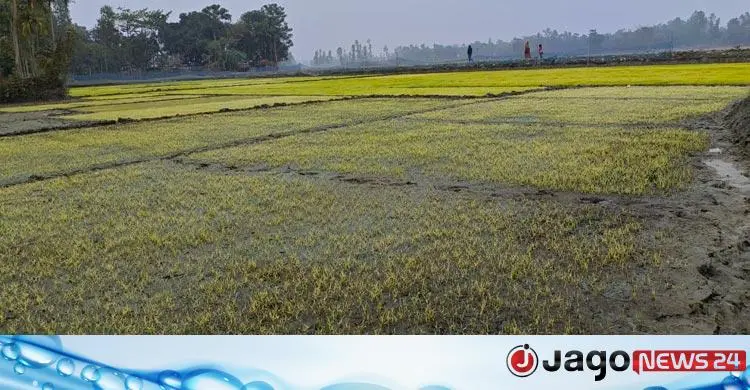
Severe cold and dense fog in Gaibandha are killing the seedlings in boro rice seedbeds. The surviving seedlings have turned yellow, and applying fungicide has not helped. With the seedbeds damaged, farmers in the district are worried about transplanting their seedlings on time.
The agriculture department says farmers in the area prepare rice seedbeds in the boro season, and the sudden severe cold and dense fog are damaging some seedlings. It says it is giving farmers various advice to keep the seedbeds from being lost.
According to the district Department of Agricultural Extension (DAE), this year's boro target is 1,29,140 hectares, against which there are 6,812 hectares of seedbeds, more than the target requires.
Farmers count the cost
Makbul Hossain, a farmer from Purba Komarnoi village in Kholahati union of Gaibandha Sadar upazila, said most boro seedbeds were being damaged by the severe cold and dense fog, and many people's had already been lost. They would have to prepare seedbeds again, raising farmers' costs. He said he had not seen the agriculture department give any advice on protecting seedbeds in the bad weather.
Hasan Ali, a farmer from Ramchandrapur village in the Sadar upazila, said he grows rice on five bighas every boro season and has made the same preparations this year. Field-level agriculture officers are advising farmers to keep water in the seedbeds and to use polythene, he said, but many are reluctant to use polythene because of the extra cost.
"The fungicides we are told to use are not working; it is just a waste of money," he said. If the biting cold lasts a few more days, most seedbeds will be lost and new ones will have to be prepared, he added.
A visit to the area found the seedbeds turned white by the cold. In places the seedlings were rotting at the base, and in some places they had died. Farmers were busy tending their seedbeds: some were pouring on warm water, some covering them with polythene, and many spraying chemicals, trying everything to save them.
Md Sabuj Mia, a farmer from Phalgachha village in Bamandanga union of Sundarganj, said in the local dialect that he has four bighas to cultivate and his seed will cost at least Tk 6,000. His seedlings had been very good, he said, but a few days of cold had left them in a bad way, turning white and starting to rot. "If they are lost, where will I find seedlings to plant my land? That is my worry," he said.
Another farmer, Md Zaherul Islam, said: "As soon as I saw white symptoms in the seedbed I called the agriculture officer. He came, looked at the seedbed and gave advice. Following that I am spraying warm water and covering it with polythene at night, and spraying fungicide as well. The seedbed has not suffered much damage yet."
DAE expects little loss
Md Atiqul Islam, deputy director of the DAE in Gaibandha, said: "Because of the severe cold and fog over the past few days, cold injury has appeared in boro seedbeds. Agriculture officers are advising farmers in the field so that the seedbeds are not damaged. We hope farmers will not face much loss with their seedbeds."
Source: Jagonews24. First published in Bengali on The Agro News.
Comments
(0)