
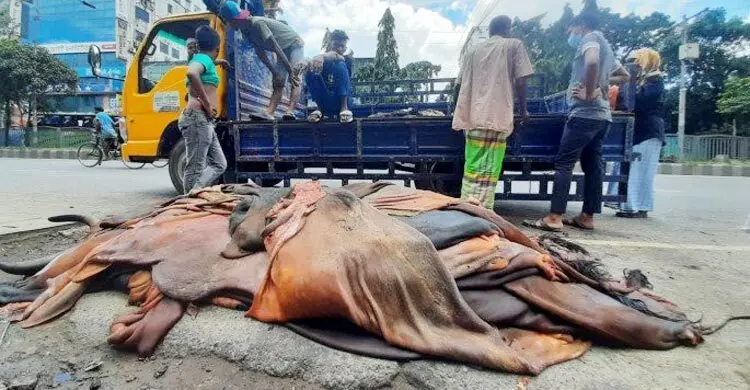
No market for the hides of sacrificial animals may be set up on the Gabtoli bridge in the capital, Local Government, Rural Development and Cooperatives Minister Tajul Islam said. He also said the necessary steps must be taken so that trucks carrying sacrificial waste can travel to the Aminbazar landfill without hindrance.
He said this on the afternoon of Thursday, 30 May, after a meeting in the conference room of the Local Government Ministry at the Secretariat to review overall preparations for managing cattle markets, ensuring sacrifice at designated places and handling sacrificial waste for Eid-ul-Azha.
The meeting was attended by Dhaka South City Corporation mayor Atiqul Islam, a representative of the South City, Gazipur City mayor Zayeda Khatun and officials of various ministries and departments, according to the report.
Waste and cattle markets
On waste management, the minister said steps must be taken so that the blood and waste of sacrificial animals do not pollute or dirty the environment in Dhaka or anywhere else in the country. All sacrificial waste must be removed and the places of sacrifice cleaned before sunrise. Awareness campaigns could encourage those making sacrifices to clean the spots themselves.
On cattle markets, Tajul Islam said no market may be set up on or beside roads and highways where it could disrupt normal traffic. Legal action will be taken through mobile courts against those who break this instruction.
He said security must be ensured at the cattle markets, and specific instructions must be given at district and upazila level. Counterfeit note detection machines must be installed at the markets, and steps and publicity are needed to stop extortion or illegal payments on the roads or at the markets.
The minister said cashless transactions must be arranged at various markets through ATM booths, point-of-sale machines and mobile financial services (MFS), with help from Bangladesh Bank and other banks. Awareness and monitoring must be stepped up so that gangs who drug people or use ointments to rob them cannot commit crimes at markets or while animals are being transported.
Designated places for sacrifice
On ensuring sacrifice at designated places, Tajul Islam said the public must be encouraged and motivated. Hygienic places must be chosen, with canopies or tarpaulins put up with the rainy season in mind. Lists of places for sacrifice, imams and butchers must be drawn up, and training arranged for butchers.
"Wide publicity must be arranged through websites, digital displays, loudspeakers, leaflets, banners and cable operators. Youth and cooperative organisations must be involved in this work. The supply of disease-free animals to the cattle markets must be ensured," the minister added.
He said the railway and road authorities, colonies, RAJUK and other institutions will help local government bodies use their unused land temporarily as places for sacrifice. Local administrations and local government bodies will widely publicise lists of area-based cattle markets and designated sacrifice places, and local cable TV operators could help with this. Everyone must be encouraged to use salt to preserve hides after sacrifice.
The minister also said deputy commissioners will ensure these decisions are carried out through virtual meetings with municipal mayors, upazila parishad chairmen and union parishad chairmen, running mobile courts if needed. Imams of local mosques will also speak to raise awareness about sacrificing at designated places and removing sacrificial waste.
He added that people could be encouraged to make sure salt is applied to hides as soon as the animals are sacrificed.
Source: Jagonews24. First published in Bengali on The Agro News.

Comments
(0)