
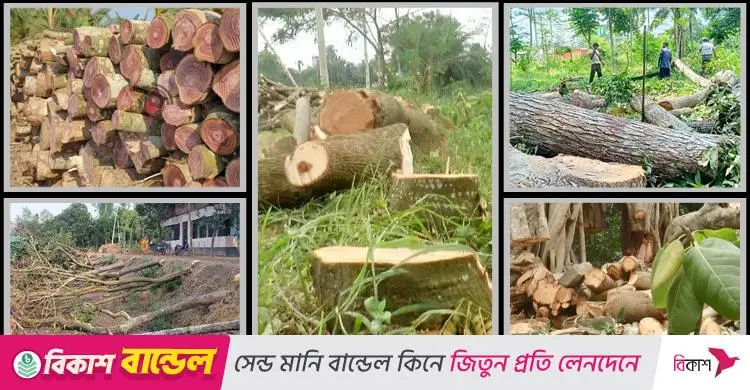
Trees across the country are to be divided into three classes according to which may and may not be felled. Felling trees that are endangered, rare or essential to the environment would bring a fine of up to Tk 1 lakh. Trees in the second class could be felled with permission, and those in the third class would need no permission. The Forest Department has drafted the "Forest and Tree Conservation Ordinance, 2025" with these provisions.
The Forest Department is already gathering the views of various stakeholders on the draft. Forest Department officials said it will then be sent to the Ministry of Environment, Forest and Climate Change and finally to a meeting of the Advisory Council for approval.
The draft sets out how forest land will be surveyed and recorded. It also allows forest land (less than one acre) to be exchanged, subject to conditions, to make it easier to build industries. In return for the forest land, the government would declare as reserved forest twice the area of unencumbered land next to the forest, provided by the industrial establishment.
"An entirely new law"
Md Amir Hossain Chowdhury, chief conservator of forests at the Bangladesh Forest Department, told Jagonews: "There was really nothing that could be called a forest and tree conservation law. We have combined these two subjects in the draft ordinance. It is an entirely new law. It will not repeal any other law."
The chief conservator said the forest law does not set out the duties and responsibilities of the Forest Department, and the draft tries to include them. The draft also states the government's role.
He said the Forest Department controls 10.87 per cent of the country's forest land. "How forest land is surveyed and recorded is not really set out in the survey law either. Only their manual says a little about how it is to be surveyed. Our forest land in Gazipur, Bhaluka and Cox's Bazar is slipping out of our hands during surveys or at other times. So we are trying to include these matters in the forest conservation ordinance."
He said the draft sets out how the Forest Department will carry out forest surveys and how errors can easily be corrected.
Explaining an option in the new ordinance, Amir Hossain said: "Suppose someone in Gazipur has bought private land for a factory, and up to one acre of isolated forest land falls within it. That one acre may stop him building his industry, which is an obstacle for him. So we have kept an option: if up to one acre of forest land falls within an industrial establishment, he can exchange it with the Forest Department for land elsewhere. In the same mouza he will buy two acres in place of one, and we will create forest there again."
He said tree conservation is also being added to the ordinance. Many large trees in villages are felled freely. There will be three schedules on which trees may and may not be felled. The first will list trees that cannot be felled under any circumstances and for which no permission will be given: trees that have become very rare and those that are essential for biodiversity.
The second schedule will contain trees that can be felled with permission, the chief conservator said. The government will decide whether the district administration or the Forest Department will give permission. A third schedule will list trees that need no permission to fell: the trees people usually plant for commercial purposes.
He hoped the three schedules would be ready within a week and said their provisions would be flexible and could be revised and changed if needed. After taking stakeholders' views the draft will be finalised and sent to the Ministry of Environment, Forest and Climate Change, and after the ministry's own procedures it will go to the Advisory Council for approval.
How forest land will be surveyed and recorded
The draft says land gazetted in the name of the forest department, or recorded in its name in any earlier record or survey, must be recorded in the forest department's name.
Whether or not it has tree cover, land recorded as forest land or included in the gazette as forest must be recorded in the forest department's name on behalf of the government under existing law. Where "protected forest" is recorded in the name of the deputy commissioner, the record must mention that it is managed by the forest department. For vested forest, if acquired or vested forest land is recorded in the name of another agency or person, the record must note the forest department's management.
If land recorded as forest land or gazetted as forest is recorded in the name of any other person or agency, or a khatian is created or a mutation made, it will be deemed void.
Once the ordinance takes effect, the Forest Department will survey forest land on a priority basis and take the steps needed to mark boundaries and update records.
Before any plots containing part forest-department land, or khas land adjoining forest plots, are settled, the forest department concerned must be informed and the boundaries of forest and khas land marked through a joint survey.
To protect the integrity of forests, the government may transfer khas land inside forests to the forest department and may acquire privately owned land for the department and declare it forest.
The draft says forest land will remain under the Forest Department's control, and no natural forest may be used for non-forest purposes. For other forest land, the head of government may approve non-forest use only for an essential national need where there is no alternative, subject to an independent environmental and social impact assessment, compensatory afforestation and a cabinet decision. Approval cannot be given if the use would cause irreparable harm to the forest ecosystem or increase the risk to any endangered plant or animal.
Conditional exchange of forest land
If less than one acre of isolated forest land lies within land owned by a statutory body or industrial establishment, an exchange may be allowed with the approval of the head of government, considering necessity and the public interest, by a procedure set in rules. In that case, by government gazette notification, the body or establishment must hand over to the forest department twice the area of unencumbered land adjoining the forest concerned, which the government will declare reserved forest.
Rules on conserving and felling trees
The draft says trees in gazetted forests, unclassed state forests, social forests, government and autonomous institutions, educational institutions and public spaces cannot be felled or removed without the approval of a tree officer.
The ordinance will have three schedules. Schedule 1 will list endangered trees of rare species, Schedule 2 century-old and other important trees, and Schedule 3 common trees.
No tree listed in Schedule 1 or declared endangered and protected by the Forest Department may be felled. Schedule 2 trees on privately owned land may not be felled without permission obtained through the set procedure.
Anyone wishing to fell a Schedule 2 tree must apply on a form to the officer concerned, stating the species, number, approximate height, girth at breast height and the reason for felling. A tree officer, or an officer not below the rank of forester, will examine the application and inspect the trees, then give a written decision with reasons within 30 days of receiving it.
If felling is approved, the tree officer will make sure the applicant has planted trees of the specified species and number in the same area in place of those felled.
Anyone aggrieved by a tree officer's decision may appeal to the conservator of forests under the Forest Department's guidelines, and the appeal is to be settled within 15 days.
The draft says no tree officer's approval will be needed to fell commercial species listed in Schedule 3 or trees widely used in rural areas.
Penalties for illegal felling
Under the ordinance, felling a Schedule 1 tree would bring a fine of up to Tk 1 lakh, and the authorities could also order compensatory afforestation. Felling a Schedule 2 tree without approval would bring a fine of up to Tk 50,000, again with a possible order for compensatory afforestation.
The Code of Criminal Procedure will apply to the trial of offences under the ordinance. Any forest officer not below the rank of an empowered forester, beat officer or equivalent may file cases, investigate offences, and take and record evidence. For the purpose of investigation they may at any time enter and search any place, seize anything, collect samples, information and documents, or inspect any place, and may appear and conduct cases for the Forest Department in any court.
Source: Jagonews24. First published in Bengali on The Agro News.


Comments
(0)