
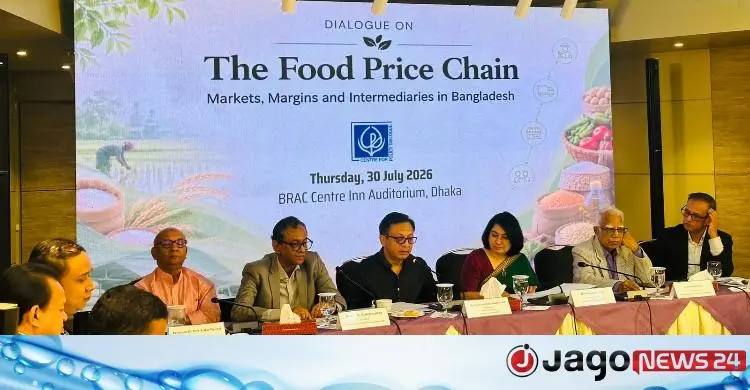
The government is going to introduce a traceability system to identify at exactly which stage, and by how much, food prices rise between the farmer's field and the consumer's table, commerce minister Khandaker Abdul Muktadir has said.
He said this would identify the causes of price increases at every step of production, transport, storage and marketing, so that unnecessary costs, extortion and market inefficiency could be reduced. The government is also stressing lower logistics costs and a more transparent and efficient supply system.
He was speaking on Thursday, 30 July, at a dialogue titled "Bangladesh's food value chain: markets, profit margins and intermediaries" at the BRAC Inn Centre in Mohakhali, Dhaka.
Logistics costs at 16 per cent of GDP
The commerce minister said food inflation has stayed high for a long time because of high logistics costs. "Our logistics cost is high. If you look at the global average standard, it is 10 per cent of GDP. Here it is 16 per cent. We have many problems here," he said.
To get out of these problems, he said, logistics and input costs must come down, and extortion in goods transport must be reduced. "To follow these lines, we are going to introduce traceability for many items. If we can do that, we will be able to identify where the problem lies from start to finish."
Saying farmers do not get accurate market information, he said: "For two years we have produced more than one crore tonnes of potatoes. Two years ago farmers did not get their money. Last year they did not either. Despite that, and although a third of it is beyond our consumption, why are farmers going to produce the same amount of potatoes for a third year? It means the right information is not reaching farmers. Or they do not have the proper input on what they could switch to instead of this easy crop."
Agriculture needs investment and support
Saying investment is needed to strengthen farmers, the minister said Bangladesh's agricultural revolution happened mostly organically, not so much through infrastructure or research. Every government played a part, and fertiliser and seed are still heavily subsidised.
"We are not America or Saudi Arabia. We do not have endless oil and gas underground. But we have farmland, and we must use it fully. Agriculture is a fragile sector; the government must always watch over it and give it support. It cannot simply be left alone. Food security is a matter of national security, but it is a delicate one," he said.
The more productivity rises, the more farmers' capacity will grow and the greater the aggregate value they will receive, the minister said.
Khandaker Abdul Muktadir said inflation is a pain for any economy, even a prosperous one with high purchasing power, and a far bigger pain for a struggling economy like ours. Inflation reduces purchasing power, he said. With its production capacity the country enjoyed low and then moderate inflation for a long time, but for the last few years, especially since Covid, it has not been brought under control.
Other speakers
CPD executive director Fahmida Khatun said inflation has stayed high for several years and has been a cause of concern for the economy for four years. Rising food prices put direct pressure on people.
Garment Sramik Sanghati president Taslima Akhter Lima said that when food prices rise, the real wages of low-income people fall, so effective market monitoring is essential.
Former secretary Siddiqur Rahman said the government used to intervene actively in the rice and wheat markets, controlling the market when prices rose and supporting farmers when prices fell. That role has become much more limited under the free-market economy and needs to be reassessed.
Former NBR chairman Abdul Majid said prices cannot be brought down by cutting taxes alone; integrated market management is needed. Citing an example from 2008, he said that even after VAT on edible oil was cut, traders refused to guarantee lower prices in writing, because in the end they have no control over the retail market. This shows structural problems within the market system that no single ministry or agency can solve.
Consumers Association of Bangladesh (CAB) president AHM Shafiquzzaman said farmers are the worst affected. Government incentives and benefits do not reach real farmers, and many farmers are still denied agricultural credit.
Agricultural economist MA Sattar Mandal said the biggest challenge now is improving the marketing of farm produce. As agriculture has become commercial, the market system has become far more important, and it must be made more efficient, competitive and transparent.
Source: Jagonews24. First published in Bengali on The Agro News.
Comments
(0)