
Fish are closely bound up with our daily lives. There are more than about 2,000 species of fish in the world's waters, so one can say that wherever there is water there are fish, and three-quarters of the earth lies under water. Fish vary enormously in size and shape because they must adapt to very different environments. An adult Philippine goby, a species of fish, is an inch long or even less, while an adult shark is forty to fifty feet long and sometimes as much as seventy feet.
Their shapes and behaviour are even more varied. The long eel looks like a live snake. The ray has a flat body. The ocean sunfish is as long as it is wide. The puffer fish looks like a ball. The andula fish has its eyes on top of its head, while the shol has both eyes on one side of its head. And the handsome sea horse does not look like a fish at first sight at all; it looks like a horse.
A fish that takes to the air
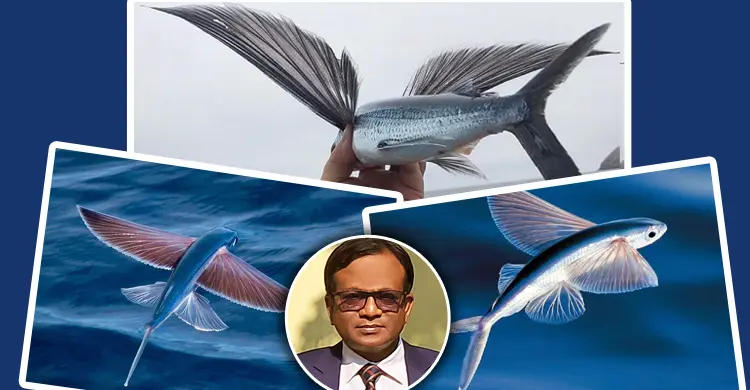
As far as we know, creatures that fly in the sky are called khechar, and it is usually such creatures that fly. Unbelievable as it may seem, there is a strange kind of fish in the sea that can glide through the air with ease: the flying fish. Its two fins are quite large, growing up to ten inches long, and it flies with their help. As it leaps out of the water into the air, it spreads the two fins out on either side.
A flying fish usually looks green while swimming in the water, though its fins are actually pale purple. Surprisingly, when it flies, the fins sometimes look dark blue and sometimes golden yellow. Its English name is flying fish. It prefers flying through the air to moving about in water, and its flying speed is remarkable: it can cover up to 56 kilometres an hour.
When it is time to lay eggs, flying fish come close to the shore. They leave the water, stay in the air for about ten seconds and lay their eggs on plants near the shore. Their eggs are unlike those of other fish, with a kind of hook attached. Live flying fish are often seen on the way to Port Blair in the Andamans. Standing at the railing of a ship's foredeck and looking down at the sea, one sees one or more shoals of fish, like little birds, rise from the water alongside the ship, fly a long way on their wings and drop back into the sea with a splash. These are flying fish. They are found to some extent in every sea in the world, and several species are caught commercially in various bays.
In the Bay of Bengal
At least ten species of flying fish have been found in our Bay of Bengal region alone. Other species are larger and live in the deep sea; it is thought that the larger species are scattered over the continental shelf and the surface of the open sea. They are also found in greater numbers on the east coast of the Indian Ocean and in Sri Lanka. As already said, flying fish living near the sea surface leap up out of the water and fly a long way over it with the help of the long fins attached beside their gills. When they swim in the water, they keep these long fins held against the body. Because they like warm weather, they usually live in sea areas that are neither cold nor hot.
A typical flying fish grows to 18 to 24 centimetres long, and the larger species to 23 to 35 centimetres. Flying fish spawn around objects floating on the surface, such as fishing nets, ropes, aquatic plants and pieces of floating wood. Depending on size, each female lays five thousand to twelve thousand eggs at a time, in sticky ribbon-like strands around the floating objects. The males release their sperm over the eggs, fertilising them. About 100 hours after fertilisation the young hatch and float on the surface of the sea. A few days later, a little bigger, they take the shape of immature flying fish. Fishers often lift out of the sea the floating objects they have laid to attract fish to their nets, which destroys many of the eggs collected on them. Flying fish feed on small fish, usually hunting at night, and live for one to three years.
How they are caught
Methods of catching flying fish differ from country to country and depend on the size of the fish and the breeding season. Well-known small species are usually caught during breeding with small-mesh nets or scoop nets. To draw them in to breed, fishers leave floating objects at particular spots, and some pour pieces of fish and oil on the water near the floating objects to attract more. Larger species are caught outside the breeding season with hooks or with specially made gill nets. Boats of four to fifteen metres are used.
Since flying fish do not stay far from the coast, the boats go out early in the morning and return with the catch in the evening. Because it does not pay, the boats carry no ice, so by the time they return the fish are in poor condition, and fishers often have to sell them very cheaply. Sometimes the fish are salted and dried.
About four hundred tonnes of flying fish are caught a year in this subcontinent. Small coastal flying fish have long been caught on the east coast of the Indian Ocean and in Sri Lanka, where fishers attract them to one place and catch them with scoop nets. Among them are two large species, the Sutton flying fish and the spotted flying fish, which are caught in gill nets on the eastern coast of the Bay of Bengal. Flying fish are, however, very scarce in the Bay of Bengal. They are seen only from May to July, which the writer calls "these two months" of the year. This is their spawning time, when they gather along the coast to lay eggs; a few days later they head back out to sea.
On the table
People in many countries like flying fish for their taste. Flying fish curry cooked in coconut milk is a favourite dish of coastal people. The middle class eat fresh flying fish, while poorer people eat it dried. So that buyers do not mistake the fish for a bird, the fins beside the gills are cut off before it is sold in the market. Flying fish roe is in great demand on the international market, and Japan imports flying fish roe from Indonesia every year.
The writer is a science writer and researcher, and an MPhil scholar in the Faculty of Social Sciences, University of Dhaka.
Source: Jagonews24. First published in Bengali on The Agro News.
Comments
(0)